South Florida Slip and Fall Lawyer: 2026 Guide to Premises Liability, § 768.0755, and Recovering After a Fall in Miami, Broward, or Palm Beach
A Coral Gables trial attorney explains how South Florida slip and fall cases work in 2026 — the transitory-substance rule in Fla. Stat. § 768.0755, comparative fault under § 768.81 after HB 837, the two-year deadline in § 95.11(4)(a), and the evidence you need to prove notice against a supermarket, hotel, restaurant, or condo association.
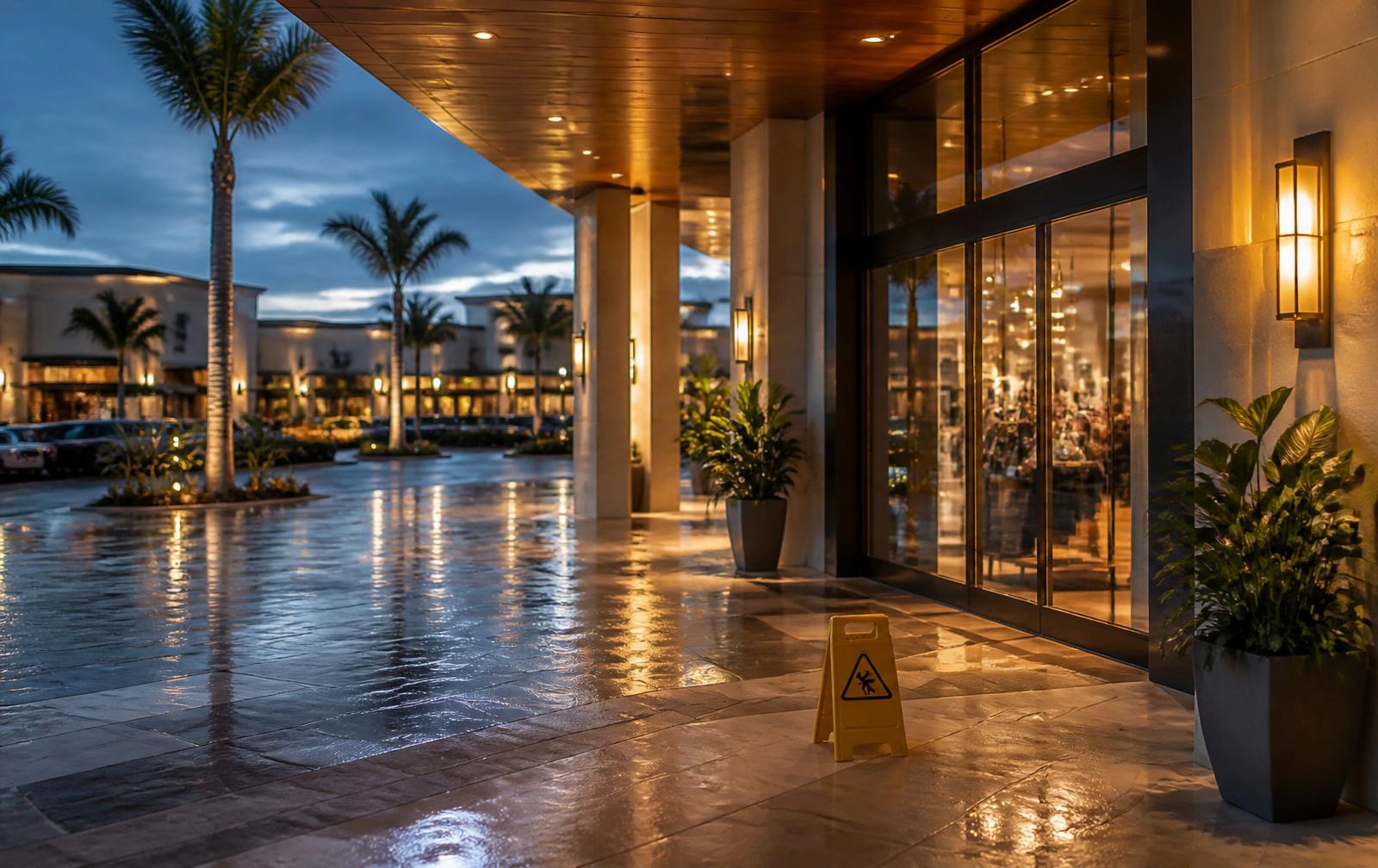
A fall on a wet tile floor at a Publix in Kendall, a slick lobby at a Fort Lauderdale hotel after an afternoon rain, a broken paver at a Boca Raton condo, or a spilled drink on the concourse at Hard Rock Stadium can end in a torn rotator cuff, a herniated disc, a broken hip, or a traumatic brain injury. South Florida slip and fall cases look simple on television and are anything but simple in a Florida courtroom. This 2026 guide from The Farber Law Firm in Coral Gables explains how premises-liability law actually works across Miami-Dade, Broward, and Palm Beach counties — the strict notice rule the Legislature built into Fla. Stat. § 768.0755, the modified comparative-fault regime under Fla. Stat. § 768.81 after HB 837, the two-year statute of limitations under § 95.11(4)(a), and the practical evidence that decides these cases. Nothing here is legal advice on a specific matter, and prior results do not guarantee any particular outcome.
Quick Answer: South Florida Slip and Fall Law in 2026
- The deadline to file a Florida negligence lawsuit for a slip and fall that occurred on or after March 24, 2023 is two years from the date of injury under Fla. Stat. § 95.11(4)(a).
- For a fall caused by a transitory foreign substance (water, food, grease, produce debris) in a business establishment, the injured person must prove under Fla. Stat. § 768.0755 that the business had actual or constructive knowledge of the dangerous condition and should have taken action.
- Constructive knowledge can be shown by evidence that the condition existed long enough that the business should have discovered it in the exercise of ordinary care, or that the condition occurred with regularity and was therefore foreseeable.
- Florida is a modified comparative-negligence state under Fla. Stat. § 768.81(6). A plaintiff found more than 50 percent at fault recovers nothing; at 50 percent or less, damages are reduced by that percentage.
- Past medical damages are proven at amounts actually paid, amounts still owed, and evidence of reasonable and necessary charges under Fla. Stat. § 768.0427 — not the sticker-price billed amount.
- Preserve the scene fast: incident report, surveillance video, footwear, clothing, and a written preservation letter to the store or property manager within days of the fall.
Why South Florida Premises Cases Are Uniquely Difficult
South Florida is humid, rainy, and heavily commercial. Tile and terrazzo floors dominate grocery stores, hotels, restaurants, and condominium lobbies from Homestead to Jupiter. Afternoon thunderstorms track water in on shoes and umbrellas from May through October. Tourism, cruise-ship terminals, and outdoor shopping plazas mean high foot traffic across surfaces that are polished, painted, or freshly mopped. On top of that, the Florida Legislature in 2010 enacted Fla. Stat. § 768.0755, which replaced the older § 768.0710 and reinstated the burden on the plaintiff to prove that the business knew or should have known about the specific hazard. A well-defended slip and fall case is one of the hardest personal-injury cases to win in Florida — and one of the most rewarding when the evidence is preserved and developed correctly.
The Statute That Controls Most South Florida Falls — Fla. Stat. § 768.0755
Under Fla. Stat. § 768.0755, if a person slips and falls on a transitory foreign substance in a business establishment, the injured person must prove that the business had actual or constructive knowledge of the dangerous condition and should have taken action to remedy it. Constructive knowledge may be proven by circumstantial evidence showing that:
- The dangerous condition existed for such a length of time that, in the exercise of ordinary care, the business establishment should have known of the condition; or
- The condition occurred with regularity and was therefore foreseeable.
This is the fight in almost every South Florida grocery-store, restaurant, and big-box fall case. Was the puddle there for two minutes or two hours? Did the store's own inspection records show sweeps every fifteen minutes, or hours-long gaps? Did the produce department routinely drop grapes on the floor without a mat or spotter? Did the entrance mat get wet during a rainstorm and go unchanged for the entire afternoon?
Beyond Transitory Substances: Structural and Design Hazards
Section 768.0755 governs transitory substances. Structural hazards — a broken step at a Miami Beach hotel, a raised paver at a Coral Gables restaurant patio, an unmarked drop-off at a South Beach club, a missing handrail in a condo stairwell, inadequate lighting in a parking garage, or a Florida Building Code violation — are governed by ordinary premises-liability principles. The plaintiff still must prove the property owner or possessor breached a duty owed to the plaintiff's status (invitee, licensee, or trespasser), that the breach caused the fall, and that damages resulted. Building-code experts, human-factors experts, and industry-standard testimony (ASTM friction thresholds, ANSI stairway standards) frequently drive these cases.
Who Can Be Held Liable in a South Florida Slip and Fall
A single fall may involve multiple defendants. Common targets in South Florida premises cases include:
- Supermarkets and big-box retailers (Publix, Winn-Dixie, Walmart, Target, Costco, Sedano's, Presidente).
- Hotels and resorts across Miami Beach, Sunny Isles, Fort Lauderdale, Hollywood, Boca Raton, and Palm Beach.
- Restaurants, bars, and nightclubs, including cruise-terminal and airport concessions.
- Shopping malls and outdoor plazas (Dadeland, Aventura, Sawgrass Mills, Bal Harbour, The Falls, Merrick Park).
- Condominium and homeowners associations, on common elements they control.
- Landlords of apartment complexes and mixed-use buildings.
- Governmental entities operating parks, buses, courthouses, and other public premises (subject to sovereign-immunity caps under Fla. Stat. § 768.28).
- Janitorial and floor-care contractors whose maintenance work created or failed to remedy the hazard.
- Independent contractors performing construction or repairs on premises open to the public.
Each additional defendant may bring an additional insurance policy — general liability, umbrella, product-liability on a defective mat or cleaner, and workers'-comp cross-claims where an employee is involved.
Comparative Fault After HB 837 — Fla. Stat. § 768.81
For causes of action accruing on or after March 24, 2023, Florida is a modified comparative-negligence state. If the injured plaintiff is found more than 50 percent at fault for the fall, the plaintiff recovers nothing. If the plaintiff is 50 percent or less at fault, damages are reduced by the assigned percentage. Defense counsel in South Florida slip and fall cases routinely argue that the plaintiff was texting, wearing flip-flops or high heels, walked past a wet-floor sign, or should have seen an open and obvious hazard. Preparation for the 50 percent bar starts at intake, with clothing preservation, footwear photographs, phone records, and a candid conversation with the client.
Statute of Limitations — Fla. Stat. § 95.11
Personal-injury claims arising from a fall on or after March 24, 2023 must be filed within two years of the date of injury under § 95.11(4)(a). Wrongful-death claims (for example, a fatal fall down a defective stairwell) are two years from the date of death under § 95.11(4)(d). Claims against a governmental defendant require pre-suit notice under Fla. Stat. § 768.28 with a three-year notice period and are subject to sovereign-immunity caps of $200,000 per person and $300,000 per incident absent a legislative claims bill.
Damages in South Florida Slip and Fall Cases
Compensatory damages in a serious premises case commonly include past and future medical expenses proven under Fla. Stat. § 768.0427, past and future lost earnings and diminished earning capacity, past and future pain and suffering, mental anguish, and loss of enjoyment of life. Common injuries we see in South Florida falls include:
- Wrist, elbow, and shoulder fractures from bracing during a fall.
- Rotator-cuff tears requiring arthroscopic repair.
- Hip fractures, particularly in older adults, often requiring open reduction and internal fixation or arthroplasty.
- Lumbar and cervical disc herniations, with epidural injections, radiofrequency ablation, or fusion.
- Traumatic brain injuries, including concussions and post-concussive syndrome.
- Facial fractures, dental damage, and scarring on tile or concrete falls.
Punitive damages are available on clear and convincing evidence of intentional misconduct or gross negligence under Fla. Stat. § 768.72 — rare in premises cases but sometimes appropriate against a defendant with a documented pattern of ignored complaints.
Evidence That Wins South Florida Slip and Fall Cases
In our experience representing Miami, Broward, and Palm Beach clients, the following evidence usually decides these cases:
- The store or property incident report, ideally requested in writing within days of the fall.
- Surveillance video from the property and adjoining businesses — often overwritten in 14 to 30 days.
- Cleaning and inspection logs, sweep sheets, and the identity of every employee assigned to the area.
- Prior similar incidents at the same location, obtainable in discovery to show a pattern under § 768.0755.
- Photographs of the substance, footwear, clothing, and the surrounding floor.
- 911 or paramedic run reports and initial ER records that document the mechanism of injury.
- Weather data (NOAA) for rain-tracked entrances and outdoor plazas.
- Building-code inspection records and prior citations for structural cases.
- Expert reports from human-factors, floor-safety, or building-code consultants.
Case Study Illustration
The following example is illustrative only and does not describe any specific client. A South Florida shopper slips on clear liquid in the produce aisle of a Miami-Dade supermarket, sustaining a torn rotator cuff and a lumbar disc herniation. Counsel serves a preservation letter within 48 hours demanding retention of surveillance video, sweep logs, and incident reports. Discovery shows the store's own sweep schedule required inspection every 30 minutes but the last documented sweep was more than two hours before the fall, and three prior spills had been logged in the same aisle that month. The plaintiff's team develops medical damages under § 768.0427 and prepares a jury argument on constructive knowledge under § 768.0755. Every case is different, and no example predicts any specific outcome.
The First 30 Days — What Injured People Should Do
- Get medical care immediately, even if you feel able to walk out of the store. Adrenaline hides injuries for hours.
- Report the fall to a manager and insist on a written incident report. Ask for a copy or the report number.
- Photograph the floor, the substance, your shoes, and your surroundings before you leave.
- Preserve the clothes and shoes you were wearing, unwashed, in a paper bag.
- Identify and get contact information for every witness before they leave the store.
- Do not give a recorded statement to the store's insurance adjuster before speaking with a lawyer.
- Track every out-of-pocket expense: co-pays, mileage, medical equipment, home help, missed shifts.
- Consult a Florida premises-liability attorney promptly. Video, sweep logs, and witness memories all disappear on a 14 to 30 day clock.
How The Farber Law Firm Handles South Florida Slip and Fall Cases
David Farber has represented Florida families in serious-injury and wrongful-death matters since 1995. Because David began his career defending insurance companies, he understands how commercial general-liability and hotel-and-resort carriers value, delay, and try to defeat premises claims — and how to answer each tactic with fast preservation letters, targeted discovery under § 768.0755, and trial-ready damages proof under § 768.0427. From our Coral Gables office at 2199 Ponce de Leon Blvd in Coral Gables, we handle premises-liability cases across Miami-Dade, Broward, Monroe, and Palm Beach counties, and we associate with local counsel elsewhere in Florida when appropriate. Slip and fall cases are commonly handled on a contingency basis, meaning fees are paid only if we recover for the client; specific terms are set out in a written engagement letter that complies with Florida Bar Rule 4-1.5(f).
Talk to a South Florida Slip and Fall Lawyer
If you or a loved one has been seriously injured in a fall at a South Florida store, hotel, restaurant, or condo, call The Farber Law Firm at (305) 774-3020 for a free, confidential case review. Deadlines are short, surveillance video is overwritten quickly, and the property's insurer has already opened a defense file. Early representation often decides whether a premises case can be built at all.
Frequently Asked Questions
What is the deadline to file a South Florida slip and fall lawsuit in 2026?
For a fall occurring on or after March 24, 2023, the deadline to file a Florida negligence lawsuit is two years from the date of injury under Fla. Stat. § 95.11(4)(a). Wrongful-death claims arising from a fatal fall are two years from the date of death under § 95.11(4)(d). Claims against a governmental entity require pre-suit notice under Fla. Stat. § 768.28 and are subject to sovereign-immunity caps.
What must I prove in a Florida supermarket slip and fall case?
Under Fla. Stat. § 768.0755, if you slip on a transitory foreign substance in a business establishment, you must prove that the business had actual or constructive knowledge of the dangerous condition and should have taken action. Constructive knowledge can be shown by evidence that the condition existed long enough that a reasonable business should have discovered it, or that the condition occurred with regularity and was therefore foreseeable.
How does Florida's 50 percent comparative-fault bar affect a fall case?
Under Fla. Stat. § 768.81(6), if a jury finds the injured plaintiff more than 50 percent at fault for the fall, the plaintiff recovers nothing. If the plaintiff is 50 percent or less at fault, damages are reduced by that percentage. Defense counsel routinely argue the plaintiff was distracted, wore inappropriate footwear, or ignored a warning sign, so preparation for the comparative-fault fight starts at intake.
Does § 768.0755 apply to a fall in a hotel lobby or condominium?
Section 768.0755 applies to transitory foreign substances in business establishments, which courts have generally read to include hotels, restaurants, and stores. Falls in the residential common elements of a condominium may proceed under general premises-liability principles rather than § 768.0755, depending on the facts and the nature of the hazard. Structural hazards such as broken steps, missing handrails, or Florida Building Code violations are governed by ordinary premises law rather than the transitory-substance statute.
What evidence should I preserve after a fall at a South Florida store?
Ask for a written incident report and the report number, photograph the floor, the substance, and your shoes, keep your clothing and footwear unwashed in a paper bag, and get contact information for every witness. Your attorney should send a written preservation-of-evidence letter within days demanding the store's surveillance video, cleaning and inspection logs, sweep schedule, prior-incident reports for that location, and the identity of employees assigned to the area.
Can I recover damages if there was a wet-floor sign?
Possibly. A warning sign does not automatically bar recovery in Florida. The jury weighs the adequacy, placement, and visibility of the warning against the nature of the hazard and the plaintiff's own conduct under the comparative-fault statute. A cone placed on the far side of a large puddle, or a sign added after the fall, may carry little weight.
How much does a South Florida slip and fall lawyer cost?
The Farber Law Firm typically handles slip and fall and other premises-liability cases on a contingency basis, meaning attorneys' fees are paid only if we recover for the client. The specific percentage and cost handling are set out in a written engagement letter that complies with Florida Bar Rule 4-1.5(f).
Have a similar situation?
Free, confidential case review with a South Florida trial attorney. Call 8888-FARBER.
Request a Free ConsultationAbout the Author
The Farber Law Firm, P.A.
The Farber Law Firm is a South Florida trial practice based in Coral Gables, representing injured people, policyholders and businesses across Miami-Dade, Broward and Palm Beach counties since 1995. The firm handles personal injury, wrongful death, insurance coverage disputes and commercial litigation, and its attorneys are members in good standing of The Florida Bar.
Articles on this site are written and reviewed by attorney David Farber and reflect Florida statutes, court rules and Florida Bar regulations current as of the publication date.
- Office
- 2199 Ponce de Leon Blvd #301
Coral Gables, FL 33134 - Phone
- 8888-FARBER
- Consultations
- Free and confidential