Can You Sue a Company for Spam Text Messages in Florida?
Florida consumers may have claims when companies send unlawful marketing texts, but the answer depends on consent, technology, opt-outs, message content, and the court. This 2026 guide separates the federal TCPA from Florida's FTSA and explains evidence, damages, and next steps.
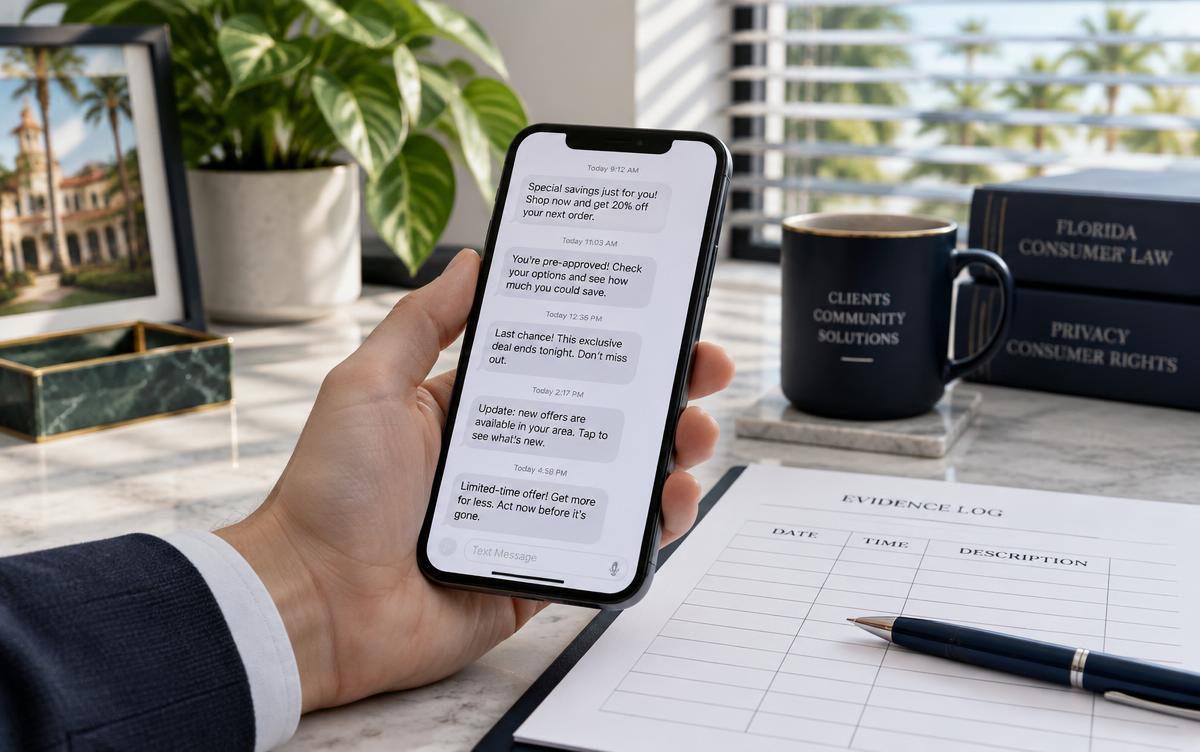
Unwanted promotional texts can be more than a nuisance. Depending on who sent them, why they were sent, what technology was used, whether you consented, and what happened after you opted out, a company may have violated the federal Telephone Consumer Protection Act or the Florida Telephone Solicitation Act. The short answer is that you may be able to sue, but not every unwanted text creates a viable claim. This guide explains the distinctions that matter for Florida consumers in 2026. It is general information, not legal advice, and it does not create an attorney-client relationship.
Quick Answer
A Florida consumer may be able to bring a claim against a company for unlawful spam texts under the federal Telephone Consumer Protection Act, 47 U.S.C. § 227, the Florida Telephone Solicitation Act, Fla. Stat. § 501.059, or both. A claim is not automatic merely because a message was unwanted. The analysis may turn on whether the message was a sales solicitation, whether valid consent existed, the dialing technology, whether the number was on a do-not-call list, whether the consumer revoked consent, and whether the sender continued after receiving an opt-out.
TCPA and FTSA: Two Different Laws
The TCPA and FTSA overlap, but they are not interchangeable. A responsible evaluation tests each statute separately rather than assuming every spam text violates both.
| Question | Federal TCPA | Florida FTSA |
|---|---|---|
| Main authority | 47 U.S.C. § 227 and 47 C.F.R. § 64.1200 | Fla. Stat. § 501.059 |
| Typical focus | Certain calls or texts made with an automatic telephone dialing system, artificial or prerecorded voice, or in violation of do-not-call rules | Telephonic sales calls, including covered texts, made with an automated system without the consent the statute requires |
| Consent | Depends on the type and purpose of the message and the rule invoked | Prior express written consent is defined in the statute for covered automated sales solicitations |
| Private damages | Actual loss or $500 per violation, whichever is greater; a court may increase an award for a willful or knowing violation | Actual damages or $500, whichever is greater; a court may increase an award up to three times for a willful or knowing violation |
| Important caution | After Facebook v. Duguid, many systems dialing from ordinary stored lists do not meet the federal ATDS definition | For text-message damages claims, Florida law generally requires a STOP reply and continued texts more than 15 days later |
When Can a Company Be Liable Under the Federal TCPA?
The TCPA restricts several different practices. One provision concerns calls or texts made to a cellular number using an automatic telephone dialing system or an artificial or prerecorded voice without the consent required by law. Another permits certain claims involving repeated telephone solicitations that violate federal do-not-call rules. The legal elements differ, so the same message may support one theory but not another.
The U.S. Supreme Court narrowed the federal definition of an automatic telephone dialing system in Facebook, Inc. v. Duguid. Equipment generally must use a random or sequential number generator in the way the statute describes. A platform that merely sends messages from an ordinary stored customer list may fall outside that definition, although other TCPA provisions can still matter. This is why the statement that every automated text violates the TCPA is inaccurate.
When Can a Company Be Liable Under the Florida FTSA?
Florida's FTSA regulates telephonic sales calls to consumers, and its definition includes covered text messages. For the automated-solicitation provision, prior express written consent must satisfy specific requirements: a signed agreement, authorization for the covered communications, the number to be contacted, and clear disclosure that consent is not a condition of purchasing goods or services. The current requirements appear in Fla. Stat. § 501.059.
The FTSA was materially amended in 2023. For a private action seeking damages over text-message solicitations, the called party must first reply STOP to the number that sent the texts. The sender then has 15 days to stop, apart from a permitted confirmation message. A damages action under this provision generally becomes available only if nonconsensual texts continue after that 15-day period. Older articles that omit this prerequisite can give Florida consumers the wrong impression.
Not Every Unwanted Text Is Illegal
The following details often determine whether a case is viable:
- The message's purpose: advertising and sales solicitations are treated differently from appointment reminders, fraud alerts, delivery updates, account notices, or emergency communications.
- Consent: a consumer may have entered a number on an order form, application, sweepstakes, lead form, or service agreement. The exact disclosure and the identity of the sender matter.
- Technology: the federal ATDS question is technical and fact-dependent after Duguid. Florida's statutory wording and requirements must be analyzed separately.
- Opt-out history: the date, wording, and destination of a STOP or other revocation message can be decisive.
- Sender identity: the displayed number may be a vendor or platform rather than the company whose product was advertised. Agency and authorization can be disputed.
- Exemptions and defenses: an established business relationship, a consumer request, emergency purpose, or other statutory exception may apply to some claims.
What if You Previously Consented?
Prior consent does not necessarily authorize every future message forever. Federal rules recognize reasonable methods of revoking consent, and covered callers generally must honor valid revocation requests within the applicable period. The FCC's consumer guide to unwanted calls and texts identifies common opt-out and complaint options.
The FCC adopted a broader cross-category revocation requirement, but in January 2026 the Commission extended that particular requirement's compliance date to January 31, 2027. The FCC's January 2026 order is important because older summaries may incorrectly describe the delayed portion as fully effective in 2026. Other revocation duties were not necessarily delayed, so the exact message, consent language, and date still require individual analysis.
The FCC One-to-One Consent Rule Is Not Current Law
The FCC adopted a seller-specific one-to-one consent rule in 2023, but the Eleventh Circuit vacated it before its planned January 2025 effective date in Insurance Marketing Coalition Ltd. v. FCC. It should not be presented as an operative 2026 rule. Existing federal and state consent requirements still apply, and a vague or misleading disclosure may fail for other reasons, but the vacated rule itself is not a valid basis for promising a claim.
Do-Not-Call Claims May Be Different
A number registered on the National Do Not Call Registry may have a separate claim when it receives repeated covered telephone solicitations contrary to federal regulations. Exceptions can include prior express permission and an established business relationship, and the federal private-action provision has its own threshold requirements. Consumers can verify or register a number through the official National Do Not Call Registry. Florida also maintains state telemarketing restrictions through the FTSA and related consumer-protection rules.
How Much Can a Spam-Text Claim Be Worth?
Both statutes authorize statutory remedies, but no amount is automatic or guaranteed.
- Under 47 U.S.C. § 227(b)(3), a successful TCPA claimant may recover actual monetary loss or $500 for each proven violation, whichever is greater. A court may increase the amount up to three times for a willful or knowing violation.
- Under Fla. Stat. § 501.059(10), a successful FTSA claimant may seek an injunction and actual damages or $500, whichever is greater. A court may increase the award up to three times for a willful or knowing violation.
- Courts decide whether messages constitute separate violations, whether enhanced damages are justified, and whether a claim belongs in court at all. Settlements, defenses, consent evidence, arbitration terms, standing, collectability, and class-certification issues can materially change the practical value.
A calculation such as ten messages multiplied by $500 is only a screening estimate. It is not a prediction of recovery, and multiple legal theories do not necessarily permit duplicate recovery for the same conduct.
Can You Sue Over One Spam Text?
Possibly, but forum and injury requirements matter. In Salcedo v. Hanna, the Eleventh Circuit held that receipt of one unsolicited text, without more, did not establish the concrete injury required for federal-court standing. The Eleventh Circuit includes Florida. State courts apply their own standing rules, and later facts or injuries can change the analysis. A single message therefore should not be advertised as a guaranteed federal lawsuit.
How Long Do You Have to Act?
TCPA claims are commonly analyzed under the four-year federal limitations period in 28 U.S.C. § 1658. Florida limitations questions can depend on the claim, the statutory version, accrual, tolling, and procedural history. Do not wait for a deadline estimate from an article. Preserve the messages and obtain advice promptly so counsel can calculate the deadline from the actual facts.
Evidence to Save Before Blocking the Sender
Preserve the original evidence before deleting, filtering, or replacing the phone:
- Screenshot the entire conversation, including the sender, date, time, message body, links, and any reply.
- Keep the original message thread and back up the device when possible.
- Record the dates and wording of every STOP, UNSUBSCRIBE, CANCEL, END, QUIT, or other opt-out.
- Save voicemails, call logs, landing pages, online forms, receipts, and the consent language displayed when the number was entered.
- Preserve proof of National Do Not Call registration, if applicable.
- Note the advertised company, website, product, short code, sender number, and any vendor named in the message.
- Keep FCC, FTC, Florida, or carrier complaint confirmations.
- Do not click unfamiliar links or send sensitive information merely to identify the sender.
A Practical Florida Action Plan
1. Preserve first
Take screenshots and keep the original thread before blocking the number. Evidence can disappear when a device is replaced or a messaging app is cleared.
2. Use a clear opt-out
For a Florida text-solicitation damages claim, replying STOP to the sending number is especially important because the FTSA expressly uses that procedure and a 15-day compliance period. Save proof of the reply and every later message.
3. Check your consent trail
Search email, purchase records, applications, quote requests, sweepstakes entries, and lead forms for the telephone disclosure you may have accepted. Do not assume consent existed or did not exist without reviewing the actual record.
4. Verify do-not-call status
Use the official registry and preserve the result. Registration can support a different theory from an autodialer claim.
5. Report suspected violations
Consumers may submit complaints through the FCC Consumer Complaint Center and report fraud or deceptive conduct at ReportFraud.ftc.gov. A government complaint does not automatically create or resolve a private lawsuit.
6. Request a legal review
A lawyer can assess the sender, message purpose, consent record, dialing method, opt-out history, number of messages, possible arbitration terms, available forum, and applicable deadlines before suggesting a claim.
Common Defenses Companies Raise
Companies often argue that the consumer gave valid consent, that an affiliate or independent vendor sent the message, that the message was informational rather than marketing, that no covered automated system was used, that an established business relationship applied, that the opt-out was not sent to the required number, or that the consumer lacks standing. They may also invoke arbitration provisions or class-action waivers connected to an account or transaction. A detailed evidence record helps counsel evaluate those defenses rather than relying only on the text's appearance.
Official Sources
- Telephone Consumer Protection Act, 47 U.S.C. § 227
- Florida Telephone Solicitation Act, Fla. Stat. § 501.059
- Facebook, Inc. v. Duguid, U.S. Supreme Court
- Salcedo v. Hanna, Eleventh Circuit
- FCC guide to unwanted robocalls and texts
- FCC January 2026 consent-revocation compliance order
- National Do Not Call Registry
Talk to The Farber Law Firm About Spam Texts
The Farber Law Firm reviews potential TCPA and FTSA claims for consumers in Miami, Coral Gables, and throughout Florida. The firm can evaluate your screenshots, consent history, opt-out record, sender information, and the law that applies to the messages you received. Outcomes are never guaranteed, and representation begins only after conflict review and a signed written engagement agreement.
Use the TCPA claim intake form to describe the messages and securely upload supporting screenshots, or book a free case review. The Farber Law Firm, P.A., 2199 Ponce de Leon Blvd #301, Coral Gables, FL 33134. Call 8888-FARBER.
Frequently Asked Questions
Can I sue a company for spam text messages in Florida?
You may have a claim under the TCPA, the FTSA, or another law, but an unwanted message alone does not guarantee liability. Consent, message purpose, dialing technology, do-not-call status, opt-out history, standing, and defenses all matter.
How much can someone recover for an illegal spam text?
The TCPA and FTSA can authorize actual loss or $500 per proven violation, whichever is greater, with a possible increase up to three times for a willful or knowing violation. Courts decide liability and damages, and no recovery is guaranteed.
Do I need to reply STOP before suing under Florida law?
For an FTSA damages action based on text-message solicitations, Fla. Stat. § 501.059 generally requires a STOP reply to the sending number and continued texts more than 15 days after the sender receives that notice. Other claims may have different requirements.
Is one unwanted text enough for a lawsuit?
Not always. The Eleventh Circuit held in Salcedo v. Hanna that one unsolicited text, without more, did not establish Article III standing in federal court. State-court rules and additional facts may produce a different analysis.
Is the FCC one-to-one consent rule in effect in 2026?
No. The Eleventh Circuit vacated that rule before its planned 2025 effective date. Other federal and Florida consent requirements remain in effect and still require a fact-specific review.
What should I save after receiving spam texts?
Keep the original thread and screenshots showing the sender, date, time, full message, links, and all opt-out replies. Also save forms or agreements where you may have supplied your number, do-not-call registration proof, and complaint confirmations.
Does contacting The Farber Law Firm create an attorney-client relationship?
No. A consultation or form submission does not itself create an attorney-client relationship. Representation begins only after conflict review and a signed written engagement agreement.
Start Your TCPA Claim Questionnaire
If you are getting robocalls, prerecorded messages, or spam texts you never consented to, our confidential TCPA intake questionnaire is the fastest way to have your call log reviewed. It takes a few minutes, there is no cost, and an attorney at The Farber Law Firm follows up directly.
- 1. Share your logDates, times, and numbers for the calls or texts you received.
- 2. We screen itWe check consent, revocation, and who benefited from the campaign.
- 3. You get answersA straight assessment of whether the facts support a claim.
Submitting the questionnaire does not create an attorney-client relationship, and no outcome is promised. Consumer TCPA matters are handled on a contingency basis when accepted, under a written fee agreement required by Rule 4-1.5 of the Rules Regulating The Florida Bar.
Have a similar situation?
Free, confidential case review with a South Florida trial attorney. Call 8888-FARBER.
Request a Free ConsultationAbout the Author
The Farber Law Firm, P.A.
The Farber Law Firm is a South Florida trial practice based in Coral Gables, representing injured people, policyholders and businesses across Miami-Dade, Broward and Palm Beach counties since 1995. The firm handles personal injury, wrongful death, insurance coverage disputes and commercial litigation, and its attorneys are members in good standing of The Florida Bar.
Articles on this site are written and reviewed by attorney David Farber and reflect Florida statutes, court rules and Florida Bar regulations current as of the publication date.
- Office
- 2199 Ponce de Leon Blvd #301
Coral Gables, FL 33134 - Phone
- 8888-FARBER
- Consultations
- Free and confidential