TCPA Lawsuit Guide 2026
A Miami consumer protection attorney's 2026 guide to Telephone Consumer Protection Act (TCPA) lawsuits: what counts as a violation under 47 U.S.C. § 227, the new FCC one-to-one consent rule, statutory damages of $500–$1,500 per call or text, the 4-year statute of limitations, and how to document and pursue a claim in Florida.
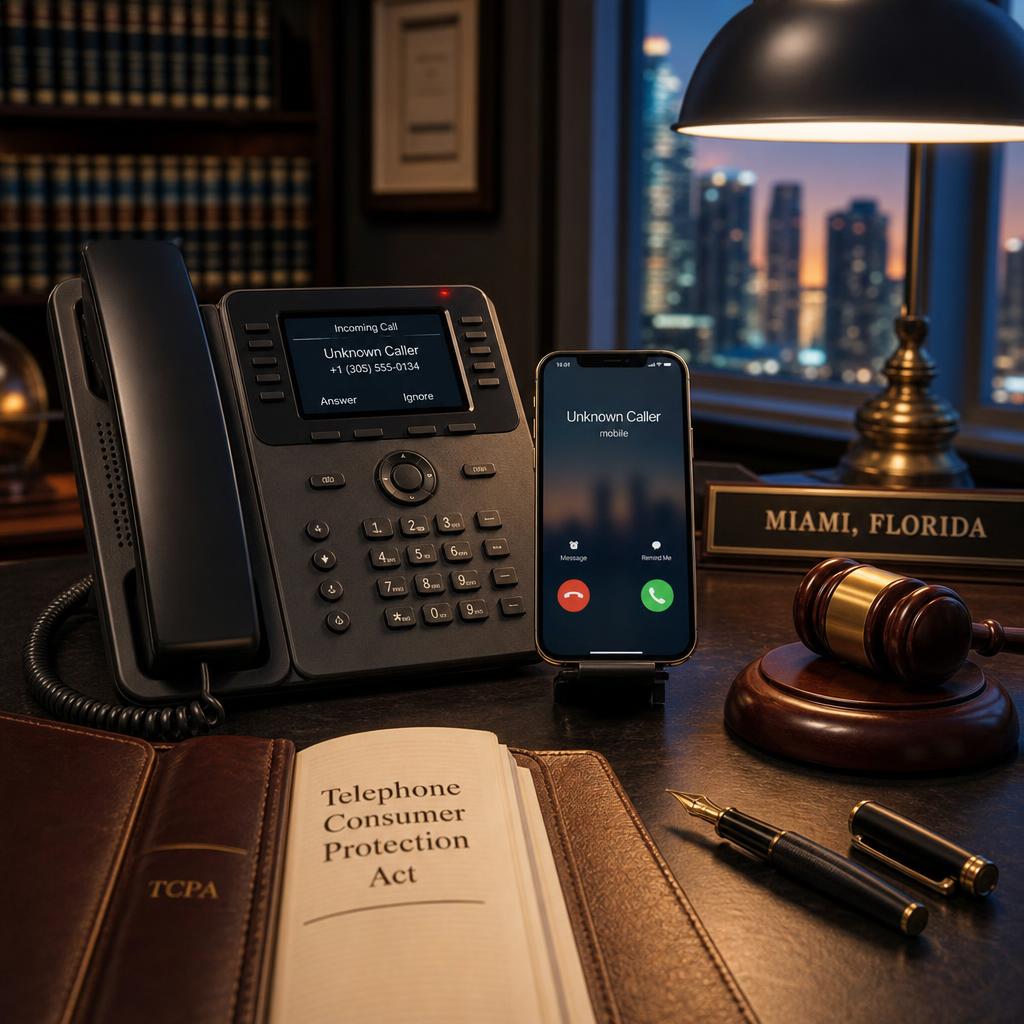
If your phone will not stop ringing with robocalls, prerecorded voicemails, or spam texts from companies you never gave permission to contact, federal law gives you the right to sue — and to collect $500 to $1,500 for every single call or text. The statute is the Telephone Consumer Protection Act of 1991 (TCPA), 47 U.S.C. § 227, enforced through 47 C.F.R. § 64.1200 and reshaped in 2024–2026 by a new FCC one-to-one consent rule and the U.S. Supreme Court's decisions in Facebook v. Duguid (2021) and McLaughlin Chiropractic v. McKesson (2025). This 2026 guide, written by a Florida consumer protection attorney, explains how a TCPA lawsuit actually works, what a violation looks like under current law, how damages are calculated, and how to preserve evidence. Nothing in this article is legal advice; every case turns on its own facts.
Quick Answer
- The TCPA lives at 47 U.S.C. § 227 and its implementing rules at 47 C.F.R. § 64.1200.
- Statutory damages are $500 per violation, or $1,500 per violation if the conduct is willful or knowing (§ 227(b)(3)).
- The statute of limitations is 4 years under 28 U.S.C. § 1658 (Rotkiske v. Klemm / Mims v. Arrow Financial).
- You can sue in federal or state court; Florida has concurrent jurisdiction.
- The FCC one-to-one consent rule (adopted 2023, in effect for many use cases as of 2025) requires separate written consent for each individual seller — no more shared 'partner network' consent buried in a lead-gen checkbox.
- Calls or texts to numbers on the National Do-Not-Call Registry without an established business relationship are separately actionable at $500–$1,500 per call under § 227(c)(5).
What the TCPA Actually Prohibits
The TCPA is not a general anti-spam statute. It targets specific technologies and specific consent gaps. In broad strokes, § 227(b) makes it unlawful — without the recipient's prior express written consent — to:
- Make any call using an automatic telephone dialing system (ATDS) or an artificial or prerecorded voice to a cell phone.
- Send a text message to a cell phone using an ATDS (courts treat SMS as a 'call' under the statute).
- Send an unsolicited advertisement by fax to any fax machine.
- Make a prerecorded telemarketing call to a residential landline.
Section 227(c) separately prohibits telemarketing calls to numbers on the National Do-Not-Call Registry, and requires callers to maintain an internal Do-Not-Call list and honor opt-out requests within a reasonable time (the FCC treats 10 business days as the outer limit under 47 C.F.R. § 64.1200(d)).
The 2021 Duguid Narrowing and What's Still Actionable
In Facebook, Inc. v. Duguid, 592 U.S. 395 (2021), the Supreme Court narrowed the definition of an 'automatic telephone dialing system' to equipment that uses a random or sequential number generator to store or produce numbers. Predictive dialers that call from an uploaded list are, in most circuits, no longer 'ATDS' devices — which cut off one large slice of pre-2021 TCPA litigation.
What Duguid did NOT touch, and what remains fully actionable in 2026:
- Artificial or prerecorded voice calls to a cell phone without prior express written consent — still a per-call violation regardless of the dialing technology.
- Prerecorded telemarketing calls to residential landlines.
- Do-Not-Call Registry violations under § 227(c)(5) — the DNC rules do not depend on ATDS use.
- Internal DNC violations — failing to honor a company-specific stop request.
- Ringless voicemails — the FCC declared these to be 'calls' subject to the TCPA in a 2022 declaratory ruling.
- Text messages sent via a platform that uses a random or sequential number generator, or that mass-blasts using technology the courts still classify as an ATDS.
The FCC One-to-One Consent Rule
In December 2023 the FCC closed the 'lead generator loophole.' Under the amended 47 C.F.R. § 64.1200(f)(9), prior express written consent must now be:
- Given to one identified seller at a time — not to a lead-generation website and every 'marketing partner' it might sell your number to;
- Logically and topically related to the interaction that produced the consent (a consumer looking for auto insurance quotes cannot lawfully be consented into solar or debt-relief calls); and
- Documented by the caller, who bears the burden of proof under longstanding FCC and circuit precedent.
After a 2025 Eleventh Circuit vacatur delayed one piece of the rule, the FCC re-issued clarifying guidance in 2026. The core takeaway for consumers: if you gave your number to Website A, only Website A (or a service Website A directly sells) can call you. A call from a random insurance carrier, solar installer, or debt-relief operator you never heard of is almost always a violation.
McLaughlin Chiropractic v. McKesson (2025) and Junk Faxes
In McLaughlin Chiropractic Associates v. McKesson Corp., 606 U.S. ___ (2025), the Supreme Court held that federal district courts are not bound by the FCC's interpretation of the TCPA under the Hobbs Act. That decision reopens junk-fax and 'online fax service' litigation that had been dismissed based on the FCC's 2019 Amerifactors order, and generally strengthens plaintiffs' ability to litigate the meaning of the statute directly in court.
Damages: How the $500 and $1,500 Numbers Work
Section 227(b)(3) and § 227(c)(5) both provide the same damages structure:
- Actual monetary loss OR $500 in statutory damages per violation, whichever is greater; and
- Up to $1,500 per violation if the court finds the defendant acted willfully or knowingly.
Each unlawful call, each prerecorded voicemail, and each text message is a separate violation. A three-week campaign of 30 robocalls to your cell phone from an unconsented seller is potentially $15,000 to $45,000 in statutory damages before any DNC-list or internal-DNC add-ons are counted. A single call can trigger stacked violations — for example, a prerecorded call to a cell phone that is also on the DNC Registry from a seller with no internal DNC policy in place can support parallel § 227(b) and § 227(c) recoveries.
The TCPA is strict liability as to most elements — the caller's good faith or reliance on a lead vendor's representations is not a defense to liability, though it can matter for the willfulness enhancement.
Statute of Limitations
TCPA claims are subject to the federal 4-year 'catch-all' statute of limitations at 28 U.S.C. § 1658. Every call or text is its own accrual date. Practically, that means a plaintiff can generally sue on any qualifying call or text sent in the last 4 years — a substantial window if a company has been calling for months or years.
Where to Sue
Mims v. Arrow Financial Services, LLC, 565 U.S. 368 (2012), confirmed that federal district courts have federal-question jurisdiction over TCPA claims. State courts also have concurrent jurisdiction, and Florida state court is a common venue for individual TCPA suits against Florida-based callers or where a Florida consumer received the calls.
Class actions remain available for large-scale robocall or text-blast campaigns; individual suits are increasingly common where the caller was a single seller and damages fit comfortably into a small federal or state case.
Evidence That Decides TCPA Cases
The stronger the documentation, the stronger the case. Preserve the following as soon as you suspect a violation:
- Call log from your phone — every date, time, and calling number.
- Screenshots of text messages, including the full sender number and message body.
- Voicemails — save the audio files; a prerecorded voice is often the single most important piece of evidence.
- Every consent interaction you can recall — the website you visited, the checkbox you did or did not click, any confirmation email or SMS.
- Your carrier records — most carriers will produce 6–24 months of detailed logs on request.
- A written log of any conversation with the caller, including any 'stop calling' request you made and the exact date you made it (this is the foundation of an internal-DNC claim under 47 C.F.R. § 64.1200(d)).
- DNC Registry confirmation email or the date you first registered your number at donotcall.gov.
Do not engage the caller extensively or pretend to be interested — none of that is required, and it can complicate a later consent analysis. A single, clearly-worded 'do not call this number again' is enough.
Common Defenses (and Why They Often Fail)
- 'You consented.' Under the one-to-one rule and longstanding FCC precedent, the caller bears the burden of producing the specific written consent that authorized that seller to make that type of call. Vague, bundled, or partner-network consents typically do not satisfy the rule.
- 'It wasn't an ATDS.' After Duguid, this can be a real defense as to § 227(b) ATDS claims — but it is irrelevant to prerecorded-voice claims, DNC claims, and internal-DNC claims.
- 'We're a nonprofit / political / informational caller.' The TCPA's exemptions are narrow. Telemarketing is broadly defined, and even 'informational' calls to a cell phone using a prerecorded voice generally require consent.
- 'You had an established business relationship (EBR).' The EBR exemption applies to DNC-Registry claims for residential lines and has an 18-month / 3-month window (§ 64.1200(f)(5)); it does not authorize prerecorded or ATDS calls to cell phones.
Is a TCPA Lawsuit Worth It?
For most consumers with a documented pattern of unwanted calls or texts, yes. Statutory damages, willfulness enhancements, and stacked § 227(b)/§ 227(c) claims can turn even a modest call log into a five-figure demand. Many consumer protection attorneys, including firms in Miami and South Florida, handle TCPA matters on a contingency-fee basis — no fee unless you recover. Consumers should ask about the fee structure at the initial consultation.
Florida-Specific Notes
Florida also has its own mini-TCPA — the Florida Telephone Solicitation Act (FTSA), Fla. Stat. § 501.059. After CS/HB 761 (2023) significantly narrowed the FTSA's private right of action for automated text messages, plaintiffs have shifted most Florida robocall and spam-text litigation back to the federal TCPA framework described above. FTSA claims involving prerecorded voice calls, autodialed telemarketing calls to numbers on Florida's DNC list, and sales calls made without a Florida solicitor registration remain viable in some circumstances, but the federal TCPA is now the primary vehicle for most Florida consumers.
Frequently Asked Questions
How much can I sue for a TCPA violation in 2026?
Statutory damages are $500 per call or text under 47 U.S.C. § 227(b)(3) and § 227(c)(5), or up to $1,500 per call or text if the violation is willful or knowing. Every call and every text is a separate violation.
What is the statute of limitations for a TCPA lawsuit?
Four years under the federal catch-all statute at 28 U.S.C. § 1658, running separately from each call or text.
Do I have to be on the Do-Not-Call Registry to sue?
No. Prerecorded-voice, ATDS, and ringless-voicemail claims under § 227(b) do not require DNC registration. DNC-Registry claims under § 227(c)(5) do require that your number be on the registry (and generally that you have received more than one violating call within 12 months).
Is a text message really a 'call' under the TCPA?
Yes. Courts and the FCC have treated SMS text messages as 'calls' under the TCPA since Satterfield v. Simon & Schuster (9th Cir. 2009), and Congress has never disturbed that reading.
What if I gave my number on a website?
Under the FCC's one-to-one consent rule, consent must be to a single, identified seller and must be topically related to the interaction. If your number was sold or shared with unrelated 'marketing partners' who then called you, that is almost always a violation regardless of what you clicked.
Can I bring a TCPA class action?
Yes. Class actions are common for large-scale robocall or text-blast campaigns and can result in multi-million-dollar settlements. Individual suits are also viable and often faster to resolve.
Does the TCPA apply to debt collectors?
Yes. Debt collectors calling a cell phone with a prerecorded voice, or texting through an ATDS-qualifying system without consent, are subject to the same rules as any other caller. Additional protections may apply under the federal Fair Debt Collection Practices Act, 15 U.S.C. §§ 1692 et seq.
Key Takeaways
- The TCPA (47 U.S.C. § 227) gives consumers a private right of action worth $500–$1,500 per unlawful call or text.
- The FCC one-to-one consent rule dramatically narrows what counts as valid consent in 2026.
- Prerecorded-voice calls, DNC violations, internal-DNC violations, and ringless voicemails all survived the Duguid narrowing of 'ATDS.'
- The statute of limitations is 4 years per call or text under 28 U.S.C. § 1658.
- Preserve call logs, screenshots, voicemails, and consent records immediately.
- Florida's FTSA is narrower than it once was; the federal TCPA is the primary consumer remedy in 2026.
Talk to The Farber Law Firm About Your TCPA Case
If unwanted robocalls, prerecorded voicemails, or spam texts have been blowing up your phone, The Farber Law Firm offers free, confidential consultations for Florida consumers considering a TCPA claim. The firm has represented individuals and businesses in consumer protection matters throughout Miami-Dade, Broward, and the rest of South Florida since 1995, and handles qualifying TCPA cases on a contingency-fee basis — you pay nothing unless there is a recovery. Bring your call log, any voicemails you saved, screenshots of the texts, and whatever you can recall about how the caller may have obtained your number.
The Farber Law Firm, P.A. — 2199 Ponce de Leon Blvd #301, Coral Gables, FL 33134. Call, or request a free case review through the contact form on this site.
This article is for general informational purposes only and does not constitute legal advice. TCPA cases depend on the specific facts, the technology used by the caller, and the current state of federal regulations and case law. Statutes, rules, and decisions cited are current as of publication in July 2026 and are subject to change. Consult a licensed Florida attorney about your specific situation.
Frequently Asked Questions
How much can I sue for a TCPA violation in 2026?
Statutory damages are $500 per call or text under 47 U.S.C. § 227(b)(3) and § 227(c)(5), or up to $1,500 per call or text if the violation is willful or knowing. Every call and every text is a separate violation.
What is the statute of limitations for a TCPA lawsuit?
Four years under the federal catch-all statute at 28 U.S.C. § 1658, running separately from each call or text.
Do I have to be on the Do-Not-Call Registry to sue under the TCPA?
No. Prerecorded-voice, ATDS, and ringless-voicemail claims under 47 U.S.C. § 227(b) do not require DNC registration. Do-Not-Call Registry claims under § 227(c)(5) do require that your number be on the registry and generally that you received more than one violating call within 12 months.
Is a text message considered a 'call' under the TCPA?
Yes. Courts and the FCC have treated SMS text messages as 'calls' under the TCPA since Satterfield v. Simon & Schuster (9th Cir. 2009), and Congress has not disturbed that interpretation.
What is the FCC one-to-one consent rule?
Adopted by the FCC in December 2023, the one-to-one consent rule requires that prior express written consent be given to a single identified seller at a time and be logically and topically related to the interaction that produced the consent. Bundled 'marketing partner' consents from lead-generation websites generally no longer satisfy the TCPA.
Can I sue a debt collector under the TCPA?
Yes. Debt collectors calling a cell phone with a prerecorded voice, or texting through an ATDS-qualifying system without consent, are subject to the same rules as any other caller, in addition to the Fair Debt Collection Practices Act, 15 U.S.C. §§ 1692 et seq.
Does the Florida Telephone Solicitation Act still apply?
The FTSA (Fla. Stat. § 501.059) still exists but was significantly narrowed by CS/HB 761 (2023), particularly for automated text messages. Most Florida robocall and spam-text litigation in 2026 is brought under the federal TCPA at 47 U.S.C. § 227.
Start Your TCPA Claim Questionnaire
If you are getting robocalls, prerecorded messages, or spam texts you never consented to, our confidential TCPA intake questionnaire is the fastest way to have your call log reviewed. It takes a few minutes, there is no cost, and an attorney at The Farber Law Firm follows up directly.
- 1. Share your logDates, times, and numbers for the calls or texts you received.
- 2. We screen itWe check consent, revocation, and who benefited from the campaign.
- 3. You get answersA straight assessment of whether the facts support a claim.
Submitting the questionnaire does not create an attorney-client relationship, and no outcome is promised. Consumer TCPA matters are handled on a contingency basis when accepted, under a written fee agreement required by Rule 4-1.5 of the Rules Regulating The Florida Bar.
Have a similar situation?
Free, confidential case review with a South Florida trial attorney. Call 8888-FARBER.
Request a Free ConsultationAbout the Author
The Farber Law Firm, P.A.
The Farber Law Firm is a South Florida trial practice based in Coral Gables, representing injured people, policyholders and businesses across Miami-Dade, Broward and Palm Beach counties since 1995. The firm handles personal injury, wrongful death, insurance coverage disputes and commercial litigation, and its attorneys are members in good standing of The Florida Bar.
Articles on this site are written and reviewed by attorney David Farber and reflect Florida statutes, court rules and Florida Bar regulations current as of the publication date.
- Office
- 2199 Ponce de Leon Blvd #301
Coral Gables, FL 33134 - Phone
- 8888-FARBER
- Consultations
- Free and confidential