Florida Golf Cart Accident Laws: A 2026 Miami Injury Guide
Golf carts are everywhere in Coral Gables, Key Biscayne, and Pinecrest — and Florida law treats them very differently from cars. Here's how § 316.212 governs where they can drive, why PIP usually doesn't apply, how HB 949 (2023) tightened Low-Speed Vehicle rules, and what to do if you or a family member is injured.
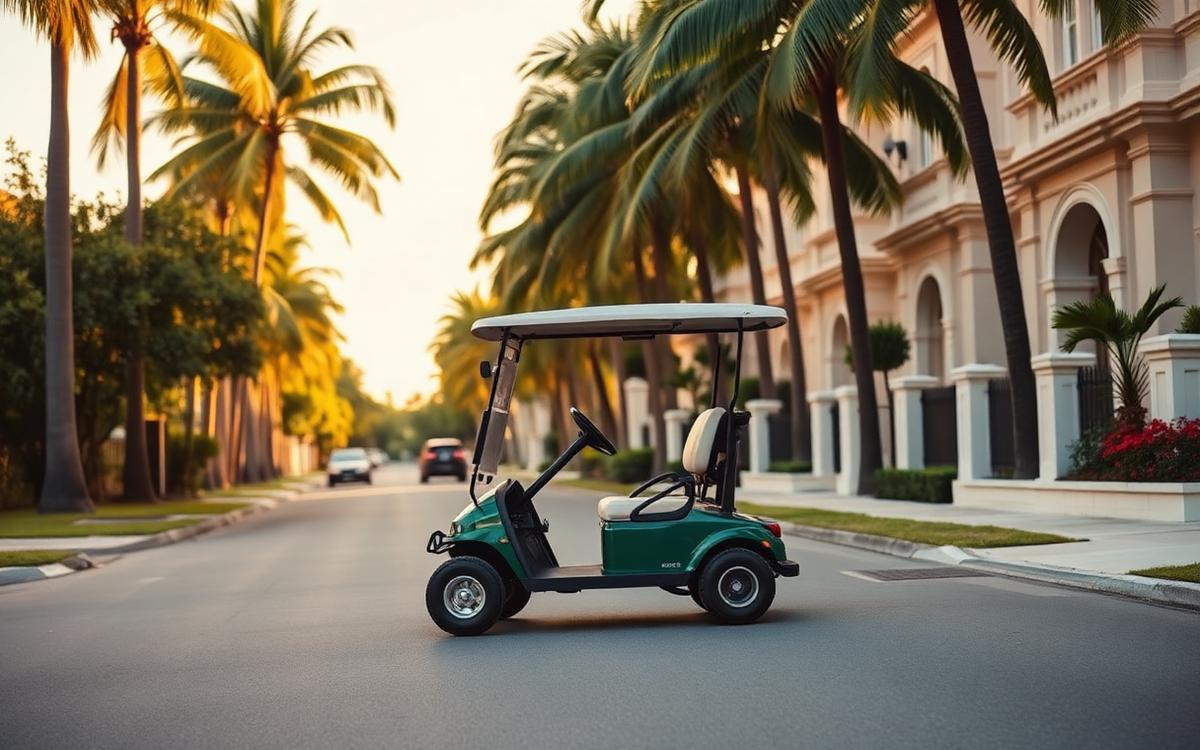
Golf carts have moved from country-club fairways to South Florida streets. In Coral Gables, Key Biscayne, Pinecrest, Palmetto Bay, and much of the Keys, families use them for school runs, beach trips, and dinner outings. That convenience has produced a steady rise in crashes — and a body of Florida law that most drivers, and even many insurers, misapply. This 2026 guide, written from a Miami personal-injury attorney's perspective, explains where golf carts can legally operate in Florida, how the state distinguishes a 'golf cart' from a 'Low-Speed Vehicle' (LSV), what insurance actually covers a crash, and the practical steps to take if someone is hurt.
Golf Cart vs. Low-Speed Vehicle — A Legal Distinction That Changes Everything
Florida law draws a sharp line between two look-alike machines. Under Fla. Stat. § 320.01(22), a golf cart is a motor vehicle designed and manufactured for operation on a golf course for sporting or recreational purposes, and not capable of exceeding 20 mph. A Low-Speed Vehicle, defined in § 320.01(41), is a four-wheeled vehicle whose top speed is greater than 20 mph but not more than 25 mph, and it must be equipped with headlamps, brake lights, turn signals, tail lamps, reflex reflectors, parking brake, rearview mirrors, windshield, seat belts, and a 17-character VIN.
The classification matters because:
- A true golf cart does not have to be titled or registered, and the operator does not need a driver's license on private property, but it also has narrowly limited street privileges.
- A Low-Speed Vehicle must be titled and registered under § 320.02, insured with PIP and property damage liability (PDL) under § 320.02(5)(b), and driven by a licensed driver under § 316.2122.
- Many so-called 'golf carts' sold in South Florida are, in the eyes of Florida DHSMV, actually LSVs — and the failure to register and insure them properly is one of the most common issues in Miami golf-cart injury cases.
Where Golf Carts Can Legally Drive in Florida
Fla. Stat. § 316.212 governs the operation of golf carts on public roads. As a baseline rule, a golf cart may only be operated on a public road if the county or municipality has, by ordinance, designated that specific road as one on which golf-cart operation is permitted — after making a written determination that it can be done safely considering speed, volume, and character of traffic. Even then, operation is limited to daylight hours unless the cart is equipped with headlights, brake lights, turn signals, and a windshield, in which case dawn-to-dusk restrictions can be relaxed by ordinance.
Statewide baseline rules in § 316.212 include:
- Operation is generally limited to roads with a posted speed limit of 30 mph or less.
- A golf cart may cross a road at an intersection where the road it crosses has a posted speed limit of up to 45 mph.
- Effective changes signed into law under HB 949 (2023) and codified in § 316.212(8), a person must be at least 15 years old and hold a learner's permit or driver's license — or at least 18 with a government-issued photo ID — to operate a golf cart on any public road or street. Before that change, Florida had no statewide age minimum for street operation.
- Municipal ordinances (Coral Gables, Key Biscayne, and many Keys communities have their own) may impose additional equipment, insurance, or route restrictions.
Operating a golf cart in a location or manner not authorized by § 316.212 or a local ordinance is a noncriminal traffic infraction under § 316.212(7) — and, in a civil injury case, is powerful evidence of negligence per se.
Insurance: Why PIP Usually Does Not Apply
This is where injured Floridians are most often blindsided. Florida's no-fault (PIP) statute, § 627.736, only requires PIP coverage on 'motor vehicles' as defined in § 627.732(3) — which excludes vehicles with fewer than four wheels and, critically, vehicles not required to be registered. A true § 320.01(22) golf cart is not required to be registered and therefore does not need PIP, and in most cases the owner's auto policy does not extend PIP to a golf-cart crash.
Practical coverage picture in a Miami golf-cart injury:
- Golf cart (not LSV): No PIP requirement. Homeowner's or umbrella policies sometimes cover liability on and around the insured's own premises but often exclude 'off-premises' operation of a motorized vehicle. Read the policy carefully.
- Low-Speed Vehicle: Must carry PIP ($10,000) and PDL ($10,000) under § 627.733 and § 320.02(5)(b). Coverage triggers the 14-day medical rule of § 627.736(1)(a).
- Auto liability: Most personal auto policies exclude 'vehicles designed mainly for use off public roads' — a category that captures many golf carts. Look at the policy's definitions and exclusions before assuming coverage.
- Uninsured / underinsured motorist (UM): UM on a personal auto policy can sometimes reach injuries suffered as a pedestrian struck by a golf cart or LSV, or as a passenger — analysis depends on the policy language and the vehicle's classification.
The failure to correctly identify the vehicle as a golf cart, LSV, or (increasingly) an unregistered LSV disguised as a golf cart is the single most common reason legitimate claims get underpaid or denied.
Common Causes of Golf-Cart Crashes in Miami-Dade
Reported causes in South Florida golf-cart injury files include:
- Right-of-way and stop-sign violations at neighborhood intersections
- Overloading — passengers standing on rear platforms, riding on laps, or hanging off the sides
- Nighttime operation without headlights or reflectors on unlit residential streets
- Unlicensed underage drivers, now a clearer statutory violation after HB 949
- Alcohol involvement — golf carts are 'vehicles' for purposes of Florida's DUI statute, § 316.193; a driver can be arrested for DUI on a golf cart
- Defective brakes, tires, or steering — product-liability claims against manufacturers or the dealer who upfit the cart
- Rollovers on tight turns, particularly with lifted or aftermarket-tire builds common on South Florida carts
Injuries That Show Up in Golf-Cart Cases
Because golf carts have no doors, no crumple zones, no airbags, and often no seat belts, even a 15-mph crash can produce serious injury. Cases handled in South Florida commonly involve:
- Traumatic brain injury and concussion from ejection or ground impact
- Cervical- and lumbar-spine injuries from being thrown forward or laterally
- Fractures of the wrist, forearm, and clavicle from a bracing fall
- Facial and dental trauma when the head strikes the steering post or dashboard
- Pediatric injuries — Florida law does not require child restraints in golf carts, but injuries to children are disproportionately severe
Comparative Negligence After HB 837 — Why Fault Allocation Now Decides Recovery
Under the modified comparative-negligence rule in Fla. Stat. § 768.81(6), a plaintiff whose share of fault exceeds 50% recovers nothing in a negligence-based personal injury or wrongful-death action (medical malpractice remains under the old pure-comparative rule). In a golf-cart case, defense insurers often argue plaintiff fault based on:
- Riding in a cart operated in a location not authorized by § 316.212 or local ordinance
- Standing on the rear platform or riding without a seat belt where one was available
- Allowing an unlicensed teen to drive after HB 949's age rule took effect
- Failure to wear a helmet (Florida does not require golf-cart helmets, but juries can still weigh the choice)
Preserving fault evidence — police reports, scene photos, witness statements, HOA and municipal ordinances, and any dashcam or Ring-camera footage — is critical from day one.
The 2-Year Statute of Limitations
Because HB 837 amended Fla. Stat. § 95.11, the statute of limitations for a negligence-based personal-injury claim arising from any Florida golf-cart or LSV crash on or after March 24, 2023, is two years from the date of injury. For wrongful death, § 95.11(4)(d) also sets a two-year deadline. Missing that deadline is a hard bar. If your crash occurred before March 24, 2023, the previous four-year period may still control — verify the accrual date with an attorney before assuming which rule applies.
What to Do After a Miami Golf-Cart Crash
- Call 911 and request Miami-Dade Police, Coral Gables Police, or the applicable municipal law enforcement. A Florida Traffic Crash Report is essential — do not accept a driver's offer to 'settle it privately.'
- Get medical evaluation the same day. Even mild head strikes should be evaluated for concussion. If any auto policy might apply, remember the 14-day medical rule.
- Photograph the scene, the cart, the roadway, any signage or ordinance markings, and all visible injuries.
- Identify every possible policy. The cart owner's homeowners and umbrella, the driver's homeowners and umbrella, any auto policy that may extend to a resident relative, and your own UM coverage.
- Do not give a recorded statement to any insurer — yours or the other party's — before consulting a Florida attorney.
- Preserve the cart. Fla. R. Civ. P. 1.380 and common-law spoliation doctrines allow sanctions for destruction of evidence; a product-liability inspection of brakes, tires, and steering can be case-dispositive.
- Pull the applicable municipal ordinance under § 316.212 to establish whether the road was designated for golf-cart operation.
- Consult a licensed Miami personal-injury attorney before signing any release, medical-record authorization, or property-damage settlement.
Bottom Line
Golf-cart law in Florida sits at the intersection of § 316.212, § 320.01, § 627.736, and the local ordinance for the street where the crash happened — and the wrong classification of a single vehicle can turn a fully covered claim into an uninsured mess. In 2026, after HB 949 and HB 837, both the age rules and the fault rules have gotten stricter, and the two-year statute of limitations leaves no room to wait. The Farber Law Firm handles Miami-Dade golf-cart, LSV, and neighborhood-vehicle injury cases throughout South Florida and offers free, no-obligation consultations.
Coral Gables, Key Biscayne, Pinecrest and Palmetto Bay — Local Ordinances You Actually Have to Read
The single most litigated question in Miami-Dade golf-cart cases is whether the specific street where the crash occurred was affirmatively designated for golf-cart operation. Coral Gables Code Chapter 46 authorizes golf-cart use on designated residential streets subject to daylight-only operation for carts without headlights and a strict prohibition on operators under 15. Key Biscayne's Village Code Chapter 30 permits golf-cart use village-wide on roads posted 30 mph or less, requires a slow-moving-vehicle emblem, and mirrors § 316.212's age rule. Pinecrest and Palmetto Bay have narrower designations tied to specific residential grids and require registration decals issued through the village. Village of Islamorada and Village of Key Biscayne both require proof of liability insurance for street operation — a requirement the state statute itself does not impose on true golf carts. Pulling the current, printed version of the ordinance for the exact block on the day of the crash — not the version an insurance adjuster describes over the phone — is often the difference between a covered claim and a denial.
HOA Rules, Gated Community Roads, and the 'Private Road' Myth
Many South Florida communities — Cocoplum, Gables Estates, Snapper Creek Lakes, Old Cutler Bay, Tahiti Beach, Journey's End — sit on private roads maintained by the association rather than the county. HOA rules can legally add requirements (minimum age, insurance, helmet, no-passenger limits, curfews) on top of § 316.212, and a violation is admissible in a civil case as evidence of negligence and can support a comparative-fault reduction. HOAs cannot, however, immunize themselves from their own negligence in road design, signage, speed-bump placement, or failure to enforce known-dangerous conditions. Where an HOA had actual notice of repeated close calls at a blind intersection and did nothing, common-law premises-liability claims against the association survive the private-road status.
Rental Golf Carts and the 'Guest' Coverage Trap
Rental golf-cart operators in Key West, Islamorada, and the Grove routinely deliver units to hotels, Airbnbs, and event venues. The rental contract will almost always contain a broad indemnity, an assumption-of-the-risk recital, and a damage-waiver structure that looks like insurance but is not. Florida courts routinely enforce exculpatory clauses in recreational-rental agreements against ordinary negligence when the language is clear, but not against gross negligence, statutory violations, or intentional misconduct. A brake failure on a rental cart, an unrepaired steering defect, or the rental of an unregistered LSV masquerading as a golf cart all move a case out of the exculpatory clause and into a product-liability or negligent-entrustment case that most rental operators cannot exclude by contract.
Dram Shop, Social Host, and Party-at-the-Beach Cases
Florida's dram shop statute, § 768.125, imposes liability on a licensed vendor who serves alcohol to a person known to be habitually addicted or to a minor who then causes injury. Social hosts have narrower exposure — generally limited to serving minors under § 768.125 — but community-club and country-club settings frequently blur the two categories. In a golf-cart crash following a wedding, a corporate event at a country club, or a beachfront bar in the Keys, the alcohol server is often a co-defendant. Preserving bar tabs, table receipts, POS timestamps, and the identity of the individual server is essential in the first weeks; those records are routinely overwritten within 30–90 days.
Uninsured Motorist and Stacking Strategies When PIP Does Not Reach the Cart
Because true golf carts are not 'motor vehicles' under § 627.732(3), UM coverage under a Florida personal auto policy does not always reach a golf-cart crash — but it sometimes does, and the analysis is highly policy-specific. Where the injured person is struck as a pedestrian by a golf cart, some UM policies respond because the injury 'arises out of the ownership, maintenance, or use' of an uninsured motor vehicle and the golf cart may qualify as such under the policy's definitions even when it does not under § 627.732(3). Where the injured person was a passenger in a golf cart struck by an underinsured auto, UM/UIM stacked coverage on the family's auto policy frequently applies. Reading the definitions, exclusions, and stacking endorsements before signing any release is essential — early acceptance of a low PDL or homeowners tender can inadvertently release UM/UIM claims that were worth more than the initial offer.
Wrongful Death After a Golf-Cart Crash
Fatal golf-cart cases proceed under the Florida Wrongful Death Act, §§ 768.16–768.26. Damages include the value of lost support and services to survivors, loss of companionship and protection for a surviving spouse, loss of parental companionship for minor children, mental pain and suffering for a parent of a deceased minor, medical and funeral expenses, and the estate's lost prospective net accumulations. The two-year deadline in § 95.11(4)(d) runs from the date of death, not the date of the crash. Miami-Dade juries in fatal golf-cart cases increasingly focus on foreseeability — the failure to helmet a child, the failure to instruct an unlicensed teen driver, or the failure to enforce a community's own posted speed limit — and comparative-fault apportionments in these cases have driven the difference between seven-figure verdicts and defense outcomes.
Insurance-Company Playbook You Should Expect
- Early recorded statements — the adjuster will call within days and ask open-ended questions designed to elicit admissions on speed, consent, alcohol, and passenger position. Say nothing before consulting counsel.
- Vehicle-classification defense — arguing after the fact that the cart was 'really' an LSV, or 'really' a golf cart, to route the claim to the least-favorable coverage. Independent inspection with the VIN, top-speed data, and equipment inventory settles this early.
- 14-day medical trap — if any auto policy applies, missing the 14-day initial-treatment window under § 627.736(1)(a) forfeits PIP; adjusters will not remind you.
- Property-only tender — a fast $5,000–$10,000 offer that resolves the cart's property damage but includes a release of bodily-injury claims. Read every release word-for-word.
- Social-media harvesting — investigators pull public Instagram, TikTok, and Facebook within 48 hours. Assume anything posted about the crash, the cart, or your activities will be Exhibit A at trial.
Case Study Composite — How a Coral Gables Case Actually Unfolds
A 14-year-old is a rear passenger in a family golf cart driven by a 16-year-old friend on a designated Coral Gables residential street after dark. The cart has no headlights. It is struck by an SUV on Riviera Drive, ejecting the passenger and causing a mild traumatic brain injury and a wrist fracture requiring surgery. Analysis in 2026: (1) § 316.212(8) violation for nighttime operation without headlights — evidence of driver negligence per se; (2) § 316.212(8) age rule met by 16-year-old, but negligent-entrustment claim survives against the cart owner; (3) SUV driver's auto policy PIP responds if the passenger's own family auto policy did not (the family's PIP does not extend to a non-listed vehicle); (4) UM stacking on the SUV owner's policy analyzed against the SUV driver's percentage of fault; (5) HOA-designated street with no posted headlight-warning signage examined for premises liability; (6) two-year deadline under § 95.11(4)(a) triggered on the date of the crash for the minor's derivative parental claims, with tolling on the minor's own claim under § 95.051. This kind of five-way coverage-and-liability analysis is the norm, not the exception, in Miami golf-cart cases.
Common Mistakes That Torpedo Golf-Cart Claims
- Accepting the responding officer's crash report as final. Florida crash reports frequently misidentify golf carts as LSVs and vice versa; a corrected report or an independent reconstruction is often needed.
- Returning the cart to the dealer or rental company before an inspection. Once the vehicle is gone, product-liability and mechanical-defect theories are effectively dead.
- Assuming the family homeowners policy covers the crash. Read the 'motor vehicle' exclusion; most Florida HO-3 forms exclude off-premises operation of a golf cart used for anything other than the insured's own property or an actual golfing venue.
- Waiting for the criminal case (DUI, reckless driving) to conclude before starting the civil investigation. Evidence disappears; the civil case cannot wait for the criminal docket.
- Signing a broad medical-authorization form for any insurer. Narrow, incident-specific authorizations preserve privacy and reduce defense fishing expeditions into unrelated medical history.
Frequently Asked Questions
Do you need a driver's license to drive a golf cart in Florida in 2026?
On public roads, yes. Under Fla. Stat. § 316.212(8), as amended by HB 949 in 2023, a golf-cart operator on a public road must be at least 15 years old and hold a learner's permit or driver's license, or at least 18 and hold a valid government-issued photo identification. On purely private property, Florida does not require a driver's license, but the property owner and any HOA rules still apply.
Does Florida PIP cover a golf-cart accident?
Usually not. Florida's no-fault (PIP) statute at § 627.736 applies to 'motor vehicles' as defined in § 627.732(3), which excludes vehicles that are not required to be registered. A true golf cart under § 320.01(22) is not required to be registered and typically has no PIP. A Low-Speed Vehicle under § 320.01(41) is required to be registered and must carry PIP and PDL, so PIP may apply to an LSV crash. Because many South Florida 'golf carts' are actually LSVs, the classification of the specific vehicle is central to any injury claim.
Where can I legally drive a golf cart in Coral Gables or Miami-Dade?
Only on public roads that a county or municipality has affirmatively designated for golf-cart operation by ordinance under Fla. Stat. § 316.212, subject to the statute's general limit of roads with a posted speed limit of 30 mph or less (with limited crossing rights at intersections up to 45 mph). Coral Gables, Key Biscayne, and several Keys communities have specific ordinances that expand or restrict these rules; always check the ordinance for the exact street before operating.
What is the statute of limitations for a Florida golf-cart injury lawsuit?
For a negligence-based personal-injury claim accruing on or after March 24, 2023, Fla. Stat. § 95.11 sets a two-year statute of limitations. Wrongful-death claims arising from a golf-cart crash are also subject to a two-year deadline under § 95.11(4)(d). Claims that accrued before March 24, 2023 may still be governed by the prior four-year period; the accrual date should be confirmed with a licensed Florida attorney.
Can I be charged with DUI on a golf cart in Florida?
Yes. Florida's DUI statute, § 316.193, applies to any 'vehicle,' and Florida courts have applied it to golf carts and LSVs operated in public. A DUI conviction on a golf cart also has significant civil consequences — it strengthens a plaintiff's negligence case and can support a claim for punitive damages under § 768.72 in certain circumstances.
Who is liable if a teenager crashes a family golf cart and injures a passenger?
Liability can extend to the teen driver, the parent or owner who entrusted the cart (under Florida's negligent-entrustment doctrine and the common-law 'dangerous instrumentality' analysis as applied to motor vehicles), and potentially the HOA or municipality if the road was not properly designated for golf-cart operation. Available insurance may include the family's homeowners, umbrella, and — for an LSV — the required auto liability policy. Each case turns on the specific facts and policy language.
Does homeowners insurance cover a golf-cart crash off the property in Florida?
Usually not. Most Florida HO-3 policies exclude motor-vehicle liability off the insured premises, with a narrow exception for golf carts used at a golfing venue. Endorsements for on-street use exist but are optional and often overlooked at purchase. Confirm coverage by reading the policy's 'motor vehicle liability' exclusion and any golf-cart endorsement before assuming the homeowners carrier will respond to an off-premises crash.
What if the golf cart involved was actually a Low-Speed Vehicle (LSV)?
It changes everything. An LSV under Fla. Stat. § 320.01(41) must be titled and registered, must carry PIP and PDL insurance under § 320.02(5)(b), and must be operated by a licensed driver under § 316.2122. That means Florida's 14-day PIP medical rule under § 627.736(1)(a) applies to the injured occupants, and auto-policy UM/UIM coverage often responds. A cart owner who registered and insured a machine as a golf cart when it was really an LSV may face uninsured-vehicle exposure personally.
Can I recover punitive damages after a Florida golf-cart DUI crash?
Sometimes. Under Fla. Stat. § 768.72, punitive damages require clear and convincing evidence of intentional misconduct or gross negligence. A DUI conviction on a golf cart under § 316.193 supports a punitive-damages claim in many cases, but the pleading must be authorized by the court after a proffer, and post-HB 837 caps under § 768.73 apply (generally the greater of three times compensatory damages or $500,000, with higher caps for specific-intent-to-harm conduct).
Are golf carts and LSVs allowed on Miami Beach and Ocean Drive?
Very restrictively. City of Miami Beach ordinances limit motorized-vehicle operation on the beach itself, and § 316.212's baseline rule limits golf-cart operation to roads posted 30 mph or less. Portions of Collins Avenue, Alton Road, and Washington Avenue exceed the limit and are off-limits to golf carts. LSVs may operate on any street posted 35 mph or less under § 316.2122, but individual Miami Beach corridors may still be excluded by municipal designation. Always verify the current ordinance before operating.
Have a similar situation?
Free, confidential case review with a South Florida trial attorney. Call 8888-FARBER.
Request a Free ConsultationAbout the Author
The Farber Law Firm, P.A.
The Farber Law Firm is a South Florida trial practice based in Coral Gables, representing injured people, policyholders and businesses across Miami-Dade, Broward and Palm Beach counties since 1995. The firm handles personal injury, wrongful death, insurance coverage disputes and commercial litigation, and its attorneys are members in good standing of The Florida Bar.
Articles on this site are written and reviewed by attorney David Farber and reflect Florida statutes, court rules and Florida Bar regulations current as of the publication date.
- Office
- 2199 Ponce de Leon Blvd #301
Coral Gables, FL 33134 - Phone
- 8888-FARBER
- Consultations
- Free and confidential