Florida Move Over Law in 2026: § 316.126, Who You Must Slow Down For, and How It Affects Your Miami Crash Claim
A Miami personal injury attorney's 2026 guide to Florida's Move Over Law (Fla. Stat. § 316.126): who you must yield to, the January 2024 expansion to disabled vehicles, fines and points, and how a violation can affect fault in a Miami car accident claim.
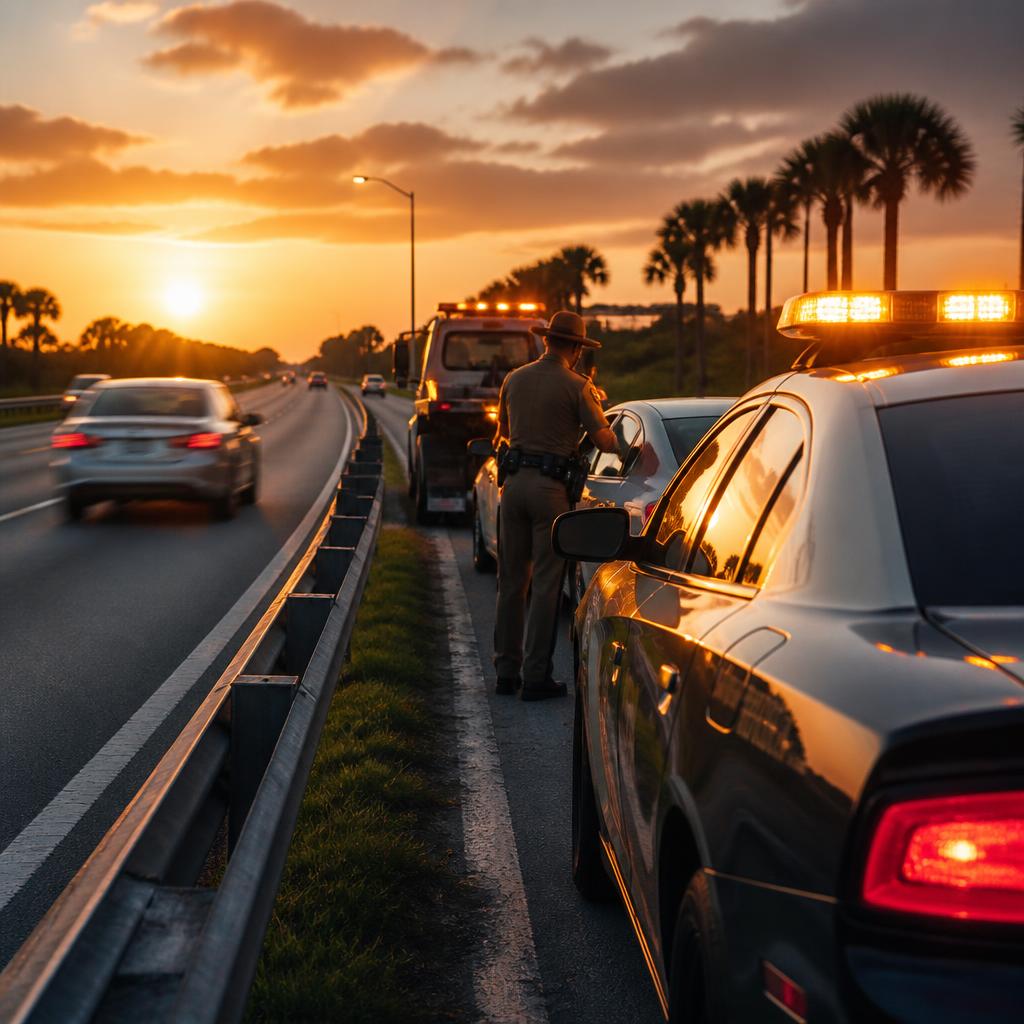
If you drive on I-95, the Palmetto, the Turnpike, or any Miami surface street, Florida's Move Over Law affects you every day. It tells you exactly what to do when you approach a stopped emergency vehicle, tow truck, utility crew — and, since January 1, 2024, any disabled vehicle displaying warning signals. Get it wrong and you face a moving violation, points, and, if a crash results, a serious civil liability problem.
This 2026 guide from The Farber Law Firm in Miami explains the current text of Fla. Stat. § 316.126, what changed in the last legislative expansion, the penalties Miami-Dade drivers are actually receiving, and how a Move Over violation is used as evidence of negligence in a Florida car accident claim.
What the Florida Move Over Law Actually Requires
Florida's Move Over Law is codified at Fla. Stat. § 316.126. On a road with two or more lanes traveling in the same direction, when you approach a stopped authorized vehicle displaying flashing, blue, red, amber, or white warning lights, you must vacate the lane closest to that vehicle as soon as it is safe. If you cannot move over — because traffic, a barrier, or road conditions make it unsafe — you must slow to a speed 20 mph below the posted limit. On a road posted at 20 mph or less, you must slow to 5 mph.
On a two-lane road (one lane in each direction), moving over is not required. Instead, you must reduce speed by the same formula: 20 mph under the limit, or 5 mph if the limit is 20 or less.
Who You Must Move Over For in 2026
The list of vehicles covered by § 316.126 has grown substantially. As of 2026, drivers must move over or slow down for: - Law enforcement, fire, emergency medical, and ambulance vehicles - Sanitation and utility service vehicles - Tow trucks and wreckers displaying amber lights - Florida Department of Transportation and road/bridge maintenance vehicles - Any disabled motor vehicle stopped on the roadside displaying hazard lights, emergency flares, or emergency signage, or with visible signs of a crash
The last item is the big one. Effective January 1, 2024, the Florida Legislature expanded § 316.126 (through SB 194 / Chapter 2023-174) to cover ordinary disabled vehicles. That means a stalled car on the shoulder of the Dolphin Expressway now triggers the same duty as a Florida Highway Patrol trooper on a traffic stop. This expansion was a direct response to a rise in roadside fatalities in Florida.
Penalties: What a Ticket Actually Costs in Miami-Dade
A Move Over violation is a noncriminal moving traffic infraction. In Miami-Dade County the base fine is typically around $124, but with statutory add-ons and court costs many drivers end up paying closer to $158 or more. The Department of Highway Safety and Motor Vehicles assesses 3 points against your driver license.
If the violation results in a crash, the fine increases. If it causes serious bodily injury or death, the driver can face significantly higher penalties and, in aggravated cases, additional charges under Florida's careless or reckless driving statutes.
Why the Move Over Law Matters in a Miami Injury Claim
Even if no ticket is issued, a Move Over violation is powerful evidence in a civil case. Florida follows a modified comparative negligence system under Fla. Stat. § 768.81, as amended by HB 837 in March 2023: a plaintiff who is more than 50% at fault recovers nothing, and any recovery is reduced by the plaintiff's percentage of fault.
In a shoulder-strike or sideswipe case, a driver who failed to move over or slow down is almost always assigned a large share of fault. The statute creates a clear standard of conduct, and violating a safety statute designed to protect a specific class of people (roadside workers, disabled motorists, first responders) is treated by Florida courts as evidence of negligence.
For families of tow operators, FHP troopers, or stranded motorists killed on Florida shoulders, the Move Over Law is frequently the backbone of a Florida Wrongful Death Act claim under Fla. Stat. §§ 768.16–768.26.
What To Do If You Are Hit While Stopped on a Florida Shoulder
If you are the person on the shoulder — a driver waiting for a tow, a passenger changing a tire, a utility worker, or a first responder — and you are struck by a passing vehicle, take these steps to protect both your health and your claim: - Call 911 immediately and request Fire Rescue, even if you feel okay. Adrenaline masks serious injuries. - Ask the responding agency (FHP, Miami-Dade Police, City of Miami Police) to document whether the striking driver moved over or slowed down. - Photograph the scene: hazard lights on your vehicle, flares or triangles, skid marks, the position of both vehicles, and any visible warning lights. - Get names and phone numbers of witnesses, including the tow operator or trooper if one was present. - Do not give a recorded statement to the other driver's insurance carrier before speaking with a Florida personal injury attorney. - See a doctor the same day. Under Florida's PIP statute (Fla. Stat. § 627.736), you must obtain initial medical treatment within 14 days of the crash to preserve your PIP benefits.
What To Do If You Are the Driver Approaching a Stopped Vehicle
Approaching is where most violations happen. Practical guidance the Florida Highway Patrol reinforces every year: - Scan far ahead. Flashing lights are visible long before you reach them; start planning your lane change early. - Signal, check your blind spot, and move one lane away from the shoulder if it is safe. - If you cannot move over, brake smoothly to 20 mph below the posted limit — abrupt braking causes secondary rear-end crashes. - Do not stare at the emergency scene. Target fixation drifts your vehicle toward what you are looking at. - Assume there is a person outside the stopped vehicle, even if you do not see one.
Common Misconceptions Miami Drivers Have
A few points come up constantly in intake calls at our Coral Gables office: - It only applies to police cars. Wrong since long before 2024, and clearly wrong now that disabled vehicles are covered. - I do not have to move over if I am in the far-right lane and the vehicle is on the left shoulder. Wrong — the duty runs to the lane closest to the stopped vehicle, whichever side that is. - Slowing down is optional if I move over. You must do one or the other; if you move over successfully, the speed reduction is not additionally required, but you still owe ordinary care. - The 20-mph reduction is only a guideline. It is the statutory rule. An officer can and will cite based on radar or pace.
How The Farber Law Firm Handles Move Over Cases
Our firm handles Florida car accident and wrongful death claims arising from Move Over violations on I-95, I-75, the Palmetto Expressway, the Dolphin Expressway, the Florida Turnpike, US-1, and surface streets across Miami-Dade and Broward. We work with accident reconstruction engineers, obtain event data recorder (black box) downloads, subpoena dashcam and body-worn camera footage from FHP and local agencies, and pursue every available layer of coverage — the at-fault driver's bodily injury liability, the client's uninsured/underinsured motorist coverage, and, where applicable, commercial policies covering tow operators, utility contractors, or fleet vehicles.
If you or a family member was hurt while stopped on a Florida shoulder, or if you were involved in a Move Over Law crash anywhere in South Florida, call The Farber Law Firm at 8888-FARBER for a free, confidential case review. There is no fee unless we recover for you.
How the Move Over Law Has Evolved — 2002 to 2026
Florida enacted its first Move Over Law in 2002 (Chapter 2002-235), covering only stopped law-enforcement vehicles. The statute was expanded in 2007 to include emergency, sanitation, utility, and wrecker vehicles. In 2014, road-and-bridge maintenance and construction vehicles were added. In 2021, the Legislature added a specific reference to Florida Department of Transportation vehicles. The 2023 expansion under SB 194 (Chapter 2023-174), effective January 1, 2024, was the most significant change in the statute's history — it moved the rule beyond authorized service vehicles and imposed the duty toward ordinary disabled motorists on the shoulder. Understanding which version of § 316.126 applies to a given crash date matters because pre-2024 crashes involving stalled cars on the shoulder were not covered by the statute at all and had to be litigated as ordinary negligence.
Why the 2024 Expansion Happened — the Numbers
The AAA Foundation for Traffic Safety has documented that roughly one person is struck and killed on a U.S. roadside every day, with tow-truck operators and law-enforcement officers historically overrepresented in the fatality statistics. Florida ranked among the top three states for roadside worker fatalities in the years preceding the 2024 amendment, and disabled-motorist deaths on Florida shoulders were rising even faster than fatalities among uniformed responders. Legislative testimony in support of SB 194 cited data from the Florida Highway Patrol showing that the majority of shoulder-strike fatalities in 2021 and 2022 involved ordinary disabled vehicles, not authorized service vehicles — the population the earlier statute did not reach. The expansion was intended to close that gap and to give prosecutors and civil plaintiffs a clear statutory violation to point to in stalled-vehicle strike cases.
Interstate and Highway-Specific Enforcement Patterns in Miami-Dade
Move Over enforcement in Miami-Dade concentrates on specific corridors. Florida Highway Patrol Troop E runs regular saturation patrols on I-95 between the Golden Glades interchange and downtown Miami, on the Palmetto Expressway (SR 826) between the Airport and Hialeah, on the Dolphin Expressway (SR 836) approaching the Airport, and on the Homestead Extension of the Florida Turnpike. Miami-Dade Police Department participates through a state-funded traffic-safety task force during quarterly enforcement waves. Body-worn and dashcam footage from these patrols is a public record and is essential evidence in any subsequent civil case — the video captures both the violation and the vehicle license plate for immediate insurance identification. Preservation requests to the individual agency should be sent within days; routine deletion cycles on non-critical footage can run as short as 30 days.
Anatomy of a Shoulder-Strike Reconstruction
Accident reconstruction of a Move Over violation crash relies on a specific evidence set that must be collected quickly. The event data recorder in the striking vehicle records speed, throttle position, brake application, steering-wheel angle, and seat-belt-buckle state for the seconds before impact. Scene photographs document skid marks, yaw marks, gouges, debris fields, and the final rest position of both vehicles — these disappear with the first heavy rain. Roadway measurements (lane width, shoulder width, distance from the fog line to the stopped vehicle, visibility from the approach direction) tie the physical evidence to the § 316.126 duty. Nighttime cases require photometric analysis of the ambient lighting, the emergency lights on the stopped vehicle, and the striking vehicle's headlamp coverage. A qualified accident reconstruction engineer paired with a human-factors expert (perception-reaction time, target-detection distance, glance behavior) produces the opinion testimony that carries the causation element at trial.
Trucking Cases — When the Striking Vehicle Is Commercial
A significant fraction of fatal shoulder strikes involve heavy trucks. Federal Motor Carrier Safety Regulations (49 C.F.R.) impose independent duties on commercial drivers to maintain a proper lookout, control speed for conditions, and adjust for reduced visibility. A commercial driver who fails to move over or slow down commits a § 316.126 violation in state court and, simultaneously, exposes the motor carrier to negligent-hiring, negligent-training, negligent-retention, and negligent-supervision claims under Florida common law. Hours-of-service logs (electronic logging devices under 49 C.F.R. § 395.8), driver-qualification files, safety-training records, and prior citation history become the discovery focus. Truck EDRs record 30 seconds to 5 minutes of pre-crash data depending on the manufacturer — significantly more than passenger-car EDRs — and are the single most important preservation target in commercial-vehicle move-over cases.
Wrongful Death Under the Florida Wrongful Death Act
Fatal Move Over cases proceed under §§ 768.16–768.26. The personal representative of the estate is the sole party who may bring the action. Recoverable damages include the value of lost support and services to survivors, loss of companionship and protection for a surviving spouse, loss of parental companionship for minor children, mental pain and suffering for a parent of a deceased minor and for children of a deceased parent, medical and funeral expenses, and the estate's lost prospective net accumulations. Punitive damages under § 768.72 are available where the striking driver's conduct rises to gross negligence — high-speed inattention on a well-lit shoulder with visible emergency lights often supports a punitive-damages claim, and post-HB 837 caps under § 768.73 apply. Miami-Dade jury verdicts in fatal-shoulder-strike cases have historically ranged from mid-six figures to eight figures depending on liability clarity and the survivor pool.
Coverage Layers to Identify Immediately
- Striking driver's bodily injury liability — Florida does not mandate BI coverage on private passenger vehicles (only PDL and PIP), so the striking driver may be uninsured for BI purposes. This is a shockingly common finding in Florida shoulder-strike cases.
- Striking driver's employer coverage — commercial and business auto policies with $1 million or more in liability, if the driver was in the course of employment.
- The victim's own UM/UIM policy — the primary source of recovery when the striking driver has no BI coverage. Stacking rules under § 627.727 apply to households with multiple vehicles.
- Umbrella policies — personal and commercial umbrellas above the primary auto layer.
- Employer policies for the person on the shoulder — a tow operator, utility worker, or first responder struck in the course of duty may have workers' compensation and, in fatal cases, occupational-death benefits that stack on the civil recovery subject to § 440.39 subrogation.
Insurance-Company Playbook You Should Expect
- Rapid recorded-statement requests from the striking driver's carrier — decline until counsel is retained.
- Attempts to blame the person on the shoulder for standing outside the vehicle, for parking too close to the travel lane, or for failing to deploy triangles or flares — these are comparative-fault arguments that reduce recovery under § 768.81, and after HB 837 can zero it out entirely if allocated above 50%.
- Property-only tenders on the disabled vehicle to lock in a release before the injury claim matures.
- Social-media harvesting of the injured worker or family within 48 hours of the incident.
- Independent medical examinations (IMEs) under § 627.736(7) aimed at limiting future-care claims — attend with counsel and treating physicians briefed.
Case Study Composite — Tow Operator Struck on I-95
A 42-year-old tow operator is hooking up a disabled sedan on the right shoulder of I-95 northbound near the Golden Glades interchange at 11 p.m. Amber strobes are active on the tow truck; the disabled vehicle's hazards are flashing. A pickup truck traveling 65 mph in the right travel lane fails to move over and clips the tow operator, causing multiple fractures and a traumatic brain injury. Analysis in 2026: (1) § 316.126 violation is clear — the tow truck's amber lights and the disabled vehicle's hazards both trigger the duty, and neither move-over nor 20-mph reduction was performed; (2) the striking driver's individual auto policy carries $50,000 in BI coverage — well short of the damages; (3) the tow company's UM/UIM policy is analyzed for stacked coverage across a commercial fleet; (4) workers' compensation covers medical and indemnity benefits with a § 440.39 lien on the civil recovery; (5) dashcam footage from FHP Troop E, subpoenaed within 30 days, captures the failure to move over from a trooper's cruiser two lanes back; (6) an accident reconstruction engineer and a human-factors expert establish that the striking driver had approximately 12 seconds of visible warning; (7) the case is developed toward the striking driver's employer if any commercial use of the pickup can be established, and toward the driver personally as a supplemental defendant on any excess judgment. The most important early move was preserving the dashcam footage and the striking vehicle's EDR before both were routinely purged.
Common Defense Arguments and How They Fail
- 'I could not move over safely.' The statute requires the speed reduction as a fallback; failing to do either is per se non-compliance.
- 'The emergency lights were not visible from that distance.' Photometric analysis using scene-appropriate lighting conditions typically rebuts this claim on a lit interstate corridor.
- 'The person on the shoulder should not have been standing outside the vehicle.' A tow operator, first responder, or utility worker performing the duties of their occupation is not comparatively negligent for standing where the job requires them to stand.
- 'The disabled vehicle should have been moved to a safer location.' A driver of a mechanically incapable vehicle cannot move it further. Even where physical movement was possible, Florida courts do not treat the choice of parking location on a limited-access highway as a defense to a shoulder strike.
Frequently Asked Questions
What is the Florida Move Over Law in 2026?
Under Fla. Stat. § 316.126, drivers on a multi-lane Florida road must vacate the lane closest to a stopped emergency, utility, tow, maintenance, or disabled vehicle displaying warning signals. If moving over is not safe, drivers must slow to 20 mph below the posted speed limit (or 5 mph if the posted limit is 20 mph or less).
Does the Florida Move Over Law apply to disabled vehicles?
Yes. Effective January 1, 2024, the Legislature expanded § 316.126 to cover any disabled motor vehicle stopped on the roadside that is displaying hazard lights, flares, emergency signage, or visible signs of a crash. It no longer applies only to law enforcement and service vehicles.
What is the fine for violating the Move Over Law in Miami-Dade?
The base fine is a noncriminal moving violation of roughly $124, but with court costs and statutory add-ons Miami-Dade drivers commonly pay closer to $158 or more, plus 3 points on their driver license. Fines are higher if the violation causes a crash.
Can a Move Over Law violation be used against a driver in a Florida injury lawsuit?
Yes. Violation of a safety statute is strong evidence of negligence in Florida civil cases. Under Florida's modified comparative negligence rule (Fla. Stat. § 768.81, as amended by HB 837 in 2023), a driver who failed to move over is typically assigned a large share of fault, and a plaintiff more than 50% at fault recovers nothing.
Do I still have to move over on a two-lane road?
No — moving over is not required on a two-lane road (one lane in each direction). Instead, you must reduce speed by 20 mph below the posted limit, or slow to 5 mph if the posted limit is 20 mph or less.
How long do I have to file a Move Over Law crash claim in Florida?
For crashes occurring on or after March 24, 2023, Florida's statute of limitations for negligence-based personal injury claims is generally two years under Fla. Stat. § 95.11(4)(a), as amended by HB 837. Wrongful death claims must generally be filed within two years under § 95.11(4)(d). Deadlines can shorten in specific situations, so consult a Florida attorney promptly.
What insurance covers me if I am struck while broken down on a Florida shoulder?
Multiple layers usually apply. The striking driver's bodily injury liability responds first, but Florida does not require BI coverage on private passenger vehicles, so the striking driver may be uninsured. Your own uninsured/underinsured motorist coverage on your auto policy is often the primary source of recovery in that scenario, subject to stacking rules under § 627.727. If you were on the shoulder in the course of employment (a tow operator, first responder, or utility worker), workers' compensation applies with a § 440.39 subrogation lien on any civil recovery.
Can I recover punitive damages after a Florida Move Over Law crash?
Sometimes. Under Fla. Stat. § 768.72, punitive damages require clear and convincing evidence of intentional misconduct or gross negligence. High-speed inattention on a lit interstate shoulder with clearly visible emergency lights often supports a punitive-damages claim. The pleading must be authorized by the court after a proffer, and post-HB 837 caps under § 768.73 apply (generally the greater of three times compensatory damages or $500,000, with higher caps for specific-intent-to-harm conduct).
Does the Move Over Law apply to school buses, trash trucks, and mail vehicles?
It applies to sanitation vehicles (trash trucks) displaying warning lights and to any authorized vehicle with amber, red, blue, or white flashing lights operating in a work context on Florida roads. School buses are governed by a separate statute (§ 316.172) that requires all traffic to stop for buses displaying stop signals; mail vehicles displaying hazard lights on the shoulder are covered under the 2024 expansion of § 316.126 to include disabled and stopped vehicles with warning signals.
What if I am the disabled motorist and the striking driver blames me for being on the shoulder?
Comparative-fault arguments against the disabled motorist are common but typically weak. Florida law does not treat the lawful use of a highway shoulder as negligence, especially when the vehicle is mechanically incapable of moving. Where hazard lights, triangles, or flares were deployed and the vehicle was fully off the travel lane, allocation of significant fault to the disabled motorist rarely survives a defense-verdict challenge. Preserve scene photos, tow-service records, and any 911 recording that documents the pre-strike positioning of the vehicle.
Have a similar situation?
Free, confidential case review with a South Florida trial attorney. Call 8888-FARBER.
Request a Free ConsultationAbout the Author
The Farber Law Firm, P.A.
The Farber Law Firm is a South Florida trial practice based in Coral Gables, representing injured people, policyholders and businesses across Miami-Dade, Broward and Palm Beach counties since 1995. The firm handles personal injury, wrongful death, insurance coverage disputes and commercial litigation, and its attorneys are members in good standing of The Florida Bar.
Articles on this site are written and reviewed by attorney David Farber and reflect Florida statutes, court rules and Florida Bar regulations current as of the publication date.
- Office
- 2199 Ponce de Leon Blvd #301
Coral Gables, FL 33134 - Phone
- 8888-FARBER
- Consultations
- Free and confidential