Florida Parking Lot Accident Laws: Who Pays When Someone Hits Your Parked Car?
Someone hit your parked car in Florida? Learn who may pay, collision versus liability coverage, hit-and-run steps, evidence, and 2026 reporting and filing rules.
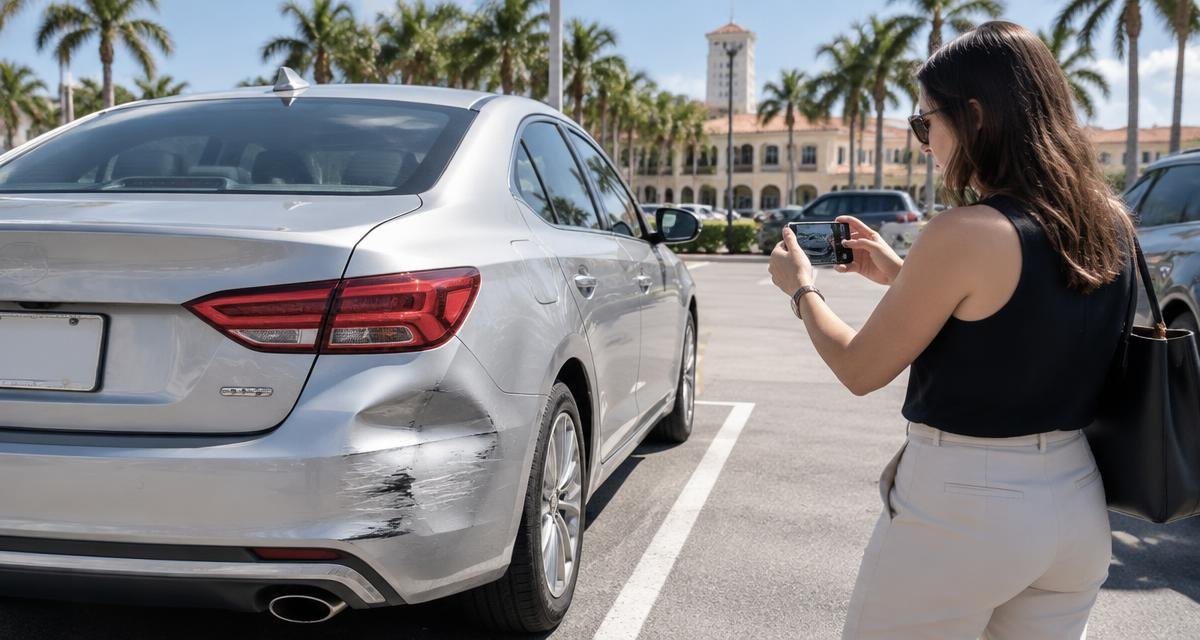
Finding a dented bumper after grocery shopping, work, or a beach visit is frustrating, especially when the other driver is gone. You may be left with repairs, towing charges, and questions about whether your insurance will pay. In Florida, the answer depends on evidence of responsibility, the insurance available, and the terms of each policy—not simply on whether the collision happened on a public street or in a private parking lot.
This guide addresses parked-car damage in Miami, Coral Gables, Miami Beach, Doral, Kendall, Fort Lauderdale, West Palm Beach, and throughout Florida. It also distinguishes damage to an unattended vehicle from injuries suffered by someone sitting in a parked car. Legal sources were checked against the official materials available on October 20, 2026. This is general educational information, not a determination of fault, coverage, or a filing deadline. The article image is illustrative, not a client incident or evidence of a firm result.
Quick Answer: Who Pays When Someone Hits Your Parked Car in Florida?
If another driver negligently hits your parked car, that driver may be legally responsible for the resulting damage. Their property damage liability insurance may pay a covered claim, subject to proof of fault, policy limits, and coverage conditions. If the driver is unknown, uninsured, or disputes responsibility, your own collision coverage may provide a repair or total-loss payment, usually subject to a deductible. Florida's no-fault personal injury protection, or PIP, does not pay to repair your car. Without applicable coverage or an identifiable responsible party, you may have to pay the repair bill yourself.
Who Might Pay? Common Parking-Lot Scenarios
| Situation | Possible payment source | Important qualification |
|---|---|---|
| Another driver hits your legally parked car and stays | Their property damage liability coverage | Fault, coverage, and the amount of damage still require evaluation |
| Someone hits your parked car and leaves | Your collision coverage, if purchased | A deductible and policy conditions usually apply; police reporting can help document the incident |
| The responsible driver has no applicable insurance | Your collision coverage or a claim against a liable party | A judgment does not guarantee that money can be collected |
| The other insurer delays or disputes the claim | Your collision coverage may provide an alternative | Your insurer may pursue reimbursement; deductible recovery is not guaranteed |
| Your parked vehicle contributed to the collision | Available coverage and liability depend on the evidence | A parking violation alone does not settle civil fault |
| You were sitting inside and suffered an injury | Potential PIP, bodily injury liability, or UM benefits | Injury coverage is separate from payment for the damaged vehicle |
| A tree branch, flooding, or vandalism damaged the car | Comprehensive coverage may apply | These are different events from another vehicle striking your car |
1. Florida No-Fault Insurance Does Not Decide Who Pays for Car Repairs
Florida's registration insurance requirements generally include at least $10,000 in PIP and $10,000 in property damage liability coverage. These are different protections. PIP addresses qualifying injuries and related benefits for covered people. Property damage liability addresses damage an insured person causes to someone else's property. Neither minimum requirement automatically provides collision insurance for your own vehicle. See FLHSMV's Florida insurance requirements and Fla. Stat. § 324.022.
The $10,000 property damage minimum is not a guaranteed payment to each claimant. A single crash may damage several cars, a building, or other property, and the available limit may be shared. The actual policy may carry higher limits or present a coverage issue. Ask the insurer to explain the relevant coverage and do not assume an insurance card proves that every loss will be paid.
A person pursuing vehicle repairs does not need to establish a permanent bodily injury simply to bring a property damage claim. Florida's injury threshold for specified noneconomic damages is a separate question under Fla. Stat. § 627.737.
2. Does Insurance Cover a Parked-Car Hit-and-Run?
Collision coverage generally addresses damage to your own vehicle caused by a collision, including a covered incident in which another vehicle strikes it while parked. Depending on your policy, it may be useful when you cannot identify the other driver or while the other insurer investigates. Collision is optional coverage rather than part of Florida's basic PIP and property damage liability minimums. Review your declarations page, deductible, exclusions, and reporting conditions.
Comprehensive coverage generally addresses specified non-collision risks such as theft, vandalism, flooding, or falling objects. It is not ordinarily the coverage for another car backing into your bumper. A scraped car with no witness can raise uncertainty about what happened; report your observations accurately rather than choosing a cause solely because one coverage has a lower deductible. The Florida Department of Financial Services Automobile Insurance Toolkit explains these coverage distinctions.
Do not assume Florida uninsured motorist coverage will repair your car. Standard Florida UM coverage principally concerns bodily injury caused by uninsured or underinsured motorists, not a general vehicle-repair benefit. Ask your insurer whether any separate property damage endorsement applies. The governing UM statute is Fla. Stat. § 627.727.
3. What Should You Do Immediately After Discovering the Damage?
- Check for danger. Call 911 for an emergency, injuries, or an immediate safety threat. Do not confront or chase a departing driver.
- Photograph the scene before moving the car if it is safe. Capture the parking space, lines, signs, damage, debris, nearby vehicles, and any note left behind.
- If the other driver is present, exchange identifying, registration, and insurance information. Record what each person says without arguing about fault.
- Contact the appropriate local police agency and explain the circumstances. Ask how the incident should be documented and obtain a report or incident number if available.
- Ask nearby businesses, building management, or parking security to preserve video for the relevant time window. Obtain witness names and contact information.
- Notify your insurer promptly, even if you also pursue the other driver's insurer. Keep your claim number, written communications, and reporting confirmation.
- Arrange a qualified inspection. Do not drive a vehicle with unsafe tires, leaking fluids, damaged lights, or other suspected safety problems.
- Save estimates, towing and storage invoices, rental receipts, and repair records. Ask about inspection requirements before repairs remove evidence.
If you did not see the collision, distinguish what you know from what you infer. A discovery time is not necessarily the impact time. A nearby vehicle with a scratch is not proof that its driver hit your car. Original photos, video, and independent witnesses are more useful than guesses or accusations posted online.
4. What Must a Driver Do After Hitting an Unattended Car?
Under Fla. Stat. § 316.063, a driver who damages an unattended vehicle must stop and either locate and notify the owner or operator, or securely leave a conspicuous written notice. The required information includes the driver's name and address and the registration number of the vehicle being driven. The driver must also notify the nearest authorized police office without unnecessary delay. Leaving only a phone number is not the full statutory description of what is required.
The unattended-property provision applies to any damage described by that section; it is not conditioned on the separate dollar threshold for general crash notification. A private parking lot is not permission to leave without complying. FLHSMV's hit-and-run guidance discusses the duty to stop after crashes on public or private property. Criminal enforcement and civil payment are separate: a leaving-the-scene investigation does not itself establish the amount an insurer owes.
5. Do You Need a Police Report for a Parking-Lot Accident?
Contact local law enforcement to document a suspected hit-and-run, injuries, disputed facts, or significant damage. The official 2026 text of Fla. Stat. § 316.065 requires immediate notice by a driver involved in a crash causing injury, death, or apparent vehicle or property damage of at least $2,000. Older online summaries may still quote $500; use the current statute rather than treating an older summary as current law. The separate unattended-property reporting duty under § 316.063 still matters even below the general dollar threshold.
Report format is a different issue. Fla. Stat. § 316.066 identifies circumstances requiring an officer's long-form report, such as injury or complaints of pain, specified violations, an inoperable vehicle requiring a wrecker, or a commercial motor vehicle. Its short-form or exchange-of-information provision expressly addresses public roadways. Do not assume every minor private-lot incident produces the same report or that officers must attend every incident. Follow the agency's instructions about any applicable self-report process.
A report can support the timeline and identify parties, but it is not a guarantee that the insurer will accept liability. If no officer responds, retain your own photographs, witness information, management incident record, and notice to the carrier. Lack of an officer's report does not automatically make every insurance claim invalid.
6. How Is Fault Determined in a Florida Parking Lot?
A driver must use reasonable care when backing out, turning into a space, or traveling through a parking aisle. Evidence that a car was stationary and properly parked can strongly support the owner's account, but there is no useful blanket rule that every parking-lot crash is 50/50 or that the moving driver automatically pays in every case. Relevant evidence includes vehicle positions, sight lines, markings, signs, video, witness accounts, impact location, and whether a door or vehicle movement contributed.
Parking outside the lines or in a prohibited area can be relevant if it actually contributed to the collision. A parking citation is not a substitute for analyzing causation. Likewise, a backing collision may involve more than one moving vehicle and cannot be evaluated as though both were stationary.
Fla. Stat. § 768.81 generally reduces damages in a negligence action according to the claimant's share of fault and bars recovery if the claimant is greater than 50% at fault, subject to applicable exceptions. The claim, accident date, and governing law require individual review. An insurer's initial percentage is a position to evaluate, not necessarily a final legal determination.
7. What Costs Can a Parked-Car Damage Claim Include?
A supported claim may include reasonable repair costs or the vehicle's value if it is a total loss, together with other legally recoverable or contractually covered expenses. Towing, storage, and reasonable loss-of-use or rental costs can be disputed based on necessity, duration, rates, fault, and policy terms. Keep receipts and ask promptly about storage charges so they do not grow unchecked. Rental reimbursement under your own policy is separate optional coverage and may have daily and total limits.
Repairing a vehicle does not automatically restore its pre-crash market value. A diminished-value claim may be appropriate in some circumstances, particularly against a responsible third party, but it requires evidence and is not a fixed percentage or automatic benefit under every policy. Pre-existing damage, mileage, repair quality, and the vehicle's history can matter. Do not add a speculative figure merely because an online calculator provides one.
For a total loss, review the valuation, comparable vehicles, mileage, options, condition adjustments, and any applicable taxes or fees. A loan balance and a vehicle's insured value are different numbers. Gap coverage, if purchased and applicable, may address some of that difference; it does not guarantee every loan-related charge will be paid. Avoid signing a broad release without understanding whether it also affects an injury or other unresolved claim.
8. Should You Use Your Own Insurance or the Other Driver's?
A third-party property damage claim may avoid paying your own collision deductible if the responsible driver's insurer accepts liability and applicable coverage is available. However, an investigation, disputed account, or inadequate limit can delay payment. Your own collision claim may be a practical alternative, subject to the deductible and policy terms. There is no single best route for every owner.
If your insurer pays a covered claim, it may seek reimbursement from a responsible party through subrogation. It may also seek some or all of your deductible, depending on the circumstances. Do not promise yourself a refund before recovery occurs. Coordinate settlements with your carrier so you do not impair its rights, and disclose payments already received: you cannot recover twice for the same loss. Ask your insurer or agent how a claim may affect premiums rather than assuming that every not-at-fault claim has no pricing consequences.
9. What If the Insurer Denies, Underpays, or Delays the Claim?
Request the carrier's position in writing. Identify whether the dispute concerns who caused the crash, whether the policy covers the driver or vehicle, the repair scope, valuation, exclusions, or limits. Provide organized supporting evidence and ask the adjuster to explain disputed line items. A delay is not automatically bad faith, and disagreement about an estimate does not automatically establish wrongdoing.
Your own policy may contain an appraisal procedure for certain disputes about the amount of loss; it does not necessarily resolve coverage or apply to a third-party claim against another driver's carrier. The Florida Department of Financial Services offers consumer insurance assistance. A complaint or informal negotiation does not replace a lawsuit when one is needed and should not be assumed to suspend deadlines.
Some repair-only claims can be handled directly without an attorney. Legal review becomes more useful when fault is contested, an injury is involved, coverage is denied, valuation is substantial, multiple parties are involved, or a release or deadline raises concerns. Whether litigation is economically practical depends on the amount disputed, available evidence, fees, and collectability.
10. What Are the Florida Filing Deadlines?
Act promptly rather than treating a lawsuit deadline as the date to begin an insurance claim. Policies may require prompt notice and cooperation. Video may be overwritten, vehicles may be repaired, and witnesses may become difficult to locate long before a limitations period expires.
Fla. Stat. § 95.11 contains a two-year period for actions founded on negligence and a four-year provision for taking, detaining, or injuring personal property. A collision involving both injuries and vehicle damage can raise different claim classifications and deadline questions. Do not select the longer period simply because the loss involves a car, or assume every claim arising from a crash has the same deadline. Have counsel identify the applicable cause of action, accrual date, and any exceptions; seek advice well before two years after a recent crash. Older incidents, government defendants, contract claims, and other circumstances may involve additional rules.
Miami and South Florida: Preserving Local Evidence
In Miami-Dade, useful evidence may come from a shopping center's security team, a condominium garage, a valet operator, an employer, or nearby storefront cameras. Contact the business that actually controls the recording and give a specific date, time range, parking level, and bay or aisle location. Ask for preservation promptly; a request does not guarantee that video exists or that it can be released without further process.
If a valet, delivery driver, rental vehicle, or employee was involved, identify the driver, vehicle owner, business, and applicable insurance rather than assuming one party is automatically liable. Employment and vehicle-ownership facts can affect responsibility. Similarly, a property owner does not automatically owe payment just because a collision occurred on its premises; a claim against that owner requires an independent legal basis supported by evidence.
Trusted Sources for Florida Drivers
- Florida Legislature: duty after damaging an unattended vehicle, § 316.063.
- Florida Legislature: crash notification, § 316.065, and crash reports, § 316.066.
- FLHSMV: Florida insurance requirements.
- Florida Department of Financial Services: Automobile Insurance Toolkit.
- Florida Legislature: uninsured motorist coverage, § 627.727.
- Florida Legislature: comparative fault, § 768.81, and limitations periods, § 95.11.
How The Farber Law Firm Can Help
When a parking-lot collision involves an injury, a disputed claim, or a complicated insurance question, a focused legal review can help clarify the issues before you accept a settlement. The Farber Law Firm, P.A. handles Florida personal injury and insurance dispute matters. The firm can assess whether your situation falls within its practice and whether representation is appropriate; a routine repair-only dispute may be better addressed directly with the insurer. Acceptance of any matter requires the firm's review and a signed written engagement.
Explore the firm's Miami car accident services, personal injury practice, and insurance coverage dispute services. For other legal needs, visit Business Law, Consumer Protection, Employment Law, or the complete services page.
Request a free consultation to discuss whether the firm can assist, or call 305-774-0134 or 8888-FARBER. The principal office is 2199 Ponce de Leon Blvd #301, Coral Gables, FL 33134. Share a brief, non-confidential description first; do not send sensitive records until the firm confirms a secure method. An inquiry is not representation and does not preserve a filing deadline. Fees and costs, if a matter is accepted, are governed by the written engagement agreement. No result or insurance payment is guaranteed.
Frequently Asked Questions
Someone hit my parked car and left. Who pays in Florida?
Your collision coverage may pay for a covered loss, subject to a deductible and policy terms. If the responsible driver is later identified, a liability claim may also be possible. Without applicable coverage or an identifiable liable party, you may have to pay repairs yourself.
Does PIP cover damage to my parked car?
No. PIP provides qualifying injury-related benefits for covered people; it is not vehicle-repair coverage. Vehicle damage may involve the other driver's property damage liability insurance or your collision coverage.
Is the person who backs into a parked car always at fault?
Not automatically. A stationary, properly parked vehicle can provide strong evidence, but positions, movement, visibility, an opened door, and other contributing conduct matter. Parking-lot crashes are not automatically split 50/50.
Is leaving a note enough after hitting an unattended car?
Section 316.063 requires stopping, notifying the owner or leaving a conspicuous written notice containing the specified identifying information, and notifying the nearest authorized police office without unnecessary delay. A phone number alone does not fulfill the entire statutory description.
Does comprehensive insurance cover another car hitting mine while parked?
Collision is ordinarily the coverage for another vehicle striking your car. Comprehensive generally concerns specified non-collision losses such as theft, vandalism, or falling objects. Your policy and the actual cause of damage control.
Does Florida uninsured motorist coverage pay for my bumper?
Standard Florida UM coverage principally concerns bodily injuries, not ordinary car-repair costs. Check for any separate property damage endorsement rather than assuming UM coverage replaces collision insurance.
What is the general crash-notification damage threshold in the 2026 statute?
The official 2026 text of section 316.065 specifies apparent vehicle or property damage of at least $2,000, as well as injury or death. The separate duty after damaging unattended property in section 316.063 is not conditioned on that dollar threshold.
Will I get my collision deductible back?
Possibly, if your insurer obtains reimbursement from a responsible party and the circumstances support deductible recovery. Recovery and timing are not guaranteed; ask your adjuster about the process.
Can I claim rental costs or diminished value?
These may be available where supported by the facts, applicable law, and coverage. Rental reimbursement under your policy can have separate limits. Diminished value is not an automatic percentage or a benefit included in every policy.
How long do I have to sue over damage to a parked car?
Section 95.11 includes a two-year negligence period and a four-year provision concerning injury to personal property. The correct period depends on the claim and facts; do not assume the longer period applies. Obtain individual legal advice well before two years after a recent collision.
Do I need a lawyer for a minor parking-lot repair claim?
Not necessarily. Straightforward repair claims may be resolved directly. Consider legal review for injuries, contested fault, coverage denials, substantial valuation disputes, or questions about releases and deadlines. The firm must separately decide whether to accept representation.
Have a similar situation?
Free, confidential case review with a South Florida trial attorney. Call 8888-FARBER.
Request a Free ConsultationAbout the Author
The Farber Law Firm, P.A.
The Farber Law Firm is a South Florida trial practice based in Coral Gables, representing injured people, policyholders and businesses across Miami-Dade, Broward and Palm Beach counties since 1995. The firm handles personal injury, wrongful death, insurance coverage disputes and commercial litigation, and its attorneys are members in good standing of The Florida Bar.
Articles on this site are written and reviewed by attorney David Farber and reflect Florida statutes, court rules and Florida Bar regulations current as of the publication date.
- Office
- 2199 Ponce de Leon Blvd #301
Coral Gables, FL 33134 - Phone
- 8888-FARBER
- Consultations
- Free and confidential
Florida Legal Insights, in Your Inbox
Subscribe to The Farber Law Firm’s email list for educational articles on Florida injury claims, insurance coverage, and consumer rights.
By subscribing, you request legal insights by email. This is not a consultation request and does not create an attorney-client relationship. Privacy Policy.