Injured by a Delivery Robot or Autonomous Vehicle in Miami? Who Is Legally Responsible?
Hit by a sidewalk delivery robot or self-driving car in Miami? Learn who may be liable under 2026 Florida law, the $100,000 vs. $1,000,000 insurance rules, PIP gaps, comparative fault, and how to preserve critical digital evidence.
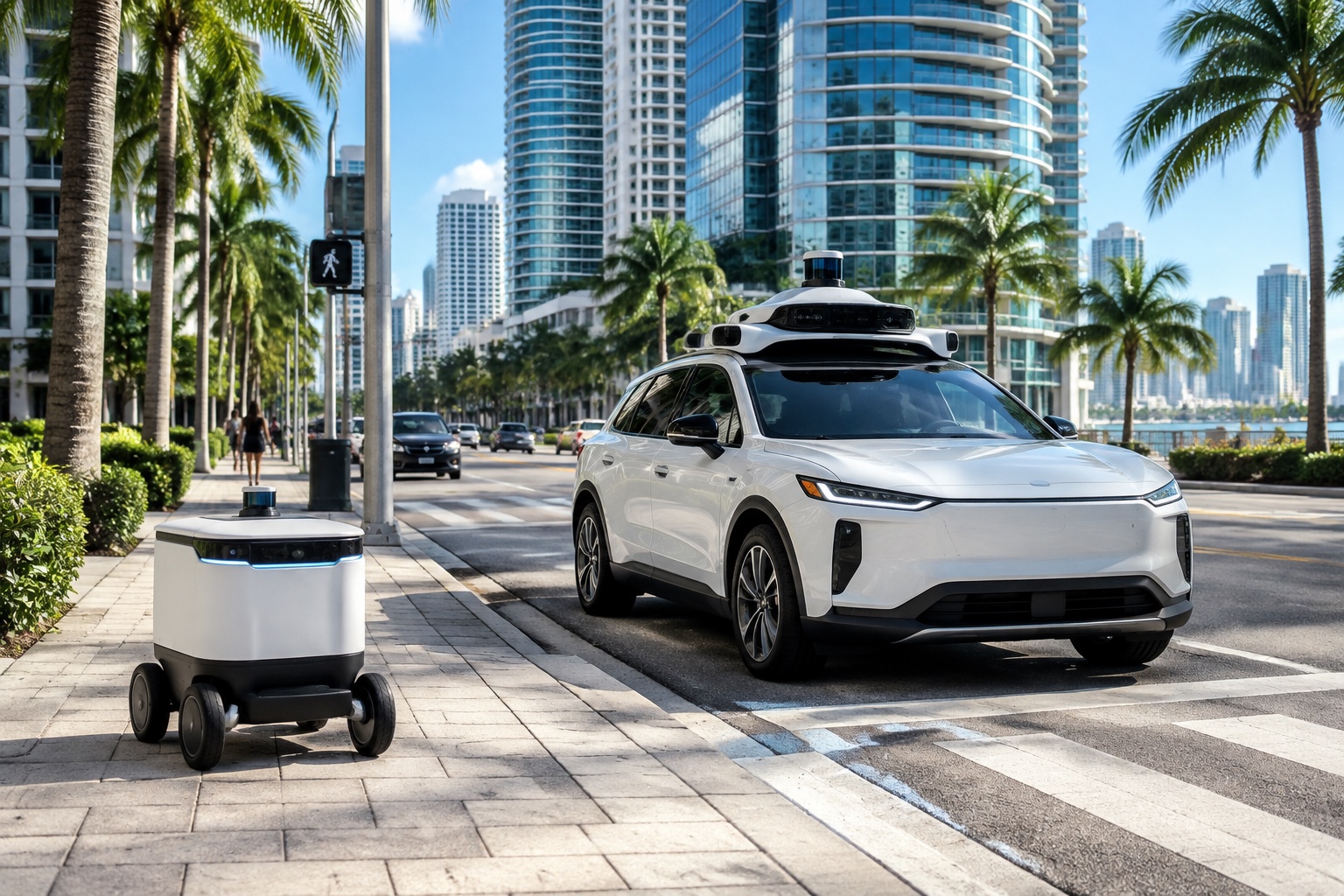
Quick Answer: Who Is Legally Responsible When a Delivery Robot or Autonomous Vehicle Injures You in Miami?
Responsibility depends on what struck you and why it failed. Under Florida law, a sidewalk delivery robot is classified as a personal delivery device, and the company that owns and operates it must yield to pedestrians, avoid unreasonably interfering with sidewalk traffic, and carry at least $100,000 in general liability insurance under Fla. Stat. § 316.2071. When a fully autonomous vehicle or robotaxi causes a crash, Florida law treats the engaged automated driving system as the legal operator under Fla. Stat. § 316.85, and an on-demand autonomous vehicle network must maintain at least $1,000,000 in primary liability coverage plus Personal Injury Protection (PIP) and uninsured motorist coverage under Fla. Stat. § 627.749.
In practice, liability rarely stops at a single label. Depending on the facts, legally responsible parties can include the fleet operator, a remote teleoperator monitoring the device or vehicle, the developer of the automated driving software or sensors, a third-party company that converted the car into an autonomous vehicle, a fleet maintenance contractor, or another negligent human driver. Because digital telemetry, camera feeds, and lidar logs can be overwritten quickly, identifying the device or vehicle and preserving evidence right away is often the most important step in a Miami injury claim.
Published November 28, 2026. This guide provides general educational information for pedestrians, cyclists, passengers, and motorists in Miami, Brickell, Coral Gables, Wynwood, Miami Beach, and throughout Florida. It summarizes the Florida statutes cited below as of publication, is not legal advice for any specific incident, does not create an attorney-client relationship, and does not guarantee liability or any financial recovery.
Why Miami Residents Are Encountering More Delivery Robots and Robotaxis in 2026
Autonomous mobility is no longer an experiment in South Florida. Sidewalk food and grocery delivery robots operated by companies such as Serve Robotics and Coco Robotics now roll daily along crowded sidewalks and crosswalks in Brickell, Downtown Miami, and Miami Beach, navigating around strollers, wheelchairs, joggers, and café seating. At the same time, public driverless ride-hailing has arrived on local roads: Waymo opened its fully autonomous robotaxi service to paying riders in Miami in January 2026 across an initial 60-square-mile territory spanning Brickell, Coral Gables, Wynwood, and the Design District.
When an injury occurs with no human driver behind the wheel, injured people face unfamiliar questions. There is no driver to hand you a license and registration card at the curb, fault often turns on software behavior or remote monitoring rather than a simple traffic ticket, and different Florida insurance statutes apply to a 10-mph sidewalk robot than to a full-sized autonomous SUV.
Delivery Robot vs. Autonomous Vehicle Liability in Florida: At a Glance
| Factor | Sidewalk Delivery Robot (Personal Delivery Device) | Fully Autonomous Vehicle / Robotaxi (On-Demand Network) |
|---|---|---|
| Primary Florida statutes | Fla. Stat. § 316.003 and § 316.2071 | Fla. Stat. § 316.85, § 316.86, § 319.145, and § 627.749 |
| Where it may operate | Sidewalks and crosswalks only; may not travel on a roadway except to cross a crosswalk | Public Florida streets and highways, with or without a human inside |
| Speed and right-of-way | Maximum 10 mph; must yield right-of-way to pedestrians and not unreasonably interfere | Must obey all Florida traffic laws; engaged automated driving system is deemed the operator |
| Minimum required insurance | At least $100,000 general liability coverage for combined operations | At least $1,000,000 primary liability, plus PIP and UM/UIM coverage while logged on or on a ride |
| Does Florida auto PIP usually apply? | Usually no, because a personal delivery device is not defined as a motor vehicle | Yes, for covered crashes involving a motor vehicle under Florida no-fault rules |
| Identification at the scene | Must display a plate or marker with a unique device number and operator contact info | License plate, fleet identifier, and statutory duty for vehicle/owner to notify police |
| Primary targets for liability | Device owner/operator, remote monitor, manufacturer, maintenance vendor, or delivery platform | AV fleet operator, ADS software or sensor maker, converter, teleoperator, or maintenance vendor |
This summary draws on Fla. Stat. § 316.003, § 316.2071, § 316.85, § 319.145, and § 627.749. Coverage and liability in an actual case depend on the facts, the applicable contracts, and any additional commercial or umbrella policies.
Florida Law Governing Sidewalk Delivery Robots
What Counts as a Personal Delivery Device
Under Fla. Stat. § 316.003, a personal delivery device is an electrically powered device operated on sidewalks and crosswalks primarily to transport property, within the weight limits set by Florida Department of Transportation rule, with a maximum speed of 10 miles per hour, and equipped to operate with or without active control or monitoring by a natural person. Crucially, the statute states that a personal delivery device is not considered a motor vehicle unless expressly defined by law as one. That single classification changes how insurance claims work after a sidewalk collision.
Statutory Safety Duties on Miami Sidewalks and Crosswalks
Florida law authorizes personal delivery devices statewide on sidewalks and crosswalks, subject to local municipal safety rules allowed under Fla. Stat. § 316.008(7)(b). Under Fla. Stat. § 316.2071, every personal delivery device must follow clear safety requirements:
- Yield the right-of-way to pedestrians on sidewalks and in crosswalks, and never unreasonably interfere with pedestrians or traffic.
- Obey all official traffic and pedestrian control signals and devices.
- Carry a visible plate or marker showing a unique identifying device number plus the name and contact information of the operator.
- Maintain a working braking system capable of bringing the device to a controlled stop.
- Stay off public roadways except as necessary to cross a crosswalk, and never operate on a sidewalk or crosswalk unless an operator is actively controlling or monitoring its navigation.
- Stay off the Florida Shared-Use Nonmotorized Trail Network and Florida Greenways and Trails System under § 316.008(7)(b)2.
Common Miami delivery-robot injury scenarios include a robot failing to yield to a pedestrian stepping out of a Brickell building lobby, colliding with a child or older adult, blocking an ADA curb ramp and causing a trip-and-fall, rolling unpredictably into a crosswalk against a signal, or stopping abruptly in a narrow Miami Beach walkway. Violating a statutory safety duty under § 316.2071 can serve as important evidence of negligence.
The $100,000 General Liability Insurance Floor
Under Fla. Stat. § 316.2071(4), a person or company that owns and operates a personal delivery device in Florida must maintain a general liability insurance policy providing at least $100,000 in coverage for damages arising from the combined operations of devices under its control. While $100,000 is the statutory floor, major robotics operators and partnering delivery platforms often hold higher commercial general liability or excess policies. For a severe fracture, torn ligament, or head injury resulting from a hard sidewalk fall, identifying every applicable corporate policy can make a significant difference.
Florida Law Governing Autonomous Vehicles and Robotaxis
The Automated Driving System Is Legally the Operator
Florida was among the first states to create a broad statutory framework for driverless cars. Under Fla. Stat. § 316.85, a fully autonomous vehicle may operate anywhere in Florida without a licensed human driver physically present. When the automated driving system (ADS) is engaged, Florida law deems the ADS itself to be the operator for traffic-law purposes. Section 316.85(5) also permits operation using a remote teleoperation system without a human inside the vehicle, provided the vehicle satisfies Florida's safety standards.
Safety Certification and the Minimal Risk Condition Duty
Under Fla. Stat. § 319.145, an autonomous vehicle registered in Florida must comply with applicable federal motor vehicle safety standards under 49 C.F.R. part 567 and must be capable of operating in compliance with Florida traffic laws. If the automated driving system experiences a failure that prevents it from performing the full driving task, a fully autonomous vehicle must be able to achieve a minimal risk condition, such as bringing the vehicle to a complete stop in a reasonably safe state and activating hazard lamps. A failure to detect a cyclist, misreading a construction zone on US-1 or I-95, braking abruptly in traffic, or stopping in an active travel lane can raise both negligence and product defect questions.
The $1,000,000 On-Demand Autonomous Network Insurance Mandate
When a fully autonomous vehicle is logged on to an on-demand autonomous vehicle network or engaged in a prearranged ride, Fla. Stat. § 627.749(2) requires automobile insurance providing:
- At least $1,000,000 in primary liability coverage for death, bodily injury, and property damage.
- Personal Injury Protection (PIP) benefits meeting the minimum coverage amounts under Fla. Stat. ss. 627.730 through 627.7405.
- Uninsured and underinsured motorist (UM/UIM) coverage as required by Fla. Stat. § 627.727.
That coverage may be carried by the vehicle owner, the on-demand autonomous vehicle network, or a combination of both. This structure mirrors the commercial coverage tiers that apply to human-driven rideshare vehicles, which we discuss in our Miami Uber and Lyft rideshare accident guide.
The Third-Party Conversion Exemption Every Miami Victim Should Know
One Florida statute catches many claimants by surprise. Under Fla. Stat. § 316.86, if a third party converts an ordinary car into an autonomous vehicle, the original vehicle manufacturer has a statutory defense and must be dismissed from a lawsuit alleging defects caused by the conversion or by autonomous equipment installed by the converter, unless the defect existed in the vehicle as originally manufactured. Suing the wrong corporate entity can waste months against Florida's two-year statute of limitations, so an early investigation into who built the base vehicle versus who integrated the lidar, cameras, and driving software is essential.
Who Can Be Held Legally Responsible? Seven Potentially Liable Parties
In both delivery-robot incidents and autonomous-vehicle crashes, fault frequently spans more than one company. A thorough investigation examines every link in the chain:
- The robotics company or autonomous fleet operator. The entity deploying and operating the robot or robotaxi is typically the primary defendant for negligent operation, improper route mapping, inadequate safety protocols, or violating Florida traffic statutes.
- Remote teleoperators and monitoring contractors. Both personal delivery devices and teleoperated autonomous vehicles can involve off-site human monitors who intervene when a device gets stuck or encounters construction. Delayed or careless remote intervention can support direct and vicarious negligence claims.
- Software, AI, and sensor manufacturers. If a perception algorithm failed to recognize a pedestrian in a crosswalk, a lidar unit malfunctioned, or a braking controller miscalculated stopping distance, the claim may involve Florida product liability theories including design defect, manufacturing defect, or failure to warn.
- Third-party autonomous vehicle converters. When an engineering company retrofits a base vehicle with autonomous hardware, that converter, rather than the original automaker protected by § 316.86, may bear responsibility for conversion-related failures.
- Local fleet maintenance and depot contractors. Autonomous fleets rely on local service partners to clean optical sensors, inspect brakes and tires, swap batteries, and calibrate cameras. Poor local maintenance in Miami heat and rain can cause avoidable collisions.
- Delivery apps, restaurants, or commercial partners. When a delivery robot fulfills an order through a major food or grocery platform, contractual control, dispatch instructions, and operational agreements determine whether the platform or merchant shares any legal duty.
- Another human driver or property owner. If a human motorist runs a red light and forces an autonomous car into a pedestrian, or if an unpermitted sidewalk obstruction forces a robot and a pedestrian into a pinch point, Florida's fault apportionment rules under Fla. Stat. § 768.81(3) allow fault to be divided among all responsible actors, including nonparties properly identified by the defense.
Insurance Coverage Traps: PIP, Health Insurance, and Uninsured Motorist Claims
Why Florida PIP Treats Delivery Robots and Autonomous Cars Differently
Florida's no-fault system generally provides up to $10,000 in Personal Injury Protection medical and disability benefits when an injured person is hurt in a crash involving a motor vehicle, provided initial medical treatment is sought within 14 days. Because an autonomous robotaxi is a motor vehicle and must carry PIP under § 627.749, PIP generally applies to covered autonomous-vehicle collisions—whether you were a passenger inside the robotaxi, the driver of another car, or a Miami pedestrian struck in a crosswalk. For more background, see our Florida PIP and no-fault insurance guide.
A sidewalk delivery robot is different. Because § 316.003 states that a personal delivery device is not considered a motor vehicle unless expressly defined as one, your personal auto PIP coverage will generally not pay medical bills if a sidewalk robot clips your ankle or knocks you down. Instead, initial treatment is typically billed to your health insurance or medical payments coverage, while your bodily injury claim seeks compensation from the robot operator's general liability policy (and any other liable company's insurance).
Uninsured and Underinsured Motorist Coverage
If you are injured by an autonomous vehicle or as a passenger in a robotaxi hit by an uninsured human driver, the mandatory UM/UIM coverage under § 627.749 and your own household UM/UIM policy may both come into play. Reviewing policy exclusions, stacking elections, and notice clauses early helps prevent unexpected coverage denials.
Florida's 50% Comparative Fault Bar and Filing Deadlines
Autonomous vehicles and delivery robots carry constant 360-degree camera arrays. In a disputed claim, insurers and corporate defense teams routinely review that footage to argue that the injured pedestrian looked at a phone, stepped outside a marked crosswalk, walked into a robot's path, or stopped suddenly in traffic.
Under Florida's modified comparative fault law, Fla. Stat. § 768.81(6), any party found to be greater than 50 percent at fault for their own harm may not recover any damages in a negligence action. If you are found 50 percent or less at fault, your recoverable damages are reduced by your percentage of fault. Learn more in our Florida comparative negligence guide.
| Deadline or Rule | Florida Requirement | Authority |
|---|---|---|
| Negligence lawsuit deadline | Generally 2 years from the date of injury | Fla. Stat. § 95.11(5)(a) |
| Wrongful death lawsuit deadline | Generally 2 years from the date of death | Fla. Stat. § 95.11(5)(e) |
| Modified comparative fault bar | Recovery barred if injured party is more than 50 percent at fault | Fla. Stat. § 768.81(6) |
| PIP initial medical care window | Must seek qualifying medical care within 14 days for motor vehicle PIP | Fla. Stat. § 627.736 |
| Immediate police crash notification | Required for vehicle crashes involving injury, death, or at least $2,000 apparent damage | Fla. Stat. § 316.065(1) |
| Digital telemetry and CCTV preservation | Often overwritten in days or weeks unless a formal preservation letter is sent promptly | Practical litigation standard |
Deadlines come from Fla. Stat. § 95.11, § 768.81, and § 316.065. Certain claims—such as those involving a government entity or product liability nuances—carry separate notice rules or repose limits, so review your dates early with counsel. See our Florida statute of limitations guide for broader context.
What to Do Immediately After a Delivery Robot or Autonomous Vehicle Injury in Miami
- Call 911 and get medical attention right away. Prioritize your safety and document injuries immediately, especially head, wrist, knee, back, and soft-tissue trauma. If a motor vehicle or robotaxi was involved, getting checked within 14 days also protects Florida PIP eligibility.
- Request an official police report. Under Fla. Stat. § 316.065 and § 316.066, Miami Police, Coral Gables Police, Miami Beach Police, or Miami-Dade law enforcement must document injury crashes involving motor vehicles. For a sidewalk delivery robot injury, insist on an incident report so there is an official time-stamped record.
- Photograph the identification plate or fleet markings before the device leaves. Florida law requires personal delivery devices to display a unique device ID number and operator contact information under § 316.2071(2)(b). For an autonomous car, photograph the license plate, fleet number, roof sensor pod, and surrounding intersection.
- Capture the scene conditions. Take wide and close-up photos of the sidewalk width, curb ramps, crosswalk signals, lighting, weather, tire marks, and any debris or spilled cargo.
- Look for nearby cameras immediately. Brickell high-rises, Coral Gables storefronts, condo lobbies, and municipal intersections often overwrite security footage within 7 to 30 days. Note which businesses face the incident spot.
- Collect witness names and phone numbers. Independent pedestrians or drivers who saw the robot fail to yield or the autonomous car brake abruptly can counter corporate claims of pedestrian fault.
- Save app records and communications. If you were a rider inside a robotaxi or ordered a robot delivery, screenshot the trip receipt, order ID, time stamps, and in-app support messages—and review any arbitration or terms-of-service notices before clicking through settlement offers.
- Do not give a recorded statement or sign a quick release. Insurance adjusters and corporate risk teams often contact injured people within days; polite refusals protect you until you know the full extent of your injuries.
- Preserve federal and regulatory crash records where applicable. Certain crashes involving automated driving systems must be reported to the National Highway Traffic Safety Administration under its Standing General Order on crash reporting, which can become relevant alongside fleet records.
- Have a lawyer send spoliation and preservation letters promptly. A formal preservation notice instructs the robotics company or AV operator to retain onboard video, lidar point clouds, software version logs, braking telemetry, remote-operator transcripts, and maintenance records.
Why Digital Evidence Makes or Breaks Autonomous Injury Cases
Unlike a traditional fender-bender where two drivers trade stories, an autonomous vehicle or delivery robot generates megabytes of machine data every second: front and side camera streams, lidar object classifications, path-planning decisions, speed and braking curves, GPS coordinates, and remote-support intervention logs. That data belongs to the company that owns the robot or vehicle.
Without a prompt legal preservation demand and targeted discovery, routine retention cycles can delete raw sensor feeds while keeping only summary telemetry. Early legal action also helps determine whether an arbitration clause in a ride-hailing or delivery app applies—a critical distinction because a pedestrian who never downloaded the company's app generally never agreed to arbitrate, whereas a paying passenger may face an app terms-of-service defense that needs careful legal analysis.
How The Farber Law Firm Helps Miami Autonomous Vehicle and Delivery Robot Injury Victims
From our Coral Gables office at 2199 Ponce de Leon Blvd #301, The Farber Law Firm, P.A. represents injured pedestrians, cyclists, passengers, and motorists across Brickell, Downtown Miami, Coral Gables, Wynwood, Miami Beach, and throughout South Florida. In an emerging-technology injury case, our team focuses on immediate evidence preservation, identifying every corporate entity and insurance policy in the chain, addressing comparative fault defenses, and building claims grounded in Florida negligence and product liability law.
Explore our Miami Personal Injury practice, our Coral Gables Personal Injury Attorney page, our Miami Beach Personal Injury Lawyer page, our Miami Car Accident Lawyer page, and our Product Liability practice to learn how we handle complex injury cases.
Hiring a lawyer is an important decision that should not be based solely on advertisements. Past results do not guarantee a similar outcome, and no result is promised in any matter.
If this article describes your situation, these practice pages explain how The Farber Law Firm can help: Miami Personal Injury and Car Accident Lawyer. You can also call 8888-FARBER for a free case review.
Share the date, Miami location, whether a delivery robot or autonomous vehicle was involved, and any device number or crash report number. Do not send sensitive documents through this initial form; ask the firm how to provide them securely. Sending an inquiry does not protect a filing deadline or mean the firm has accepted representation.
Frequently Asked Questions
Can I sue if a sidewalk delivery robot hits me in Miami?
Potentially yes. Under Fla. Stat. § 316.2071, personal delivery devices must yield the right-of-way to pedestrians on sidewalks and crosswalks and must not unreasonably interfere with pedestrians or traffic. If the operator's negligence, remote monitoring error, or a device defect caused your injury, you may have a claim against the robotics company and other responsible parties.
Who is legally the driver of a self-driving car in Florida?
Under Fla. Stat. § 316.85(3)(a), when an autonomous vehicle's automated driving system is engaged, the automated driving system is deemed the operator of the vehicle for Florida traffic law purposes, even if no human is inside the car.
How much insurance must a delivery robot company carry in Florida?
Under Fla. Stat. § 316.2071(4), a person or company that owns and operates a personal delivery device in Florida must maintain a general liability insurance policy providing at least $100,000 in coverage for damages arising from its device operations. Larger operators may carry additional commercial or excess coverage.
How much insurance must a Miami robotaxi or autonomous vehicle network carry?
Under Fla. Stat. § 627.749(2), a fully autonomous vehicle with its automated driving system engaged while logged on to an on-demand autonomous vehicle network or on a prearranged ride must carry at least $1,000,000 in primary liability coverage for death, bodily injury, and property damage, along with statutory PIP and UM/UIM coverage.
Does Florida PIP insurance cover injuries caused by a sidewalk delivery robot?
Generally no. Under Fla. Stat. § 316.003, a personal delivery device is not considered a motor vehicle unless expressly defined as one by law, so personal auto PIP usually does not apply to a sidewalk delivery robot collision. By contrast, a crash involving an autonomous car or robotaxi generally does trigger Florida motor vehicle PIP rules.
Can I hold the automaker responsible if a self-driving car crashes into me?
It depends on who built the autonomous system. Under Fla. Stat. § 316.86, if a third party converted a standard vehicle into an autonomous vehicle, the original vehicle manufacturer is generally exempt from liability for defects caused by the conversion or added autonomous equipment unless the defect existed in the vehicle as originally manufactured.
What if a remote human operator was steering or monitoring the robot or autonomous car?
Florida law requires active monitoring or control of personal delivery devices (§ 316.2071) and permits remote teleoperation of autonomous vehicles (§ 316.85(5)). If a remote operator failed to intervene safely or steered carelessly, that negligence can support claims against both the monitoring contractor and the fleet operator.
What if I was a pedestrian and never used the robotaxi or delivery app—am I bound by arbitration?
Generally, arbitration clauses in app terms of service bind people who agreed to those terms, such as riders or app customers. A bystander pedestrian or other motorist who never agreed to the company's terms typically has not consented to arbitration, though every case turns on the specific facts and account history.
How does Florida's comparative fault law affect a delivery robot or autonomous car claim?
Under Fla. Stat. § 768.81(6), Florida uses a modified comparative fault rule with a 50 percent bar. If an injured person is found more than 50 percent at fault for their own harm in a negligence action, recovery is barred; if 50 percent or less at fault, damages are reduced by that percentage.
How long do I have to file a lawsuit after a Miami autonomous vehicle or delivery robot injury?
In most Florida negligence cases, the statute of limitations is 2 years from the date of injury under Fla. Stat. § 95.11(5)(a), and 2 years from the date of death for wrongful death under § 95.11(5)(e). Waiting can also result in lost video and sensor telemetry, so prompt action matters.
How do I identify a delivery robot that injured me on a Miami sidewalk?
Fla. Stat. § 316.2071(2)(b) requires every personal delivery device to display a plate or marker showing a unique identifying device number along with the operator's name and contact information. Photograph that plate, the robot from multiple angles, and the exact location and time.
Does The Farber Law Firm charge an upfront fee to review a Miami delivery robot or autonomous vehicle injury?
No. Initial consultations are free through the form on this page or by calling 8888-FARBER. Accepted personal injury cases are generally handled on a contingency fee basis under a written agreement required by Rule 4-1.5 of the Rules Regulating The Florida Bar; no outcome is promised, and submitting information does not create an attorney-client relationship.
About the Author
The Farber Law Firm, P.A.
The Farber Law Firm is a South Florida trial practice based in Coral Gables, representing injured people, policyholders and businesses across Miami-Dade, Broward and Palm Beach counties. Founding attorney David Farber has more than 25 years of Florida litigation experience and has been a member of The Florida Bar since 2000. The firm handles personal injury, wrongful death, insurance coverage disputes and commercial litigation.
Articles on this site are written and reviewed by attorney David Farber and reflect Florida statutes, court rules and Florida Bar regulations current as of the publication date.
- Office
- 2199 Ponce de Leon Blvd #301
Coral Gables, FL 33134 - Phone
- 8888-FARBER
- Consultations
- Free and confidential
Florida Legal Insights, in Your Inbox
Subscribe for educational Florida legal insights from The Farber Law Firm, including Miami pedestrian safety, emerging vehicle liability, and personal injury rights.
By subscribing, you request legal insights by email. This is not a consultation request and does not create an attorney-client relationship. Privacy Policy.
The Farber Law Firm, P.A. · Miami Personal Injury & Product Liability
Hit by a delivery robot or self-driving car in Miami? Get a lawyer on the evidence now.
When there is no human driver standing at the curb, fault often lives inside sensor logs, corporate fleet policies, and Florida traffic statutes. From our Coral Gables office, The Farber Law Firm represents injured pedestrians, cyclists, riders, and drivers across Brickell, Miami Beach, Wynwood, Coral Gables, and South Florida.
We act quickly to preserve digital evidence
Preservation letters target robot telemetry, vehicle lidar and camera feeds, remote-operator logs, and nearby business video before it is overwritten.
We identify every responsible company
Device operators, autonomous fleet networks, delivery platforms, maintenance contractors, and equipment makers are evaluated under Florida law.
We navigate layered Florida insurance rules
We compare $100,000 personal delivery device policies, $1,000,000 autonomous network coverage, PIP rules, and uninsured motorist options.
Free case review, no upfront fee
Your initial consultation is free. Accepted personal injury cases are handled under a written contingency fee agreement.
Explore Miami Personal InjuryExplore Product Liability
2199 Ponce de Leon Blvd #301, Coral Gables, FL 33134. Initial consultations are free. Accepted personal injury matters are generally handled on a contingency fee basis under a written agreement required by Rule 4-1.5 of the Rules Regulating The Florida Bar; client responsibility for costs, if any, is set out in that agreement. No result is promised. Contacting the firm does not create an attorney-client relationship or extend any filing deadline.