Florida Seat Belt Law in 2026: § 316.614, the Seat Belt Defense, and How It Affects Your Miami Injury Claim
A Miami personal injury attorney's 2026 guide to Florida's seat belt statute (Fla. Stat. § 316.614): who must buckle up, primary vs. secondary enforcement, ticket costs, child restraint rules under § 316.613, and how the seat belt defense reduces recovery in a Florida car accident claim under HB 837 comparative negligence.
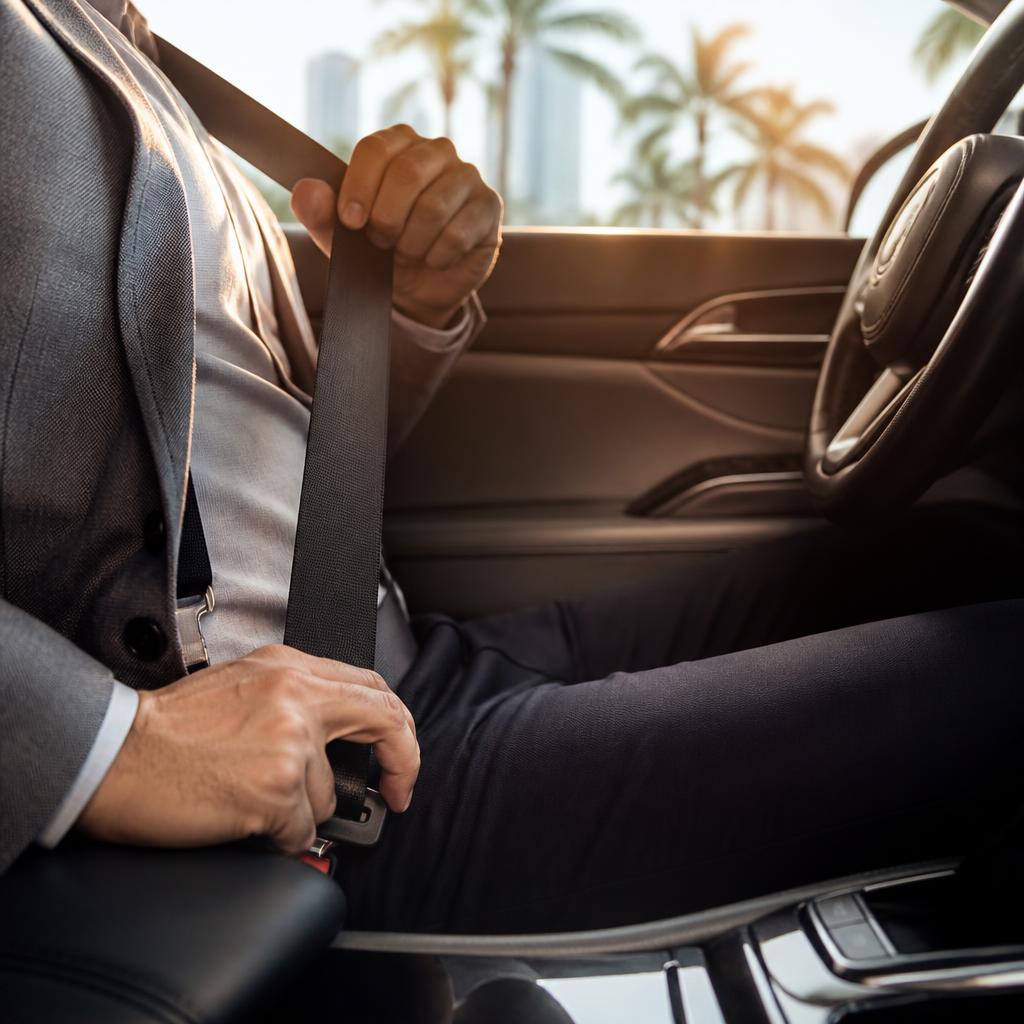
Florida's seat belt law does two things at once. It tells drivers and passengers when they have to buckle up, and it hands defense lawyers one of the most effective tools they have for reducing a car-crash verdict: the seat belt defense. In 2026, after the 2023 tort reforms of HB 837, the interaction between Fla. Stat. § 316.614 and Florida's modified comparative negligence rule matters more than ever. This guide, written from a Miami personal injury attorney's perspective, walks through exactly what the statute requires, who can be ticketed, how child-restraint rules under § 316.613 work, and — most importantly — how being unbelted at the time of a crash actually affects the value of a Miami injury claim. Nothing here is legal advice; every case turns on its own facts.
Quick Answer: Florida Seat Belt Law in 2026
- Fla. Stat. § 316.614 (the Florida Safety Belt Law) requires the driver, all front-seat passengers, and every passenger under 18 in any seat to wear a properly adjusted and fastened safety belt in a motor vehicle operated on Florida roads.
- Seat belt violations are primary offenses in Florida — an officer can stop and ticket a driver based on the belt violation alone (this has been the rule since 2009).
- The base fine is a non-moving civil infraction — no points on the license for the belt violation itself, but the ticket cost with court fees typically runs $30–$116 depending on the county.
- Child restraint (Fla. Stat. § 316.613): children 5 and under must be secured in a federally approved child restraint device; ages 0–3 in a separate car seat or the vehicle manufacturer's integrated device; ages 4–5 in a separate car seat, integrated device, or booster.
- The 'seat belt defense' is codified at Fla. Stat. § 316.614(10) and lets defendants reduce damages by the percentage of injury attributable to the plaintiff's failure to wear a belt.
- After HB 837 (2023), Florida is a modified comparative negligence (50% bar) state under § 768.81(6). An unbelted plaintiff apportioned more than 50% of the fault for their injuries recovers nothing.
- Exceptions in § 316.614(4) cover a narrow set of vehicles and medical conditions.
What § 316.614 Actually Requires
The Florida Safety Belt Law applies to motor vehicles manufactured with safety belts in compliance with Federal Motor Vehicle Safety Standard 208 and operated on Florida's public roads. Under § 316.614(4), it is unlawful for:
- Any person to operate a motor vehicle in Florida unless each front-seat passenger is restrained by a safety belt or child restraint device.
- Any person to operate a motor vehicle in Florida unless every passenger under 18, in any seat, is restrained by a safety belt or child restraint device.
- Any person 18 or older to be a front-seat passenger without a fastened safety belt.
- Any person under 18 to be a passenger in any seat without a fastened safety belt or approved child restraint.
The driver is legally responsible for every unbelted passenger under 18, regardless of where in the vehicle the minor is sitting. Adult back-seat passengers are not covered by § 316.614 — they cannot be ticketed for being unbelted in the rear seat — but they can still have their damages reduced under the seat belt defense if they are injured in a crash.
Primary Enforcement: An Officer Can Pull You Over for the Belt Alone
Florida moved from secondary to primary enforcement in 2009. Before that, a driver could only be cited for a belt violation as an add-on to another stop; today, the belt violation is enough on its own. Miami-Dade Police, City of Miami Police, Miami Beach Police, and the Florida Highway Patrol all routinely conduct 'Click It or Ticket' enforcement waves, particularly around Memorial Day, Thanksgiving, and the winter holidays. Federal grant funding through NHTSA supports these enforcement periods, and citation volumes rise sharply during them.
What a Seat Belt Ticket Costs in Miami-Dade in 2026
The seat belt violation itself is a non-moving civil infraction. No points are assessed against the license for the belt violation alone (though a moving violation added at the same stop is scored separately). The base statutory fine is $30 under § 318.18(3)(a). Once Miami-Dade Clerk of Court fees, criminal-justice trust fund add-ons, and county surcharges are applied, the total out-the-door cost typically lands between $101 and $116 in Miami-Dade County. Failure to pay or elect a hearing within 30 days triggers a license suspension and adds significantly to the cost.
The child restraint violation under § 316.613 is a moving violation carrying 3 points and a higher fine, and it cannot be avoided by attending a driver improvement course when a child was actually injured.
The Exceptions in § 316.614(4)
The statute lists a short list of exceptions. In Florida, the belt requirement does not apply to:
- A person for whom a physician has provided a written statement that the person is unable to wear a safety belt for medical reasons. Keep the note in the vehicle — verbal claims at the roadside will not defeat the citation.
- An employee of a common carrier engaged in the delivery or collection of newspapers, mail, or packages when frequent stops make continuous belt use impractical, and only within a defined route.
- A school bus, farm equipment, motor vehicles manufactured before 1968, buses used for the transportation of persons for compensation, and certain other narrowly-defined vehicles.
None of these exceptions apply to ordinary passenger vehicles operated on Miami roads in normal traffic, and the medical exception is applied strictly.
Child Restraints Under § 316.613 — A Separate Statute
Florida's child restraint law is a separate statute with harsher penalties. Under § 316.613:
- Children ages 0–3 must be secured in a separate federally approved car seat or the vehicle manufacturer's integrated child restraint. A regular seat belt is not enough at this age.
- Children ages 4–5 must be secured in a separate car seat, an integrated child seat, or a booster seat that positions the vehicle's belt correctly on the child's shoulder and hips.
- Children 6 and older may use a properly fastened adult seat belt, though NHTSA guidance and Florida injury data both support keeping children in boosters until they reach approximately 4'9" tall.
The National Highway Traffic Safety Administration continues to recommend that children ride in the rear seat until at least age 13 — the front airbag is designed for an average adult and can seriously injure a smaller occupant even in a low-speed collision. Florida law does not require rear seating, but it is a key factor in the seat belt defense analysis when a child is injured in the front seat.
The Seat Belt Defense — the Core Civil Issue
This is where § 316.614 collides with a Miami personal injury case. Under § 316.614(10), failure to wear a safety belt is not admissible as evidence of negligence in most civil actions — but it is admissible in a civil action for personal injuries or wrongful death arising out of the operation of a motor vehicle. The Florida Supreme Court's decisions in Insurance Co. of North America v. Pasakarnis, 451 So. 2d 447 (Fla. 1984), and Ridley v. Safety Kleen, 693 So. 2d 934 (Fla. 1996), established the modern seat belt defense framework. To use it, the defense must prove:
- The plaintiff did not use an available and operational seat belt.
- The plaintiff's failure to buckle up was unreasonable under the circumstances.
- A causal relationship existed between the injuries sustained and the failure to use the belt — meaning the injuries would not have occurred, or would have been less severe, if the belt had been worn.
The third element is where the case is usually won or lost. Biomechanical experts, crash reconstructionists, and treating physicians testify about whether the specific injuries — a thoracic fracture, an ejection injury, a facial laceration from the steering wheel — would have been prevented or reduced by belt use. Where the injury (a lower-extremity crush injury in a T-bone crash, for example) is unrelated to belt use, the defense fails on causation.
How the Defense Actually Changes the Verdict — the HB 837 Multiplier
Before HB 837 (2023), Florida followed pure comparative negligence: a plaintiff 90% at fault still recovered 10%. After HB 837, in most negligence cases governed by § 768.81(6), a plaintiff apportioned more than 50% of the fault recovers nothing. This changes the seat belt defense from a damages-reduction issue to, in some cases, a total-bar issue. Consider a hypothetical Miami crash:
- The plaintiff is unbelted and is thrown from the vehicle in a T-bone crash caused by a driver who ran a red light on Bird Road.
- The jury finds the defendant 60% at fault for causing the collision and the plaintiff 40% at fault for enhancement of the injuries (the seat belt defense).
- Damages: $500,000.
- Under pure comparative negligence (pre-HB 837): $500,000 × 60% = $300,000.
- Under the modified 50% bar (post-HB 837): plaintiff is still under 50% at fault, so $500,000 × 60% = $300,000 — no change.
Now change the facts. If the jury apportions the plaintiff at 55% for enhancement (a badly-injured, unbelted, back-seat passenger of a driver who was speeding), the recovery is zero under HB 837. That was not possible under the pre-2023 rule. The seat belt defense is now more dangerous to plaintiffs than at any point in modern Florida history, and it is the single most important reason to buckle up on every ride.
What Doesn't Count as 'Unbelted' — Common Defense Overreach
- A properly worn belt that malfunctioned in the crash is not a seat belt defense case; it is a product-liability case against the manufacturer, and preservation of the vehicle is critical.
- A belted passenger whose belt was cut by first responders may look unbelted in post-crash photos. Preserve EMS run sheets and cut-belt evidence.
- Rear-seat adults are not required to wear belts under § 316.614, and some Florida courts have limited the seat belt defense's reach to occupants the statute actually required to buckle. This is a live area of litigation and should not be conceded.
- The defense does not apply to injuries mechanistically unrelated to belt use — a rear-seat passenger with a broken leg from side-impact intrusion is not made worse by being unbelted.
Motorcycles, Convertibles, and Ridesharing
Motorcycles are not covered by § 316.614 — riders wear helmets under § 316.211, not belts. The seat belt defense does not apply in a motorcycle-injury case, though the analogous helmet-use argument is available in limited circumstances. Convertibles and coupes with functioning belts are treated like any other passenger vehicle. Rideshare passengers — Uber, Lyft — are subject to the same rules: an adult in the front seat must be belted, and any passenger under 18 must be belted in every seat. The rideshare company's contingent liability policy is unaffected by the passenger's own belt use, but the passenger's damages may still be reduced.
Data Behind the Statute — Why It Matters
NHTSA estimates that lap-and-shoulder seat belts reduce the risk of fatal injury to front-seat passenger-car occupants by 45% and the risk of moderate-to-critical injury by 50%. Florida's observed belt-use rate has hovered around 90% for most of the last decade, meaning roughly one in ten front-seat occupants is unbelted at any given moment. Miami-Dade's belt-use rate is typically slightly below the state average. Every 1% increase in observed belt use translates, in NHTSA modeling, to approximately 270 lives saved nationally per year.
Practical Guidance for a Miami Crash With Belt Issues
- Photograph the interior of the vehicle before it is towed. Belt geometry, retractor position, and any pre-existing damage all matter.
- Preserve the vehicle. A belt-related product-liability or defense-rebuttal case cannot be made from photographs alone.
- Request the EDR (event data recorder) download. Modern vehicles record belt-status flags for the driver and front passenger in the seconds before an airbag deployment.
- Ask EMS whether belts were cut or unfastened at the scene, and get the run sheet.
- Do not admit anything about belt use to the responding officer, the adjuster, or on social media before consulting counsel. Casual statements become the centerpiece of the defense's causation argument.
- If a child was injured, preserve the car seat exactly as installed — do not readjust it before an accident reconstruction expert has inspected it.
Statute of Limitations Reminder
For any Florida car crash on or after March 24, 2023, the personal-injury statute of limitations is 2 years under Fla. Stat. § 95.11(4)(a), as amended by HB 837. Wrongful-death claims are also on a 2-year clock under § 95.11(4)(d). The seat belt defense analysis has no effect on those deadlines, but it does affect the value of the claim you file inside them.
Bottom Line
Florida's seat belt law is short, strict, and — since HB 837 — financially unforgiving to injured occupants who were unbelted at the moment of impact. Fla. Stat. § 316.614 requires the driver, every front-seat passenger, and every passenger under 18 to buckle up; primary enforcement means the ticket alone justifies a stop; and § 316.614(10) makes belt non-use one of the few pieces of plaintiff conduct admissible in a Florida motor-vehicle injury case. The combined result is that being unbelted can move a Miami crash from a full recovery, to a reduced recovery, to nothing at all. Buckle up on every ride — and if you have been injured in a crash where belt use is in dispute, get a lawyer involved before the vehicle is released and the EDR data is overwritten.
This article is educational and not legal advice. If you or a family member was injured in a Miami-Dade car accident in 2026, contact The Farber Law Firm at 8888-FARBER for a free, confidential case review. Prior results do not guarantee a similar outcome.
Booster-Seat Grey Zone — Ages 6 to 12 in Florida
Florida's child-restraint statute stops requiring a booster at age 6, but NHTSA, the American Academy of Pediatrics, and every major automaker recommend keeping a child in a booster until roughly 4'9" tall (usually ages 8 to 12) and in the rear seat until 13. Florida law and the medical standard of care are not aligned here. In a civil case, a defense expert will argue statutory compliance if a 7-year-old was in an adult belt without a booster; a plaintiff's biomechanical expert will testify that the belt geometry across an under-4'9" child's abdomen and neck is a known injury multiplier ('seat belt syndrome' — Chance fractures, small-bowel injury, cervical-spine injury). Because the seat belt defense analysis is comparative and expert-driven, statutory compliance is a floor, not a ceiling — parents who chose booster use above what the statute requires reduce both injury risk and defense arguments in a civil case.
Airbag Interaction — Why Being Unbelted Is Worse in a Modern Car Than an Older One
Federal Motor Vehicle Safety Standard 208 has required advanced frontal airbags in all passenger vehicles since model year 2007. These airbags are designed and calibrated on the assumption that the occupant is belted. When a driver or front passenger is unbelted, the airbag deploys against a body already moving forward at crash speed rather than a restrained body decelerating on the belt — resulting in dramatically worse head, neck, chest, and facial injuries than the same crash would produce with a belted occupant, and, in some cases, injuries caused by the airbag itself. This dynamic strengthens the causation element of the seat belt defense in modern-vehicle cases and is often the single most powerful piece of biomechanical testimony a defense expert will offer.
Commercial Vehicles, Rideshare, and Taxi Passenger Rules
Fla. Stat. § 316.614(4)(c) exempts drivers of taxicabs while actively engaged in the transportation of persons for hire, but not their passengers. Uber and Lyft passengers are subject to the same rules as any private-vehicle passenger — adults must belt in the front seat, passengers under 18 must belt in any seat. The rideshare company's contingent liability policy under § 627.748 provides $1 million in third-party bodily-injury coverage during active rides, but the passenger's own belt non-use may still trigger the § 316.614(10) defense in a subsequent injury claim. Commercial trucks operated in interstate commerce are subject to 49 C.F.R. § 392.16 (Federal Motor Carrier Safety Regulations), which independently requires driver and any passenger belt use. A CDL driver cited for a belt violation on a Florida interstate faces both a state-court traffic infraction and a federal safety-record entry that affects motor-carrier safety ratings and can support a negligence-per-se theory in a subsequent civil case.
Motor-Vehicle Products Liability — Belt System Defects
Not every 'unbelted' case is a driver-behavior case. Florida recognizes design, manufacturing, and failure-to-warn defect theories against vehicle and belt-system manufacturers under strict products liability (West v. Caterpillar Tractor Co., 336 So. 2d 80 (Fla. 1976)). Documented defect categories include inertial-unlatch (the belt buckle releases from crash forces alone), false latch (the buckle appears latched but is not fully engaged), retractor failure (spooling out rather than locking on impact), and webbing failure. A vehicle should be preserved intact and inspected by a qualified restraint-systems expert before it is released to salvage — once the buckle mechanism is disassembled or the belt is cut, the defect theory is functionally dead. EDR belt-status data (which typically records driver and front-passenger belt-buckle-switch state for the seconds before deployment) is critical corroborating evidence.
Special-Needs Occupants and Medical Exemptions
The § 316.614(4) medical exception requires a written statement from a licensed physician that the person cannot wear a safety belt for a specific medical reason. Keep the note in the vehicle; the exception is applied narrowly and does not cover simple discomfort. Post-mastectomy chest sensitivity, ostomy pouches, certain post-surgical spinal conditions, and third-trimester pregnancy complications are among the recognized bases. Pregnancy alone is not a basis for the exception — Florida law follows the American College of Obstetricians and Gynecologists guidance to wear the lap belt under the abdomen across the hips and the shoulder belt between the breasts and to the side of the abdomen, and belt use during pregnancy reduces fetal loss in a crash by roughly 70% according to NHTSA. In a civil case, an unbelted pregnant driver is still subject to comparative-fault reduction on any personal injury, though the derivative claims of a surviving child may be evaluated separately.
Miami-Specific Enforcement Patterns
'Click It or Ticket' enforcement waves in Miami-Dade concentrate around Memorial Day, Thanksgiving, and the December holidays. Florida Highway Patrol runs saturation patrols on I-95, the Palmetto (SR 826), the Dolphin (SR 836), the Turnpike (Homestead Extension), and US-1 corridors during these periods, and Miami-Dade Police Department participates through a NHTSA-funded county task force. Enforcement is not evenly distributed — north Miami-Dade, Kendall, and West Miami consistently produce the highest citation volumes. Belt-violation ticket data is public through the Miami-Dade Clerk of Courts and, for scheduling and calibration challenges, through public-records requests to individual agencies. Because primary enforcement means a belt observation is itself the stop justification, downstream evidence (subsequent searches, additional citations, DUI arrests) is subject to Fourth Amendment challenge if the initial belt-observation basis is weak.
Post-Crash Playbook If You Were Unbelted
- Do not admit belt status at the scene. A responding officer's report is not a sworn statement; a casual 'I don't think I had it on' becomes the defense's opening argument for years.
- Preserve the vehicle. Send a written preservation letter to the tow yard, your insurer, and the at-fault carrier within 48 hours. Belt-mechanism inspection cannot be recreated from photos.
- Request the EDR download. Modern vehicles record buckle-switch state for the driver and front passenger; the data survives a crash but not repeated ignition cycles or salvage disassembly.
- Get treated the same day. The § 627.736 14-day rule bars PIP if you delay initial medical treatment past two weeks, and adjusters use late treatment to argue the injuries are unrelated to the crash.
- Do not post on social media. Investigators pull public accounts within 48 hours; a beach photo three weeks post-crash becomes an exhibit on the causation question.
- Preserve EMS documentation. If first responders cut belts to extricate you, the cut-belt evidence and run-sheet timestamp directly rebut a 'never buckled' defense.
- Retain counsel before speaking to the at-fault carrier. Recorded statements are the single most productive defense-discovery tool in seat belt cases.
Case Study Composite — Rear-End Crash on the Palmetto
A 34-year-old driver of a 2022 sedan is rear-ended at 45 mph while stopped in traffic on the SR 826 southbound near Bird Road. She is unbelted. Injuries: C6–C7 disc herniation with radiculopathy, requiring an anterior cervical discectomy and fusion; facial laceration from steering-wheel contact. Analysis in 2026: (1) rear-driver liability is essentially conceded — a stopped-in-traffic rear-end presumption of negligence under Florida common law applies; (2) the defense invokes § 316.614(10) with a biomechanical expert who opines that the C6–C7 injury and facial laceration would have been substantially reduced by belt use, given the vehicle's advanced frontal airbag calibration; (3) plaintiff's counter-expert focuses on the airbag deployment threshold and cervical-mechanism analysis; (4) jury allocates 25% fault to the plaintiff for belt non-use as an injury enhancement; (5) under HB 837 modified comparative negligence, plaintiff is well under the 50% bar and recovers 75% of a $650,000 verdict — $487,500. Under pre-2023 pure comparative negligence, the arithmetic would have been identical because plaintiff was under 50%; the case would still have paid $487,500. Change the facts — plaintiff in a 2004 vehicle with an unbelted rear-seat child, jury apportionment of 55% enhancement — and post-HB 837 arithmetic zeros out a case that would have paid $292,500 under the old rule. The seat belt defense's practical bite depends heavily on the vehicle year, the crash mechanism, and the credentials of the biomechanical experts on both sides.
Frequently Missed Coverage Layers in Seat Belt Cases
- UM/UIM on the injured driver's own auto policy — often the primary source of recovery when the at-fault driver's liability limits are exhausted, and unaffected by belt use except through the comparative-fault analysis.
- Medical-payments coverage (MedPay) — a fault-independent first-party medical coverage that stacks on PIP and does not care whether the plaintiff was belted.
- Health insurance and Medicare/Medicaid — collateral-source rules under § 768.76 govern set-offs; ERISA plans assert independent lien rights that must be negotiated pre-settlement.
- Employer-sponsored auto policies for work-related trips — a driver commuting for a legitimate work errand may have access to employer coverage entirely independent of personal auto insurance.
- Umbrella policies — most personal umbrellas over $1 million follow the underlying auto policy exclusions, but coverage is worth confirming before assuming there is nothing above the primary limits.
Frequently Asked Questions
Is Florida a primary enforcement seat belt state in 2026?
Yes. Since 2009, Fla. Stat. § 316.614 has been enforced as a primary offense — a Florida law-enforcement officer may stop a vehicle solely because the driver or a required front-seat passenger is unbelted, without any other traffic violation.
How much is a seat belt ticket in Miami in 2026?
The base fine is $30 under § 318.18(3)(a). With Miami-Dade Clerk of Court fees and county surcharges, the total typically runs $101–$116. It is a non-moving civil infraction and carries no license points, but a related child-restraint violation under § 316.613 is a moving violation with 3 points.
Does Florida require adult back-seat passengers to wear seat belts?
No. Fla. Stat. § 316.614 requires belts for the driver, every front-seat passenger, and every passenger under 18 in any seat. Adult rear-seat passengers cannot be cited under the statute — but their injury damages may still be reduced by the seat belt defense under § 316.614(10) in a civil case.
What is the seat belt defense in a Florida car accident case?
Under Fla. Stat. § 316.614(10) and Pasakarnis v. Insurance Co. of North America, defendants in Florida motor-vehicle injury cases can argue that the plaintiff's failure to wear an available seat belt made their injuries worse. If proven with expert testimony on causation, the plaintiff's damages are reduced by the percentage of enhancement — and, after HB 837 (2023), a plaintiff apportioned more than 50% of the fault recovers nothing.
What are Florida's child car seat rules under § 316.613?
Children ages 0–3 must be in a separate federally approved car seat or the vehicle manufacturer's integrated child restraint. Children ages 4–5 must be in a separate car seat, integrated seat, or booster. From age 6, a properly fitted adult belt is permitted, though NHTSA recommends staying in a booster until roughly 4'9" tall and riding in the rear seat until age 13.
How long do I have to file a Florida car accident lawsuit if seat belt use is disputed?
Two years from the date of the crash for injuries accruing on or after March 24, 2023, under Fla. Stat. § 95.11(4)(a) as amended by HB 837. The seat belt defense affects the value of the case, not the deadline. Preserve the vehicle and EDR data before the statute runs — those are the pieces of evidence most often lost first.
If I was in an Uber or Lyft and unbelted, can the ride company argue the seat belt defense against me?
Yes, indirectly — the defendant (the rideshare driver, the rideshare company's insurer, or a third-party at-fault driver) can raise § 316.614(10) if the injuries would have been reduced by belt use. Florida requires all adult front-seat passengers and every passenger under 18 in any seat to be belted, and rideshare passengers are not exempt. The rideshare company's $1 million contingent-liability policy under § 627.748 responds to third-party bodily injury during active rides, but recovery is still subject to comparative-fault reduction if belt non-use enhanced the injury.
What if the seat belt malfunctioned or failed in the crash?
That is a products-liability case, not a seat belt defense case. Florida recognizes strict-liability design, manufacturing, and failure-to-warn theories against vehicle and belt-system manufacturers. Preservation of the vehicle intact, including the buckle mechanism and the retractor, is essential — once the belt system is disassembled or the belt is cut, the defect theory is functionally dead. EDR belt-buckle-switch data should be downloaded before the vehicle is released to salvage.
Does Florida require belts in older cars without factory belts?
No. Fla. Stat. § 316.614 exempts motor vehicles manufactured before 1968, which corresponds to the effective date of Federal Motor Vehicle Safety Standard 208. A restored 1965 Mustang without factory-installed belts is exempt from the belt-use requirement for the driver and any passenger, though the seat belt defense analysis in a civil case would still consider whether aftermarket belts were installed and available.
How much of my case can the seat belt defense actually take?
It depends on the biomechanical causation evidence, the vehicle year, the crash mechanism, and the jury. Miami-Dade juries commonly apportion 15%–35% of the plaintiff's damages to belt non-use in cases where the causation link is well-supported, and 0% in cases where the injuries are mechanistically unrelated (a leg-crush injury in a T-bone crash, for example). Post-HB 837, any allocation that pushes the plaintiff over 50% is a total bar to recovery, so pre-suit valuation must model both the reduction and the outright-bar scenarios before settlement discussions begin.
Have a similar situation?
Free, confidential case review with a South Florida trial attorney. Call 8888-FARBER.
Request a Free ConsultationAbout the Author
The Farber Law Firm, P.A.
The Farber Law Firm is a South Florida trial practice based in Coral Gables, representing injured people, policyholders and businesses across Miami-Dade, Broward and Palm Beach counties since 1995. The firm handles personal injury, wrongful death, insurance coverage disputes and commercial litigation, and its attorneys are members in good standing of The Florida Bar.
Articles on this site are written and reviewed by attorney David Farber and reflect Florida statutes, court rules and Florida Bar regulations current as of the publication date.
- Office
- 2199 Ponce de Leon Blvd #301
Coral Gables, FL 33134 - Phone
- 8888-FARBER
- Consultations
- Free and confidential