How to Get a Florida Accident Report in 2026: South Florida Crash Report Tips for Miami-Dade, Broward, and Palm Beach Drivers
A Coral Gables trial attorney explains how to find, request, and read a Florida Traffic Crash Report in 2026 — the 60-day confidentiality rule in Fla. Stat. § 316.066(2), where to order reports from FLHSMV, FHP, and local South Florida agencies, what the HSMV 90010S and 90011S forms actually say, how to correct an error, and how the report affects your insurance and injury claim.
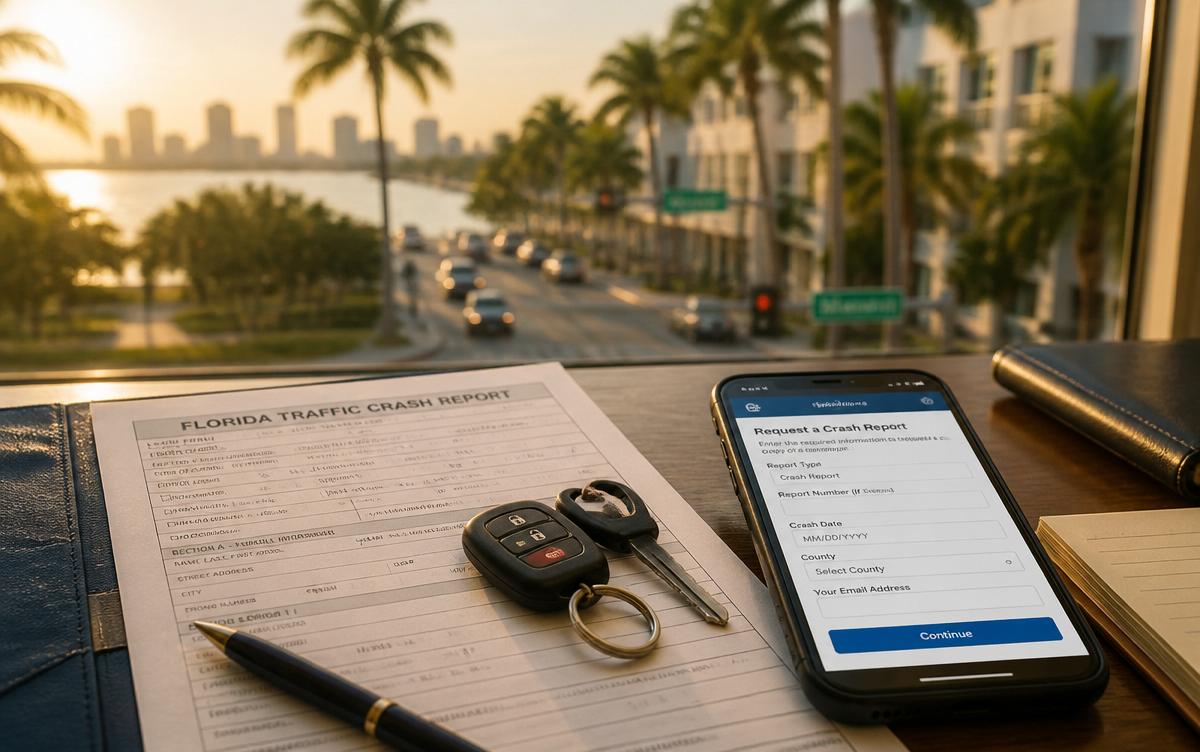
After a crash on the Palmetto, the Dolphin, I-95 through Miami, or a surface street in Coral Gables, Hialeah, Fort Lauderdale, or West Palm Beach, one document quietly shapes everything that follows: the Florida Traffic Crash Report. Your insurer will pull it. The other driver's adjuster will read it. A jury may hear about it. And most South Florida drivers do not know where to get it, when they are legally allowed to get it, or what to do when the narrative on page two is simply wrong. This 2026 guide from The Farber Law Firm in Coral Gables walks through the practical steps, the governing Florida statutes, and the mistakes that quietly damage otherwise strong claims. Nothing here is legal advice on any specific matter, and prior results do not guarantee a similar outcome.
Quick Answer: Getting a Florida Crash Report in 2026
- Florida crash reports are held confidential and exempt from public disclosure for 60 days after the report is filed under Fla. Stat. § 316.066(2).
- During that 60-day window, the report may be released to the parties involved, their legal representatives, their insurers, prosecutors, victim-services programs, radio and television stations, newspapers, and certain other statutorily identified parties who sign the required sworn statement.
- Most Florida reports are available online through the FLHSMV Florida Crash Portal, typically within about 7 to 10 days of the crash, for a statutory fee plus a convenience charge.
- Local South Florida agencies — Miami-Dade Sheriff's Office, City of Miami Police, Coral Gables Police, Hialeah Police, Broward Sheriff's Office, Fort Lauderdale Police, Palm Beach County Sheriff's Office — also release reports directly through their records units.
- A long-form Florida Traffic Crash Report (HSMV 90010S) is prepared for crashes involving injury, death, a commercial vehicle, a hit-and-run, an impaired driver, or a vehicle towed from the scene. A short-form (HSMV 90011S) covers minor property-damage crashes.
- If no officer investigated, a driver in a crash involving apparent injury, death, or more than $500 in damage must self-report using a Driver Report of Traffic Crash (HSMV 90011S) under Fla. Stat. § 316.066(1).
- The report is generally not admissible as evidence in a civil trial under Fla. Stat. § 316.066(4), but it is a roadmap for the investigation your attorney will build.
Step One: Know Which Agency Investigated Your Crash
Florida has no single police force, and the agency that worked your crash controls the paperwork. In South Florida, jurisdiction usually breaks down like this:
- Florida Highway Patrol handles most crashes on interstates and state highways, including I-95, I-75, I-595, the Palmetto Expressway (SR 826), the Dolphin Expressway (SR 836), Florida's Turnpike, and unincorporated stretches of US 1.
- Municipal police departments handle crashes on city streets: City of Miami, Miami Beach, Coral Gables, Hialeah, Doral, Aventura, Fort Lauderdale, Hollywood, Boca Raton, West Palm Beach, and dozens of others.
- County agencies — the Miami-Dade Sheriff's Office, Broward Sheriff's Office, and Palm Beach County Sheriff's Office — cover unincorporated areas and contracted municipalities.
- Airport, seaport, university, and transit police investigate crashes on their own property, including Miami International Airport and PortMiami.
If you are not sure who responded, look at the driver exchange-of-information slip the officer handed you at the scene. It normally lists the agency, the officer's name and badge number, and a crash or case number. That number is the fastest way to locate the report later.
Step Two: Wait the Right Amount of Time
Officers in Florida generally have 10 days to submit a written crash report to the Department of Highway Safety and Motor Vehicles. In practice, most South Florida reports appear online within 7 to 10 days, though complex fatality and hit-and-run investigations can take considerably longer while a traffic homicide investigator completes the file. If a report is not available after two weeks, call the investigating agency's records unit and ask whether the report is still under review or whether a supplemental investigation is open.
Step Three: Request the Report the Right Way
There are three practical routes to a Florida crash report in 2026:
- The FLHSMV Florida Crash Portal at the Department's official website. You search by date, county, and either report number, name, or driver license number, then complete a sworn statement affirming you are entitled to the record during the 60-day confidentiality period. Reports are $10 by statute, plus a service or convenience fee charged by the portal vendor.
- The investigating agency's records division. Local departments frequently release reports to involved parties by walk-up request, mail, or an online records portal, sometimes faster than the state system.
- Your attorney. If you have retained counsel, the firm requests the report as your legal representative, typically the same day the report becomes available, and also requests the materials the report does not contain.
Step Four: Understand the 60-Day Confidentiality Rule
Florida is unusual in restricting access to crash reports. Under Fla. Stat. § 316.066(2), a crash report held by an agency is confidential and exempt from the public-records law for 60 days after the report is filed. The statute lists who may obtain the report during that period, including the parties involved in the crash, their legal representatives, their licensed insurance agents and insurers, prosecutorial authorities, victim-services programs, and radio and television stations and newspapers operating under specified conditions. Requesters must sign a written sworn statement confirming their entitlement, and knowingly false statements are a criminal offense under the statute. After the 60 days elapse, the report generally becomes a public record available to anyone.
This rule exists to keep solicitors from harvesting crash data. It also means that if a stranger contacts you days after a South Florida crash offering medical care, chiropractic treatment, body-shop work, or legal services, you should be cautious about how they obtained your information and whether the contact complies with Florida law.
Step Five: Read the Report Like a Lawyer
A long-form Florida Traffic Crash Report contains far more than names and insurance information. When our firm reviews a report for a South Florida client, we look at:
- The crash diagram, and whether the drawn vehicle positions match the physical damage and the debris field.
- The officer's narrative, which often paraphrases statements the drivers themselves never quite made.
- Driver actions and contributing-cause codes assigned to each unit, such as failed to yield right of way, careless driving, or improper lane change.
- The citation section, which shows whether any driver was charged under Chapter 316.
- The injury severity codes for each occupant, which insurers use for early reserve-setting.
- Vehicle damage points and estimated speed information.
- Witness names, addresses, and telephone numbers, which are often the single most valuable field on the entire report.
- Whether a commercial motor vehicle, a rideshare vehicle, or a government vehicle was involved, each of which changes the insurance and notice analysis.
- Whether the crash involved suspected alcohol or drug use, and whether a blood draw or breath test occurred.
What the Crash Report Will Not Tell You
The report is a starting point, not the case. It rarely includes intersection or business surveillance video, event data recorder downloads from the vehicles, 911 audio and computer-aided dispatch logs, body-worn camera or dashcam footage, cell-phone usage records, commercial-carrier driver logs and telematics, or the medical records that ultimately drive damages. Much of that material is overwritten on a 14 to 30 day cycle, which is why preservation letters go out early in a serious South Florida injury case.
Is a Florida Crash Report Admissible in Court?
Generally no. Under Fla. Stat. § 316.066(4), crash reports made by persons involved in crashes and statements made by such persons to law enforcement for the purpose of completing the report are, with limited exceptions, inadmissible in any trial, civil or criminal. Florida courts have long applied the accident report privilege to keep compelled statements out of civil trials. That does not make the report unimportant: adjusters rely on it, it identifies witnesses and evidence, and the investigating officer may in some circumstances testify about independent observations. The correct way to use a crash report is as an investigative roadmap, not as trial proof.
How to Fix an Error in a Florida Crash Report
Errors are common: transposed license plates, the wrong insurer, a misidentified driver, an incorrect direction of travel, or a narrative that reverses who had the green light. You cannot simply rewrite the report, but you can ask the investigating agency to issue a supplemental or amended report. The practical steps:
- Contact the investigating officer or the agency's traffic unit in writing and identify the specific field or sentence that is wrong.
- Provide objective proof: photographs, dashcam or surveillance video, a witness statement, repair estimates, a corrected insurance declaration page, or medical records establishing an injury the report omitted.
- Ask for a supplemental report or amendment rather than a change of the officer's opinion. Factual corrections (a wrong VIN, a misspelled name, an omitted passenger) are routinely made. Opinion items such as the contributing-cause code are much harder to change.
- Keep the request and the agency's response. If the agency declines, your attorney can develop the correct facts through discovery, depositions, and expert reconstruction.
Self-Reporting a Crash When No Officer Responded
Fender-benders in South Florida parking lots and residential streets often end without a police unit. Florida law still requires the driver of a vehicle involved in a crash resulting in injury, death, or apparent property damage of at least $500 to report it, and where no investigating officer prepares a report, the driver must file a Driver Report of Traffic Crash (HSMV 90011S) with the Department within 10 days under Fla. Stat. § 316.066(1). Filing that self-report protects your PIP claim and prevents the other driver from later denying the crash occurred at all.
Why the Report Matters for Your Insurance and Injury Claim
Florida remains a no-fault state. Under Fla. Stat. § 627.736, your own Personal Injury Protection coverage pays 80 percent of reasonable and necessary medical expenses and 60 percent of lost wages up to the $10,000 policy limit, and you must seek initial medical care within 14 days of the crash to preserve those benefits. To step outside no-fault and pursue the at-fault driver for pain and suffering, the injury must meet the permanent-injury threshold in Fla. Stat. § 627.737(2). The crash report is the document that ties you to a specific date, a specific vehicle, and a specific set of insurers — which is exactly why an error in the report can stall a legitimate claim for months.
Two other 2026 rules matter. For causes of action accruing on or after March 24, 2023, the statute of limitations for negligence is two years from the date of injury under Fla. Stat. § 95.11(4)(a), and wrongful-death actions are two years from the date of death under § 95.11(4)(d). And Florida now applies modified comparative negligence under Fla. Stat. § 768.81(6): a plaintiff found more than 50 percent at fault recovers nothing, and at 50 percent or less, damages are reduced by the assigned percentage. Because adjusters often anchor their comparative-fault arguments to the officer's contributing-cause codes, the report can influence the value of a claim long before anyone files suit.
South Florida Practical Tips
- Photograph the officer's exchange-of-information slip before you leave the scene. Slips get lost; phone photos do not.
- Save your crash or case number in your phone notes along with the agency name.
- Order the report yourself even if your insurer says it already has a copy. You want to read the narrative with your own eyes.
- Check the injury severity code assigned to you. A code of no apparent injury on a crash where you later develop a herniated disc gives the defense an argument you should be ready to answer.
- Verify the other driver's insurance information on the report against the actual policy. Coverage on a crash report is sometimes stale or belongs to a different vehicle.
- If the crash involved a commercial truck, a rideshare vehicle, a rental car, or a government vehicle, get counsel involved quickly. Preservation obligations and notice deadlines differ.
- For a crash involving a government entity, note that pre-suit notice under Fla. Stat. § 768.28 and sovereign-immunity limits apply.
Illustrative Example
The following example is illustrative only and does not describe any specific client or predict any outcome. A driver is rear-ended on the Palmetto Expressway during afternoon traffic. FHP responds and prepares a long-form report, but the narrative lists the wrong lane of travel and codes the injured driver as having no apparent injury because she declined transport. Nine days later she is diagnosed with a cervical disc herniation. Counsel obtains the report through the crash portal, requests a supplemental report supported by dashcam video showing lane position, sends preservation letters for the expressway camera feed and both vehicles' event data recorders, and documents the 14-day PIP treatment requirement with the treating physician's records. The corrected factual record, not the report alone, is what supports the claim. Every case is different.
How The Farber Law Firm Helps
Our Coral Gables office has represented injured people and policyholders across Miami-Dade, Broward, and Palm Beach counties since 1995. When we open a crash file, we order the report the day it becomes available, run down every witness listed on it, send preservation demands for video and vehicle data before it is overwritten, and identify every layer of coverage — PIP, bodily injury liability, uninsured and underinsured motorist, resident-relative policies, umbrella coverage, and commercial policies. If the report contains an error that hurts you, we develop the record that corrects it. Consultations are free and confidential, and personal-injury matters are handled on a contingency-fee basis set out in a written agreement that complies with Florida Bar Rule 4-1.5(f).
Sources and Further Reading
- Fla. Stat. § 316.066 (Written reports of crashes; confidentiality; admissibility).
- Fla. Stat. § 316.065 (Crashes; reports; penalties).
- Fla. Stat. § 627.736 (Florida Motor Vehicle No-Fault Law, PIP benefits and the 14-day rule).
- Fla. Stat. § 627.737 (Tort exemption; limitation on right to damages).
- Fla. Stat. § 95.11(4)(a) and § 95.11(4)(d) (Limitations on negligence and wrongful-death actions).
- Fla. Stat. § 768.81(6) (Modified comparative negligence).
- Fla. Stat. § 768.28 (Waiver of sovereign immunity; pre-suit notice).
- Florida Department of Highway Safety and Motor Vehicles, Florida Crash Portal and Crash Report forms HSMV 90010S and HSMV 90011S.
Statutes, agency procedures, and portal fees change. Verify current law and current agency practice before relying on any summary, including this one.
Frequently Asked Questions
How do I look up an accident report in Florida?
Most Florida crash reports can be purchased through the FLHSMV Florida Crash Portal by searching the crash date, county, and either the report number, a party name, or a driver license number. You can also request the report directly from the investigating agency's records unit, such as the Florida Highway Patrol, City of Miami Police, Coral Gables Police, Broward Sheriff's Office, or Palm Beach County Sheriff's Office.
How long does it take to get a Florida crash report?
Officers generally have 10 days to submit a written crash report, and most South Florida reports appear online within about 7 to 10 days. Fatality, hit-and-run, and traffic-homicide investigations can take substantially longer.
Are Florida accident reports public record?
Not immediately. Under Fla. Stat. § 316.066(2), a crash report is confidential and exempt from public disclosure for 60 days after it is filed. During that period only statutorily identified parties, including those involved in the crash, their attorneys, and their insurers, may obtain it after signing a sworn statement. After 60 days the report is generally a public record.
How much does a Florida accident report cost?
The statutory fee is $10 per report, and the state's online portal vendor adds a convenience fee. Local agencies may charge their own per-page or per-report copy fees consistent with Florida law.
Can I get a crash report if no police came to the scene?
Yes, but you may need to create the record yourself. If the crash involved injury, death, or apparent property damage of at least $500 and no officer investigated, Florida law requires the driver to file a Driver Report of Traffic Crash (HSMV 90011S) with the Department within 10 days under Fla. Stat. § 316.066(1).
Can a Florida crash report be used as evidence in court?
Generally no. Fla. Stat. § 316.066(4) makes crash reports and the statements drivers give for purposes of the report inadmissible in civil and criminal trials, subject to limited exceptions. The report is still valuable as an investigative roadmap and is relied on heavily by insurance adjusters.
What if the police report is wrong?
Contact the investigating agency in writing, identify the specific error, and provide objective proof such as photographs, video, a witness statement, or corrected insurance documents. Agencies routinely issue supplemental reports for factual corrections. Opinion items like contributing-cause codes are harder to change, and those facts are usually developed through discovery instead.
Does the crash report decide who is at fault?
No. The officer's contributing-cause codes and any citations are influential with insurers, but fault in a Florida civil case is decided by the evidence and ultimately by a jury applying the modified comparative-negligence standard in Fla. Stat. § 768.81(6).
Do I need the report before I see a doctor?
No, and waiting is a mistake. Florida PIP requires initial medical care within 14 days of the crash under Fla. Stat. § 627.736(1)(a). Get evaluated first, then obtain the report.
How long do I have to file a Florida injury lawsuit?
For causes of action accruing on or after March 24, 2023, most Florida negligence claims must be filed within two years of the date of injury under Fla. Stat. § 95.11(4)(a), and wrongful-death claims within two years of the date of death under § 95.11(4)(d). Claims against government entities have additional pre-suit notice requirements under Fla. Stat. § 768.28.
Have a similar situation?
Free, confidential case review with a South Florida trial attorney. Call 8888-FARBER.
Request a Free ConsultationAbout the Author
The Farber Law Firm, P.A.
The Farber Law Firm is a South Florida trial practice based in Coral Gables, representing injured people, policyholders and businesses across Miami-Dade, Broward and Palm Beach counties since 1995. The firm handles personal injury, wrongful death, insurance coverage disputes and commercial litigation, and its attorneys are members in good standing of The Florida Bar.
Articles on this site are written and reviewed by attorney David Farber and reflect Florida statutes, court rules and Florida Bar regulations current as of the publication date.
- Office
- 2199 Ponce de Leon Blvd #301
Coral Gables, FL 33134 - Phone
- 8888-FARBER
- Consultations
- Free and confidential