Miami Premises Liability Lawyer Guide 2026: Fla. Stat. § 768.0755, Negligent Security, and Proving a Property Owner Knew
A Coral Gables trial attorney explains Florida premises liability law in 2026 — the three classes of visitors, the constructive-knowledge test in Fla. Stat. § 768.0755, the § 768.0706 multifamily security presumption, how HB 837 comparative fault and the two-year deadline apply, and the evidence that actually wins Miami-Dade cases.
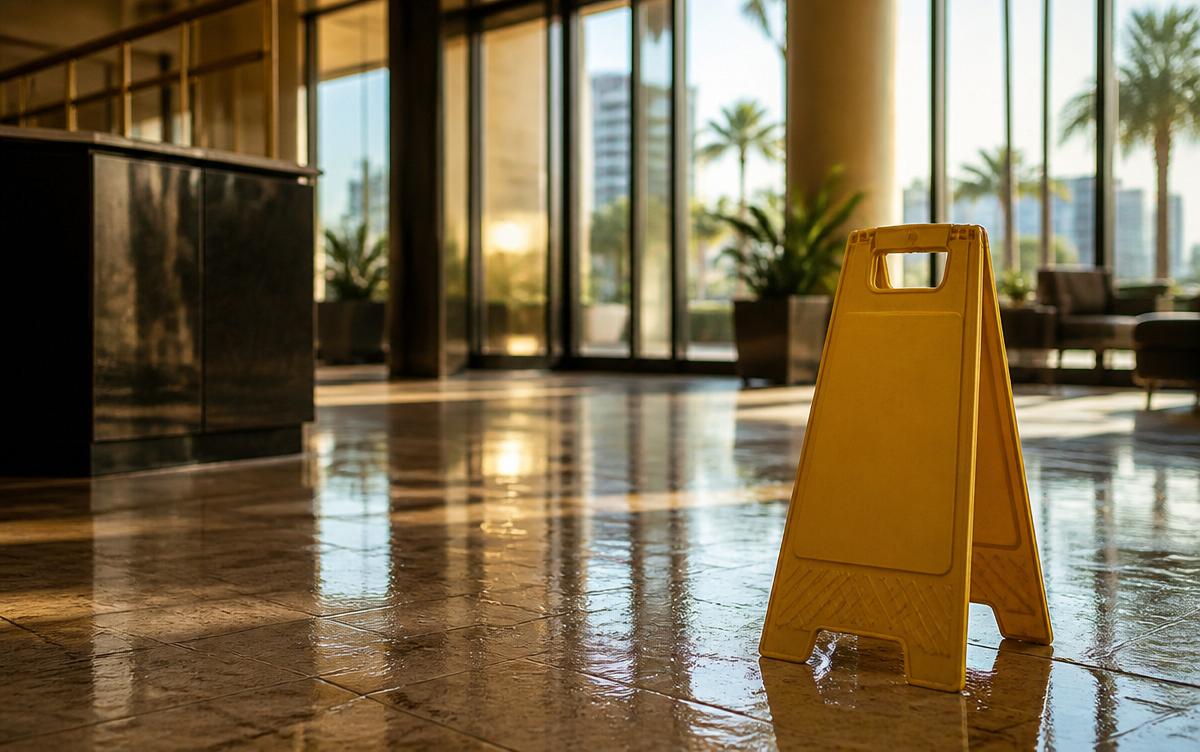
If you were hurt on someone else's property in Miami — a flooded supermarket aisle in Hialeah, an unlit parking garage in Brickell, a broken stair tread in a Little Havana duplex, a poolside deck in Miami Beach — you are dealing with a premises liability claim. These cases look simple and almost never are. Florida law does not make a property owner an insurer of everyone who walks in. It makes the owner responsible only for what it knew or should have known, and only when it failed to act reasonably in response.
This 2026 guide walks through how premises liability actually works in Miami-Dade County: who owes a duty to whom, the exact statutory test for slip-and-fall cases involving a substance on the floor, how negligent security claims differ, what the 2023 tort reform package changed, and the deadlines that quietly destroy otherwise strong claims. It is general legal information, not legal advice about your specific case.
What Premises Liability Means in Florida
Premises liability is a negligence claim with a property twist. To recover, you must prove four things: the property owner or possessor owed you a duty of care, the owner breached that duty, the breach caused your injury, and you suffered damages. The property status of the defendant matters — the duty flows from control over the premises, not just paper title. A landlord, a management company, a tenant business, a maintenance contractor, and a security vendor can all be defendants in the same case because each controlled some part of the condition that hurt you.
The scope of the duty owed depends on why you were on the land. Florida recognizes three traditional categories of entrant, and the label controls the outcome more often than most injured people expect.
Invitees
An invitee enters for a purpose connected to the owner's business or on land held open to the public. Shoppers at a Publix, guests at a Coconut Grove hotel, patients at a Kendall medical office, and customers at a Doral warehouse club are invitees. Owners owe invitees the highest duty: to maintain the premises in a reasonably safe condition, to correct dangerous conditions the owner knew or should have known about through reasonable inspection, and to warn of concealed dangers the invitee is unlikely to discover. This is the category most Miami retail, restaurant, hotel, and condominium-common-area cases fall into.
Licensees
A licensee enters with permission but for the licensee's own purpose — a social guest at a friend's Pinecrest home is the classic example. The owner must refrain from willful or wanton harm and must warn of known dangerous conditions that are not open to ordinary observation. There is no duty to inspect for unknown hazards. Florida also recognizes uninvited licensees, who are owed a narrower duty still.
Trespassers
A trespasser enters without permission. Under Fla. Stat. § 768.075, the owner generally owes only a duty to avoid intentional misconduct, and the statute gives owners substantial immunity when the trespasser was under the influence of alcohol or a controlled substance to a specified degree, or was committing certain felonies. The attractive nuisance doctrine remains an important exception for child trespassers drawn to hazards like unfenced swimming pools, which matters a great deal in a county with as much residential pool density as Miami-Dade.
The Statute That Decides Most Miami Slip-and-Fall Cases
If you slipped on a substance on the floor of a business, one statute controls your case: Fla. Stat. § 768.0755, enacted in 2010. It provides that when a person slips and falls on a transitory foreign substance in a business establishment, the injured person must prove the business had actual or constructive knowledge of the dangerous condition and should have taken action to remedy it.
That single sentence shifts the entire evidentiary burden onto you. It is not enough to prove the floor was wet and that you fell. You must prove the store knew, or that enough time had passed that a reasonably careful store should have known.
The statute defines two ways to establish constructive knowledge:
- The dangerous condition existed for such a length of time that, in the exercise of ordinary care, the business establishment should have known of the condition.
- The condition occurred with regularity and was therefore foreseeable.
In practice, the first route turns on time-on-the-floor evidence. Florida courts have consistently held that the mere presence of a substance, without evidence of how long it was there, is not enough to survive summary judgment. That is why what you do in the first ten minutes after a fall often decides the case years later.
Evidence that proves time on the floor
- Surveillance video showing the spill occurring and the minutes that elapsed before your fall. Most Miami retailers overwrite footage on a 14 to 30 day cycle, which is the single most common reason viable cases collapse.
- The physical characteristics of the substance: dirt, cart tracks, footprints, drying edges, or a spreading puddle all suggest the substance sat unattended.
- Sweep logs, inspection sheets, and the store's own written floor-care policy, which frequently requires inspections at intervals the store did not actually follow.
- Employee statements and incident reports created before the defense retains counsel.
- Weather data and door-mat placement for rain-tracking cases, which are seasonal and predictable in South Florida.
The second route, recurring condition, is powerful and underused. If the produce misting station at a particular store has produced water on the floor repeatedly, or if the same entryway floods every afternoon during the summer rainy season, prior incident reports and maintenance records can establish foreseeability without any evidence about your specific spill.
What § 768.0755 does not cover
The statute applies to transitory foreign substances in a business establishment. It does not govern claims about permanent structural defects — a broken handrail, a raised sidewalk slab, an unmarked step-down, defective stair geometry, a missing pool gate latch, or inadequate lighting. Those remain ordinary negligence claims under common-law premises principles, without the heightened knowledge burden. Correctly characterizing the hazard at the pleading stage can be the difference between a case that survives and one that is dismissed.
Open and Obvious Conditions
Florida property owners have no duty to warn of dangers that are open and obvious to a reasonable person. But the doctrine is narrower than defense counsel usually argues. The obviousness of a hazard eliminates the duty to warn; it does not automatically eliminate the separate duty to maintain the premises in a reasonably safe condition. Florida appellate courts have repeatedly held that an owner may still be liable for an obvious hazard where the owner should have anticipated that the invitee would encounter it anyway — for example, when it is the only path to the entrance, or when the invitee's attention is foreseeably distracted by merchandise displays.
Negligent Security Claims in Miami
A large share of Miami premises cases are not slip-and-falls at all. They arise when a person is shot, stabbed, robbed, or assaulted on commercial property — apartment complexes, parking garages, nightclubs, gas stations, and hotels. The theory is that the owner failed to take reasonable security measures against foreseeable criminal conduct.
Foreseeability is the battleground. It is typically proved through prior similar incidents on the property or in the immediate vicinity, police call-for-service histories, crime-grid data, and the owner's own internal security assessments. Miami-Dade police records obtained through a public records request are frequently the backbone of these cases.
Two provisions enacted in 2023 changed the landscape significantly:
- Fla. Stat. § 768.0706 creates a presumption against liability for the owner or operator of a multifamily residential property that substantially implements a specified list of security measures — including security camera coverage at entry points with 30-day retention, lighted parking lots and walkways from dusk to dawn at specified illumination levels, one-inch deadbolts on dwelling doors, locked gates at pool and recreation areas, peepholes, and documented crime deterrence training for employees. Owners must also have completed a crime prevention through environmental design assessment. This does not create immunity, and the presumption is rebuttable, but it makes early discovery into compliance essential.
- Fla. Stat. § 768.0701 requires that, in a negligent security action brought against an owner or principal operator, the trier of fact must consider the fault of all persons who contributed to the injury — including the criminal assailant. That means a jury can apportion a substantial percentage of fault to a third party who is not in the courtroom, reducing the recoverable share against the property owner.
How the 2023 Tort Reform Package Affects Premises Cases in 2026
House Bill 837, signed March 24, 2023, reshaped Florida negligence law, and by 2026 its effects are fully visible in premises litigation.
Modified comparative negligence. Under Fla. Stat. § 768.81(6), a plaintiff found to be more than 50 percent at fault for their own harm recovers nothing. Below that threshold, damages are reduced by the plaintiff's percentage of fault. Florida previously followed pure comparative negligence, where a plaintiff 80 percent at fault could still recover 20 percent. In premises cases — where defense counsel routinely argues the plaintiff was distracted, wearing improper footwear, ignoring a cone, or in an area they should not have entered — the 50 percent bar is now the central defense strategy. This modified system applies to negligence causes of action that accrued after the statute's effective date; the medical negligence carve-out does not change the analysis for ordinary premises claims.
Statute of limitations. HB 837 shortened the deadline for general negligence claims from four years to two. Under Fla. Stat. § 95.11(4)(a), a negligence action that accrued on or after March 24, 2023 must be filed within two years. Wrongful death claims are governed by Fla. Stat. § 95.11(4)(d) and carry a two-year deadline running from the date of death. Claims that accrued before March 24, 2023 remain subject to the prior four-year period, but by 2026 essentially all of those are time-barred.
Evidence of medical damages. Fla. Stat. § 768.0427 limits the presentation of past medical damages to amounts actually paid, with specific rules for letters of protection and for plaintiffs with and without health insurance. This has practical consequences for how treatment is documented and how a Miami premises case is valued.
Special Deadlines You Cannot Miss
The two-year statute is not the only clock, and it is not the shortest one.
- Government-owned property. If you were injured at a county park, a Miami-Dade transit station, a public school, a municipal parking facility, or on a sidewalk owned by a city, Fla. Stat. § 768.28 controls. You must present a written claim to the agency and to the Department of Financial Services and generally wait 180 days before filing suit. Sovereign immunity caps recovery at 200,000 dollars per person and 300,000 dollars per incident absent a legislative claim bill.
- Condominium and homeowners associations. Common-element injuries typically require careful review of the declaration and the association's insurance, and multiple entities may share responsibility.
- Workplace injuries. If you were hurt while working on someone else's property, workers' compensation is generally the exclusive remedy against your employer, but a third-party premises claim against the property owner or another contractor often remains available in parallel. Report the injury within 30 days to protect the compensation claim.
- Evidence preservation. Send a spoliation letter demanding preservation of surveillance video, sweep logs, and maintenance records immediately. Once footage is overwritten in the ordinary course, courts are often reluctant to sanction the owner.
What Damages Are Available
Florida premises plaintiffs may pursue economic damages — past and future medical expenses, lost wages, diminished earning capacity, household services, and out-of-pocket costs — and non-economic damages for pain, suffering, disability, disfigurement, mental anguish, and loss of enjoyment of life. Florida does not cap non-economic damages in ordinary premises negligence cases. Punitive damages require the heightened showing in Fla. Stat. § 768.72 of intentional misconduct or gross negligence, pled only after the court finds a reasonable evidentiary basis.
Value is driven by liability strength, the objective severity and permanency of the injury, the credibility of the treatment history, the available insurance, and the percentage of comparative fault a jury is likely to assign. Anyone who quotes you a settlement figure before reviewing the medical records and the surveillance footage is guessing.
What to Do After a Miami Premises Injury
- Report the incident to a manager on duty before you leave, and ask for a copy of the written incident report.
- Photograph and video the hazard from multiple angles, wide and close, including the surrounding area, lighting, signage, and your footwear.
- Photograph the absence of warning cones as carefully as you would photograph their presence.
- Get names and phone numbers of every witness and every employee present. Witnesses disappear.
- Ask, in writing if possible, that surveillance video be preserved.
- Seek medical evaluation the same day or the next day. Gaps in treatment are the most effective argument the defense has.
- Do not give a recorded statement to the property owner's insurer or claims adjuster before speaking with counsel.
- Do not post about the incident on social media.
- Keep the shoes and clothing you were wearing, unwashed, in a sealed bag.
Why These Cases Need Early Legal Involvement
Premises liability is one of the few injury practice areas where the outcome is often determined within the first two weeks by evidence that no longer exists a month later. Video retention windows, sweep-log cycles, employee turnover, and the modified comparative fault regime all reward early, aggressive investigation. The Farber Law Firm has litigated Florida premises and property claims from Coral Gables since 1995, on both the liability and the insurance-coverage sides of these disputes, which is a useful vantage point when a property owner's carrier disputes both fault and the reasonableness of your medical charges.
If you were injured on commercial or residential property in Miami-Dade, Broward, or Palm Beach County, a free case review will tell you whether the hazard is governed by § 768.0755 or by ordinary negligence principles, what evidence must be preserved today, and how the comparative-fault and damages rules are likely to apply to your facts.
Frequently Asked Questions
What is the statute of limitations for a premises liability claim in Florida in 2026?
Two years. Under Fla. Stat. § 95.11(4)(a), negligence claims that accrued on or after March 24, 2023 must be filed within two years of the injury. Wrongful death claims arising from a premises incident are governed by Fla. Stat. § 95.11(4)(d) and also carry a two-year deadline, measured from the date of death. Claims against government entities carry additional pre-suit notice requirements under Fla. Stat. § 768.28.
Do I have to prove the store knew about the spill?
Yes, if you slipped on a transitory foreign substance in a business establishment. Fla. Stat. § 768.0755 requires proof of actual or constructive knowledge. Constructive knowledge can be shown by evidence that the condition existed long enough that a reasonably careful business should have discovered it, or that the condition occurred with regularity and was therefore foreseeable. The statute does not apply to structural defects such as broken stairs, missing handrails, or inadequate lighting.
Can I still recover if I was partly at fault for my fall?
Yes, as long as you were not more than 50 percent at fault. Under Fla. Stat. § 768.81(6), as amended by HB 837 in 2023, a plaintiff found more than 50 percent responsible recovers nothing. At or below that threshold, your damages are reduced by your percentage of fault. This is a change from Florida's prior pure comparative negligence system.
What is a negligent security claim?
A claim that a property owner failed to take reasonable measures against foreseeable criminal activity, resulting in an assault, shooting, robbery, or other harm to a lawful visitor. Foreseeability is typically established through prior similar incidents and police call-for-service data. Fla. Stat. § 768.0706 gives multifamily residential owners a rebuttable presumption against liability if they substantially implement specified security measures, and Fla. Stat. § 768.0701 requires the jury to apportion fault to the criminal assailant and other third parties.
Who can be sued in a Miami premises liability case?
Anyone who controlled the dangerous condition. That can include the property owner, the tenant business, the management company, a maintenance or janitorial contractor, a security vendor, or a condominium or homeowners association. Identifying every responsible party early matters because it affects the available insurance coverage and how fault is apportioned at trial.
How long does a property owner have to keep surveillance video?
There is no universal legal retention period for private surveillance footage. Most South Florida retailers, hotels, and apartment complexes overwrite on a 14 to 30 day cycle. Fla. Stat. § 768.0706 references 30-day retention as part of the multifamily security safe harbor, but that is a condition of the presumption, not a general mandate. A written preservation demand should be sent as soon as possible after the incident.
What if I was injured on county or city property in Miami-Dade?
Sovereign immunity rules in Fla. Stat. § 768.28 apply. You must serve a written notice of claim on the agency and the Department of Financial Services and generally wait 180 days before suing. Recovery is capped at 200,000 dollars per person and 300,000 dollars per occurrence unless the Legislature passes a claim bill.
How much is a Miami premises liability case worth?
There is no formula. Value depends on the strength of the knowledge evidence, the severity and permanency of the injury, documented medical expenses and wage loss, available insurance limits, and the percentage of comparative fault likely to be assigned to you. Fla. Stat. § 768.0427 also limits how past medical damages may be presented at trial. Any valuation given before the records and video are reviewed is speculation.
Have a similar situation?
Free, confidential case review with a South Florida trial attorney. Call 8888-FARBER.
Request a Free ConsultationAbout the Author
The Farber Law Firm, P.A.
The Farber Law Firm is a South Florida trial practice based in Coral Gables, representing injured people, policyholders and businesses across Miami-Dade, Broward and Palm Beach counties since 1995. The firm handles personal injury, wrongful death, insurance coverage disputes and commercial litigation, and its attorneys are members in good standing of The Florida Bar.
Articles on this site are written and reviewed by attorney David Farber and reflect Florida statutes, court rules and Florida Bar regulations current as of the publication date.
- Office
- 2199 Ponce de Leon Blvd #301
Coral Gables, FL 33134 - Phone
- 8888-FARBER
- Consultations
- Free and confidential