Miami Slip and Fall Lawyer's 2026 Guide: Premises Liability, Fla. Stat. § 768.0755, and What Your Case Is Actually Worth
A Miami premises liability attorney's 2026 guide to slip and fall claims in Florida: the § 768.0755 actual/constructive knowledge standard, HB 837's 2-year deadline, comparative fault, evidence that wins, and how case value is built.
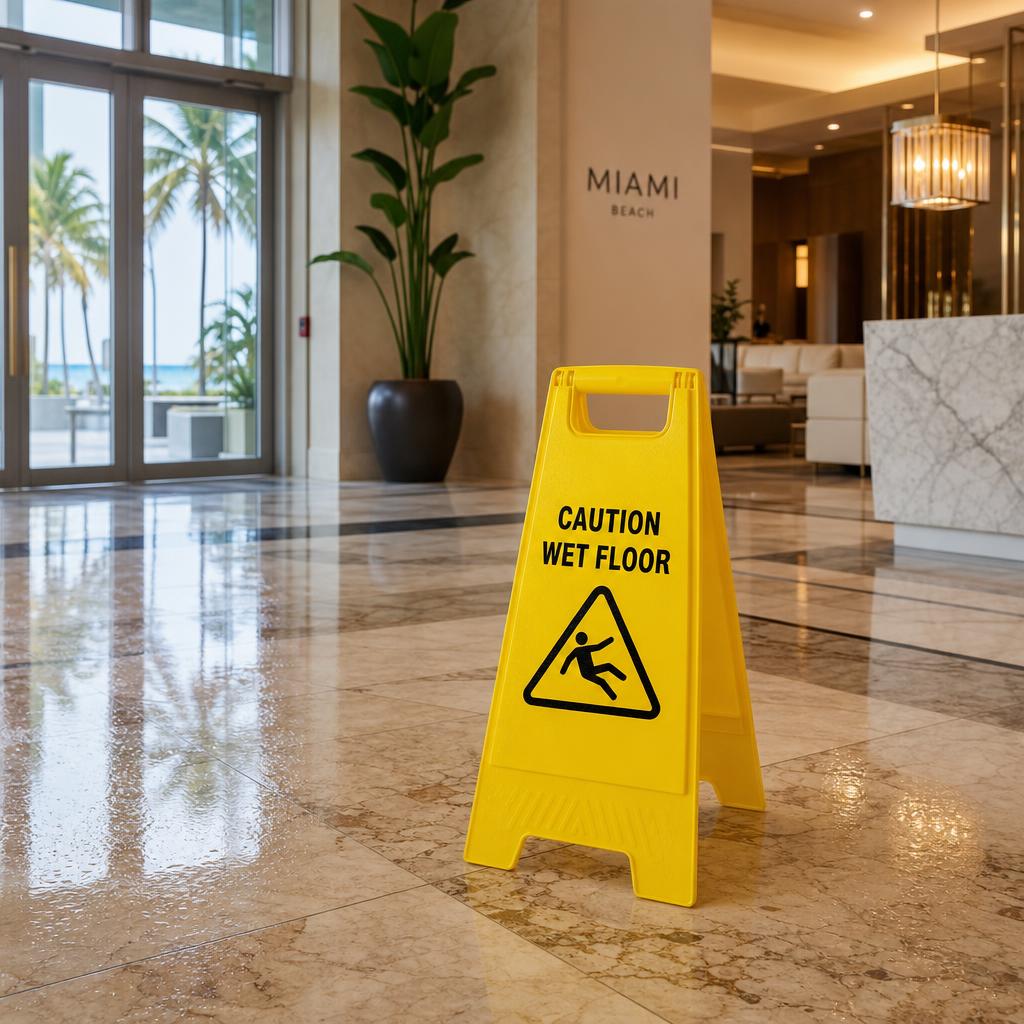
Slip and fall cases are the most misunderstood category of personal injury claims in Florida. A fall on a wet supermarket tile, a slick hotel lobby, a broken parking-lot curb, or an unlit condo stairwell looks like an obvious case to the injured person and their family. It is not. Since Fla. Stat. § 768.0755 took effect in 2010 and the rules were tightened again in HB 837 in 2023, the legal burden on the injured person in a Florida premises case is one of the highest in the country. This 2026 guide, written by a Miami slip and fall lawyer, explains exactly what Florida law requires, how insurance carriers evaluate these claims, and what evidence actually decides the outcome. Every case is different; nothing in this article is a promise of any result.
Quick Answer: Florida Slip and Fall Claims in 2026
- Under Fla. Stat. § 768.0755, an injured person on a business's property must prove the business had actual or constructive knowledge of the dangerous condition and should have taken action to remedy it.
- The statute of limitations for negligence claims accruing on or after March 24, 2023 is two years under Fla. Stat. § 95.11(4)(a) after HB 837.
- Florida uses modified comparative negligence under Fla. Stat. § 768.81(6) — more than 50% of the fault on the injured person means zero recovery.
- PIP does not apply to premises falls that are unrelated to a motor vehicle; medical bills come out of health insurance or Letters of Protection until resolution.
- Recoverable damages include past and future medical expenses, lost wages and earning capacity, out-of-pocket costs, and non-economic damages once permanency is established.
- The single most valuable evidence in a Miami slip and fall case is preserved surveillance video and the store's internal inspection/sweep logs — both of which disappear quickly.
Where Slip and Fall Cases Happen in Miami-Dade
- Supermarkets and big-box retailers — Publix, Winn-Dixie, Sedano's, Presidente, Walmart, Target, Costco, and Home Depot locations across Miami-Dade.
- Hotel and resort lobbies, pool decks, and bathrooms in Brickell, Downtown, Coral Gables, Coconut Grove, Miami Beach, and Doral.
- Restaurants, bars, and nightclubs — especially back-of-house tile with grease or ice-machine leaks.
- Condominium and apartment common areas — lobbies, elevators, garages, pool decks, and unlit stairwells governed by Chapter 718 (condos) and Chapter 83 (landlord-tenant).
- Shopping-mall concourses, food courts, and parking garages at Dadeland, Aventura, Dolphin, and Brickell City Centre.
- Cruise ports and terminal buildings at PortMiami — where maritime law may partly displace Florida premises law.
- Public sidewalks and pedestrian ramps maintained by the City of Miami, City of Miami Beach, and Miami-Dade County — governed by Fla. Stat. § 768.28 sovereign immunity rules.
- Construction and renovation zones inside otherwise open businesses.
The Rule That Actually Controls These Cases: Fla. Stat. § 768.0755
Section 768.0755 is the statute Florida enacted in 2010 that replaced the older common-law framework and, in practical terms, shifted the burden onto the injured person. To recover for a fall caused by a transitory foreign substance (water, food, a spilled product, cleaning solution) in a business establishment, the injured person must prove the business had actual or constructive knowledge of the dangerous condition and should have taken action to remedy it. Constructive knowledge can be shown by circumstantial evidence that (a) the condition existed for such a length of time that, in the exercise of ordinary care, the business should have known of it, or (b) the condition occurred with regularity and was therefore foreseeable. The statute rejects a pure res ipsa loquitur theory: the mere fact that a fall happened is not enough.
Actual vs. Constructive Knowledge — What That Really Means
Actual knowledge is direct evidence that an employee saw the spill, was told about it, or created it — a produce clerk who dropped grapes, a maintenance worker mopping without a warning sign, a manager notified of a leak. Constructive knowledge is proved through time, pattern, and inspection failure. If surveillance shows a puddle on the tile for 27 minutes before the fall while employees walk past it, that is powerful constructive-knowledge evidence. If the store's own sweep log shows inspections were supposed to occur every 30 minutes but the last documented inspection was two hours earlier, that is powerful constructive-knowledge evidence. Recurring-condition cases — a rooftop AC unit that drips into the same hallway every rainy season, an ice-machine that regularly leaks — succeed on the foreseeability prong even without proof of the exact length of time.
The 2-Year Deadline After HB 837
Before March 24, 2023 a Florida negligence victim had four years to sue. HB 837 cut the general negligence statute of limitations in half. For any premises-fall incident on or after that date, you have two years from the date of the incident to file a lawsuit under Fla. Stat. § 95.11(4)(a). Claims against a government entity — the City of Miami, Miami-Dade County, a public school, a public housing authority — require a written pre-suit notice under Fla. Stat. § 768.28(6) and are subject to sovereign-immunity caps. Cruise-line falls typically require suit in federal court within one year and written notice within six months under the passenger ticket contract. These deadlines are jurisdictional. An adjuster's promise to keep talking does not toll them.
Florida's 50% Comparative Negligence Bar
Under Fla. Stat. § 768.81(6), if a jury or an insurance adjuster building a reserve assigns the injured person more than 50% of the fault, the case is worth zero. At 50% or below, damages are reduced by the fault percentage. In a slip and fall, the defense will argue the injured person was distracted by a phone, was wearing unsafe footwear, walked past a warning sign, ignored a coned-off area, or should have seen an open and obvious condition. A credible plaintiff, unambiguous video, and a clean sequence of events are how these arguments are defeated.
The Open and Obvious Doctrine
Florida still recognizes that a property owner has no duty to warn of a condition that is truly open and obvious to a reasonable person — a dry step, a clearly marked wet-floor sign, an obviously wet pool deck. That defense is narrower than defendants argue: the owner still owes a duty to maintain the premises in a reasonably safe condition even when a hazard is obvious, and the doctrine typically becomes a comparative-fault question rather than a complete bar. Wet grocery aisles with no warning sign, water tracked through an unlit hotel corridor, and translucent liquids on shiny tile rarely qualify as open and obvious.
Damages: How a Miami Slip and Fall Case Is Actually Valued
- Past medical expenses — ER visit, imaging, orthopedic and neurosurgical care, physical therapy, injections, and any surgical intervention (rotator-cuff repair, ACL reconstruction, lumbar or cervical fusion, hip replacement).
- Future medical expenses — projected across the injured person's life expectancy where permanency exists, supported by treating-physician testimony and, in larger cases, a certified life-care planner.
- Lost wages and lost earning capacity — the difference between the pre-fall and post-fall earning trajectory, reduced to present value by a forensic economist in cases involving long-term impairment.
- Out-of-pocket costs — mileage, prescriptions, home-health assistance, adaptive equipment.
- Non-economic damages — pain and suffering, mental anguish, loss of enjoyment of life, and, for a married plaintiff, loss of consortium under Fla. Stat. § 768.0415.
- The permanent-injury threshold in Fla. Stat. § 627.737 does not apply to premises cases the way it applies to auto cases; permanency is still important to future damages, but non-economic damages are available without the auto-specific threshold.
Evidence That Wins Miami Slip and Fall Cases
- Surveillance and CCTV video preserved before the store's retention cycle overwrites it (often 7–30 days). A written preservation letter must go out immediately.
- The store's internal sweep log, inspection checklist, and any incident report generated at the time of the fall.
- Photographs of the exact substance, its color, its dispersion pattern (tracked footprints, cart tracks), and any warning sign or lack thereof.
- The injured person's own clothing and footwear — photographed and preserved, not laundered.
- Names and contact information for every employee on shift and every witness in the aisle.
- Prior-incident reports and OSHA logs showing the same or similar falls at the same location.
- Maintenance records for the roof, HVAC, refrigeration cases, ice machines, or plumbing in recurring-condition cases.
- The 911 audio, EMS run report, and hospital admission records tying the injury to the fall.
- Weather records for tracked-in-rain cases (National Weather Service, Miami station).
What to Do in the First 30 Days After a Miami Fall
- Get medical care the same day. A gap between the fall and the first medical visit is the single most powerful argument an adjuster has to devalue a case.
- Report the incident to the store, hotel, restaurant, or property manager and request a written copy of the incident report before you leave.
- Photograph the substance, the surrounding area, warning signs (or the absence of them), your clothing, and your shoes.
- Get names and phone numbers of witnesses. Adjusters rely on the assumption that no one else will remember.
- Preserve your footwear exactly as it was; do not clean it.
- Do not give a recorded statement to the store's liability carrier before speaking with counsel. Early statements are used to argue distraction, footwear, and comparative fault.
- Retain a Miami slip and fall lawyer promptly so a written video-preservation and evidence-preservation letter goes to the property owner within days — before CCTV is overwritten and the sweep log is edited.
Special Situations Miami Lawyers See Every Week
- Condominium common-area falls — the association is typically the correct defendant and its CGL carrier the payer, but individual unit owners can be responsible for balcony and interior conditions under the declaration of condominium.
- Landlord-tenant falls in apartment common areas — governed by Fla. Stat. Ch. 83 and the lease; the landlord's duty to maintain safe common areas is well established.
- Cruise-ship falls — General maritime law and the ticket contract typically require federal-court suit in the Southern District of Florida within one year, with a six-month written notice of claim.
- Government-property falls (public sidewalks, county buildings, parks) — sovereign-immunity notice under Fla. Stat. § 768.28(6) and damages capped at $200,000 per person / $300,000 per incident absent a claims bill.
- Construction-zone falls inside an operating business — the general contractor and any subcontractor performing the work may be co-defendants alongside the premises owner.
Frequently Asked Questions
How much is a Miami slip and fall case worth?
There is no standard figure. Value depends on the severity and permanency of the injury, whether surgery was required, wage loss, the strength of the actual/constructive-knowledge evidence, the comparative-fault picture, and the available insurance coverage. Soft-tissue cases with a short course of treatment resolve very differently from cases involving surgery, permanent impairment, or lost earning capacity. No lawyer can promise a specific outcome.
How long do I have to sue after a slip and fall in Florida?
Two years from the date of the fall for incidents on or after March 24, 2023 under Fla. Stat. § 95.11(4)(a). Government defendants require a pre-suit notice under Fla. Stat. § 768.28(6). Cruise-ship claims typically require suit in federal court within one year with six-month written notice.
Does the store have to pay just because I fell there?
No. Florida rejects any theory that the fall itself proves negligence. Under Fla. Stat. § 768.0755 you must prove the business had actual or constructive knowledge of the dangerous condition. That is why preserved video, sweep logs, and inspection records matter so much.
What if I was partly at fault — looking at my phone, wearing sandals, walking fast?
Under Fla. Stat. § 768.81(6) your damages are reduced by your percentage of fault. More than 50% and you recover nothing. Distraction, footwear, and walking speed are the most common comparative-fault arguments and are answered with video, witness testimony, and expert human-factors analysis where warranted.
Do I need to have had surgery to have a real case?
No. Surgery is one indicator of severity but is not required. Documented permanent impairment, ongoing pain, imaging findings, and functional limitations all support case value. Conservative-care cases are viable when the injury and treatment are well documented.
What does it cost to hire The Farber Law Firm for a slip and fall case?
The initial consultation is free and confidential. Slip and fall matters are typically handled on a contingency-fee basis under a written retainer agreement — the client pays no attorney's fee unless there is a recovery. All fees and costs are explained in writing before any engagement begins.
Talk to a Miami Slip and Fall Attorney
If you or a family member was seriously injured in a fall at a Miami-Dade store, hotel, condominium, restaurant, or public property, the decisions made in the first days — about medical care, evidence preservation, and statements to the property's insurer — quietly determine whether the case is ever viable. The Farber Law Firm has represented South Florida injury victims since 1995 from our Coral Gables office at 2199 Ponce de Leon Blvd #301. Call 305-774-0134 or request a free case review for a confidential conversation about your options under Florida's 2026 premises liability framework.
Frequently Asked Questions
What is the deadline to file a slip and fall lawsuit in Florida?
Two years from the date of the incident under Fla. Stat. § 95.11(4)(a) for negligence claims accruing on or after March 24, 2023. Government defendants require a separate pre-suit notice under Fla. Stat. § 768.28(6), and cruise-ship claims typically require federal-court suit within one year.
What must I prove in a Florida slip and fall case?
Under Fla. Stat. § 768.0755 you must prove the business had actual or constructive knowledge of the dangerous condition and should have taken action to remedy it. Constructive knowledge is shown by the length of time the condition existed or by evidence that it recurred with foreseeable regularity.
What if I was partly at fault for my fall?
Under Fla. Stat. § 768.81(6) your recovery is reduced by your percentage of fault, and if you are found more than 50% at fault you recover nothing.
What evidence matters most in a slip and fall case?
Surveillance video preserved before it is overwritten, the store's inspection and sweep log, photographs of the substance and area, incident reports, witness contact information, and the injured person's unwashed footwear.
Does Florida PIP cover a slip and fall?
No. PIP applies to motor vehicle accidents. Medical bills after a premises fall are handled through health insurance, Medicare or Medicaid, or Letters of Protection until the case resolves.
Have a similar situation?
Free, confidential case review with a South Florida trial attorney. Call 8888-FARBER.
Request a Free ConsultationAbout the Author
The Farber Law Firm, P.A.
The Farber Law Firm is a South Florida trial practice based in Coral Gables, representing injured people, policyholders and businesses across Miami-Dade, Broward and Palm Beach counties since 1995. The firm handles personal injury, wrongful death, insurance coverage disputes and commercial litigation, and its attorneys are members in good standing of The Florida Bar.
Articles on this site are written and reviewed by attorney David Farber and reflect Florida statutes, court rules and Florida Bar regulations current as of the publication date.
- Office
- 2199 Ponce de Leon Blvd #301
Coral Gables, FL 33134 - Phone
- 8888-FARBER
- Consultations
- Free and confidential