Florida Homeowners Insurance and Solar Panels: Who Pays When a Storm Destroys Your System?
Storm destroyed your solar panels? Learn when Florida homeowners insurance pays, how hurricane deductibles, flood exclusions, leases, and warranties affect the claim, key deadlines, and what to do after a denial.
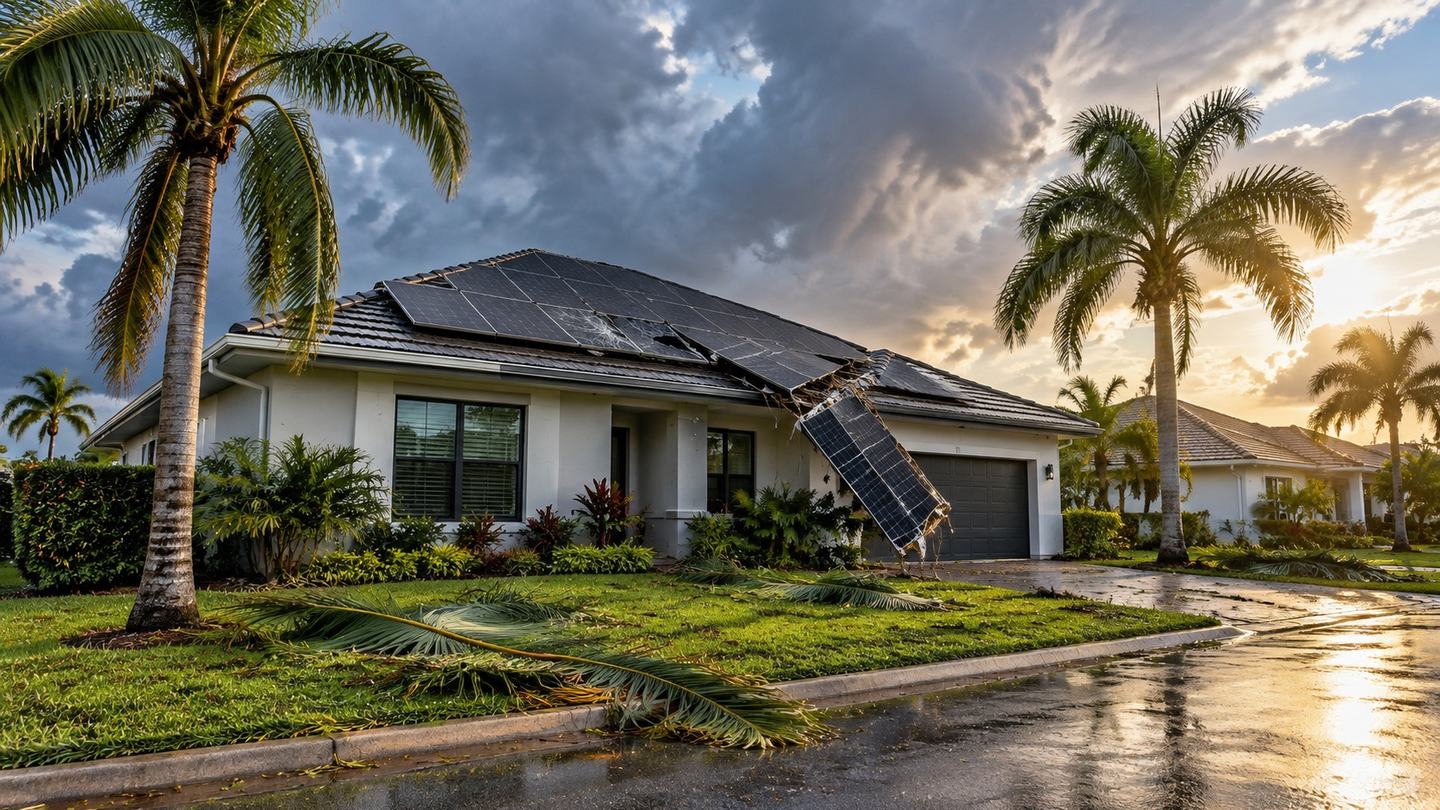
Quick Answer: Who Pays When a Storm Destroys Your Solar Panels in Florida?
If you own your solar system and it is attached to your home, your homeowners insurance policy is usually the first place to look. Most Florida homeowners policies treat owned, roof-mounted panels as part of the dwelling, so storm damage from covered perils such as hurricane wind, hail, lightning, or a falling tree is generally handled under dwelling coverage, subject to your deductible, exclusions, and limits. Ground-mounted arrays are often handled under other structures coverage, which usually carries a lower limit. If you lease the panels or buy power under a power purchase agreement, the solar company typically owns the equipment and your contract decides who insures and repairs it.
Three gaps catch many Florida homeowners. Flood and storm surge damage is excluded from standard homeowners policies and is covered, if at all, by a separate flood policy. A hurricane deductible of 2, 5, or 10 percent of your dwelling limit can absorb much or all of a solar loss. And manufacturer warranties generally cover defects, not storm damage. Insurers also commonly dispute whether damage came from the storm or from wear, installation problems, or earlier damage.
Published November 19, 2026. This guide is general educational information for homeowners in Miami, Coral Gables, Fort Lauderdale, and across Florida. Every policy is different, so the language of your own policy, endorsements, and solar contract controls. Reading this article does not create an attorney-client relationship, and it does not suggest that any particular claim is covered or will succeed.
Who Pays for Storm-Damaged Solar Panels: At a Glance
| Your situation | Where to look first | Questions that decide the outcome |
|---|---|---|
| You own roof-mounted panels damaged by hurricane wind, hail, or lightning | Homeowners policy, dwelling coverage | Which deductible applies, whether wind is excluded, and whether your dwelling limit reflects the system's cost |
| You own a ground-mounted array or solar carport | Homeowners policy, other structures coverage or a solar endorsement | Whether the other structures limit is high enough to replace the system |
| You lease the panels or have a power purchase agreement | The solar company, under your contract | Who must insure the equipment, who files the claim, and who pays to remove and reinstall it |
| Flood water or storm surge damaged inverters, batteries, or a ground array | A separate flood policy, if you have one | Flood policy limits and restrictions on equipment in basements or below elevated floors |
| Panels failed without a storm, or output dropped over time | Manufacturer product or performance warranty | Warranty length, registration, and what counts as a defect |
| Roof leaks or loose racking traced to the installation | Installer workmanship or roof penetration warranty | Whether the installer is still in business and what the warranty excludes |
| Lost energy savings and higher electric bills while the system is down | Usually not covered by a standard homeowners policy | Whether any endorsement or the solar contract addresses lost production |
The table reflects how standard homeowners forms are commonly written and the Florida statutes discussed below. Your insurer's policy form, endorsements, and declarations page can change the answer, so treat the table as a starting point rather than a coverage decision.
How a Florida Homeowners Policy Usually Treats Solar Panels
Roof-Mounted Panels Are Usually Part of the Dwelling
Panels, racking, and conduit that are permanently attached to your house are generally treated like other permanent fixtures, such as a central air conditioning system. That usually places them under dwelling coverage, often called Coverage A. If a covered storm damages the panels, a claim for the panels is typically part of the same claim as any roof or structural damage, and one deductible usually applies to the whole loss.
Ground-Mounted Arrays and Solar Carports
A system mounted on poles in the yard, on a detached garage, or on a solar carport is often classified as an other structure, commonly called Coverage B. Many policies set the other structures limit as a percentage of the dwelling limit, frequently 10 percent. A $40,000 ground array on a home with a $350,000 dwelling limit could exceed a $35,000 other structures limit before any other detached structure is counted. Some insurers offer endorsements that raise the limit or schedule the solar system separately.
Batteries, Inverters, and Electrical Equipment
Inverters, battery storage units, and wiring that are permanently installed are usually treated as part of the structure they serve. Portable batteries and generators may instead be treated as personal property. Battery systems can also carry their own warranty terms, installation codes, and insurer underwriting questions, so it is worth confirming in writing how your insurer classifies them.
Did You Tell Your Insurer and Raise Your Limits?
Many homeowners never tell their insurer about a solar installation. That can create two problems. First, a dwelling limit that was set before the system was installed may not be enough to rebuild the home and replace the panels after a major storm. Second, many replacement cost policies include a loss settlement condition that can reduce payment if the home is insured for less than a stated percentage of its replacement cost. Some policies also require notice of significant changes to the property. Ask your agent to confirm in writing that the system is listed and that your limits reflect its replacement cost.
Which Storm Damage Is Covered?
Hurricane Wind and the Hurricane Deductible
Wind is the most common cause of storm damage to solar systems in Florida. Panels can be lifted, cracked by flying debris, or torn loose along with their mounting hardware. When a named hurricane causes the damage, your policy's hurricane deductible usually applies instead of the all other perils deductible.
Under Fla. Stat. § 627.701, insurers must offer personal lines residential policyholders hurricane deductible options of $500, 2 percent, 5 percent, and 10 percent of the dwelling limit, with some exceptions for higher-value homes. Percentage deductibles add up quickly. On a home with a $400,000 dwelling limit, a 2 percent hurricane deductible is $8,000 and a 5 percent deductible is $20,000. If the solar system is the only damage, a large deductible can absorb much or all of the claim. The statute also generally applies the hurricane deductible on a calendar-year basis for covered hurricane losses under policies from the same insurer or insurer group, so a second hurricane in the same year may be treated differently.
Hail, Lightning, Tornadoes, and Falling Trees
Hail, lightning strikes, tornadoes, and trees or limbs that fall on panels during a storm are commonly covered perils under Florida homeowners policies, subject to the applicable deductible and exclusions. Lightning and power surges can damage inverters and monitoring equipment even when the panels look intact, so check your system's monitoring data after any severe storm.
Flood and Storm Surge Are a Different Claim
Standard homeowners policies exclude flood, including storm surge. Roof-mounted panels are rarely damaged by flood water, but ground-mounted arrays, inverters, battery units, and electrical panels mounted low on a wall can be. Those losses fall under a separate flood policy, if you have one, such as a policy through the National Flood Insurance Program or a private flood insurer.
The NFIP's Standard Flood Insurance Policy Dwelling Form has its own limits, with building coverage for a single-family home available up to $250,000, and it restricts coverage for many items in basements and in enclosed areas below the lowest elevated floor of certain elevated buildings. After a hurricane that brings both wind and water, separating wind damage from flood damage is one of the most frequent sources of disputes. Photos and video that show how and when the damage happened matter.
Wind Exclusions in Some Florida Policies
Some Florida homeowners carry a policy that excludes windstorm, with wind coverage purchased separately, for example a wind-only policy from Citizens Property Insurance Corporation in eligible coastal areas. If that is your situation, a solar claim caused by hurricane wind usually goes to the wind policy, not the homeowners policy. Check your declarations page for a windstorm exclusion before you file.
Common Reasons Insurers Deny or Reduce Solar Panel Claims
- Wear and tear or deterioration. Insurers may argue that cracked glass, corroded connectors, or loose racking existed before the storm. A similar dispute arises with roofs, as discussed in our guide to roof leak claims denied for wear and tear.
- Faulty installation or workmanship. Many policies exclude the cost of correcting defective workmanship, although they may still cover resulting damage from a covered peril. The wording of the exclusion matters.
- Pre-existing or unrelated damage. Without pre-storm photos or monitoring data, it can be harder to show the system was working before the storm.
- Flood versus wind. When both are present, the insurer may attribute damage to excluded flood or surge.
- Undervaluation and depreciation. An insurer may pay actual cash value first and hold back depreciation until repairs are completed, or estimate replacement with cheaper or incompatible equipment.
- Late notice. Florida's claim notice deadlines apply to solar claims just as they apply to roof claims.
How Replacement Cost Payments Work
If your dwelling is insured on a replacement cost basis, Fla. Stat. § 627.7011(3) generally requires the insurer to initially pay at least the actual cash value of the insured loss, less the deductible, and to pay the remaining amounts necessary to perform the repairs as work is performed and expenses are incurred. In practice, that means the first check for a solar loss may reflect depreciation, with more money available after the system is repaired or replaced. Keep invoices and proof of payment for every part of the work.
When Replacement Panels Do Not Match
Solar panel models change quickly, and the exact model on your roof may no longer be available. Under Fla. Stat. § 626.9744(2), when a homeowners policy settles losses on a repair or replacement cost basis and replaced items do not match in quality, color, or size, the insurer must make reasonable repairs or replacement of items in adjoining areas. The statute lets the insurer consider cost, the degree of uniformity that can be achieved, and the remaining useful life of undamaged items. Whether mismatched panels that are electrically incompatible with the rest of the array are a matching issue is not settled by the statute's text, so the policy language and an installer's written explanation of the compatibility problem matter.
The Roof Problem: Removing and Reinstalling Panels
A storm can damage the roof under an otherwise intact solar array. To repair or replace the roof, the panels usually must be detached, stored, and reinstalled, which can involve licensed electrical work, new permits, and inspections. When the roof damage is covered, the reasonable cost of removing and resetting the panels to make the covered repair is commonly included in the claim estimate, but insurers sometimes leave it out or underprice it. Ask your contractor to list detach-and-reset, electrical, permit, and inspection costs as separate line items.
Two Florida rules are worth knowing here. Under § 626.9744(1), physical damage incurred in making a covered repair or replacement, if covered and not otherwise excluded, is included in the loss to the extent of the applicable limits. And under § 627.7011(1), insurers must offer law and ordinance coverage, which can pay for code-required upgrades, up to 25 or 50 percent of the dwelling limit as selected by the policyholder. If reinstalling a system triggers current Florida Building Code or electrical code requirements, that coverage can matter.
If you lease your system, read the contract before scheduling roof work. Many solar leases and power purchase agreements require the solar company or its approved contractor to remove and reinstall the equipment, and some charge a fee for it.
Leased Panels, Power Purchase Agreements, and Solar Loans
Leases and Power Purchase Agreements
When a solar company owns the equipment on your roof, it generally insures that equipment and handles repairs under the contract. Your homeowners policy usually still matters for damage to your roof and home, and some contracts require you to carry certain coverage, name the company in some way, or notify it promptly after damage. Report storm damage to both your insurer and the solar company, and keep copies of every notice.
Solar Loans and Financed Purchases
If you financed the purchase, you usually own the system and it is insured like any other part of your home. A lender may hold a security interest in the equipment, and claim checks may name your mortgage company or another lienholder as a payee. Continue making loan payments while the claim is pending unless your lender agrees otherwise in writing, because insurance disputes generally do not pause loan obligations.
Warranties Versus Insurance
Solar systems often come with several warranties, and none of them is a substitute for insurance:
- Product warranties generally cover manufacturing defects in panels, inverters, and batteries.
- Performance warranties generally promise that panels will produce a stated percentage of their rated output for a set number of years.
- Workmanship warranties from the installer generally cover installation errors for a stated period.
- Roof penetration warranties, when offered, generally cover leaks at the points where the racking is attached to the roof.
Warranties commonly exclude damage from storms and other acts of nature, which is why insurance usually responds to storm losses. If an insurer blames the installation or a defect, though, the warranties may become the path to repair, and an installer's records can help show what failed and why.
Florida also regulates solar equipment quality. Under Fla. Stat. § 377.705, solar energy systems manufactured or sold in Florida must meet standards established by the Florida Solar Energy Center, unless otherwise certified by a Florida-licensed engineer using the Florida Building Code. Your installer's documentation of the equipment, permits, and inspections can help an adjuster identify exactly what was installed.
What to Do After a Storm Damages Your Solar System
- Stay safe. Solar panels can generate electricity whenever light reaches them, even when cracked or detached. Do not touch damaged panels, wiring, or batteries, and do not climb onto the roof. Contact your installer or a licensed electrician to shut the system down safely.
- Report the claim promptly. Notify your insurer in the way your policy requires and write down the claim number, date, and the name of the person you spoke with.
- Notify the installer, and if you lease the system, the solar company. Some contracts require prompt notice.
- Document everything. Take wide and close-up photos and video of the panels, racking, roof, inverters, and any debris. Save your monitoring app's production history, which can show the exact time the system stopped producing.
- Prevent further damage. Have a qualified contractor tarp exposed roof penetrations or secure loose equipment, and keep receipts for emergency work.
- Get detailed written estimates from a licensed solar contractor and, if needed, a licensed roofer, including detach-and-reset, electrical, permit, and inspection costs.
- Keep damaged components until the insurer has had a reasonable chance to inspect them, unless safety requires removal. Photograph anything that must be removed.
- Gather your paperwork: purchase contract or lease, equipment specifications and serial numbers, permit and inspection records, warranties, and your utility interconnection agreement.
- Be cautious with assignment of benefits requests. For residential and commercial property policies issued on or after January 1, 2023, Fla. Stat. § 627.7152 makes an attempt to assign post-loss property insurance benefits void, invalid, and unenforceable.
- Read every coverage letter carefully and ask the insurer, in writing, to identify the specific policy language behind any denial or reduction.
Florida Claim Deadlines That Apply to Solar Panel Claims
| Step | Florida rule | Source |
|---|---|---|
| Give notice of a new or reopened claim | Barred unless notice is given within 1 year after the date of loss | Fla. Stat. § 627.70132 |
| Give notice of a supplemental claim | Barred unless notice is given within 18 months after the date of loss | Fla. Stat. § 627.70132 |
| Date of loss for a hurricane | The date the hurricane made landfall | Fla. Stat. § 627.70132(3) |
| Insurer acknowledges your communication | Within 7 calendar days, with limited exceptions | Fla. Stat. § 627.70131(1) |
| Insurer's physical inspection, if any | Within 30 days after it receives proof-of-loss statements | Fla. Stat. § 627.70131 |
| Insurer pays or denies | Within 60 days after notice of an initial, reopened, or supplemental claim, unless factors beyond its control prevent it | Fla. Stat. § 627.70131(7) |
| Notice before filing suit | At least 10 business days before suit, after the insurer's coverage determination | Fla. Stat. § 627.70152 |
| Lawsuit for breach of a property insurance contract | Generally within 5 years from the date of loss, if timely notice was given | Fla. Stat. § 95.11 |
These rules come from § 627.70132, § 627.70131, § 627.70152, and § 95.11. Exceptions and tolling rules can apply, and your policy may impose its own post-loss duties, so confirm your specific deadlines early rather than relying on a summary.
If Your Solar Panel Claim Is Denied or Underpaid
Ask for the Reasons in Writing
Under § 627.70131(7), an insurer that denies all or part of a claim must give a reasonable written explanation of the basis in the policy for the denial. Compare each stated reason with your policy, your photos, the monitoring data, and your installer's findings. Florida's Homeowner Claims Bill of Rights, which insurers must provide within 14 days after an initial claim communication, summarizes several of these timelines in plain terms.
Use the State's Free Mediation Program
The Florida Department of Financial Services runs a property insurance mediation program under Fla. Stat. § 627.7015. For eligible residential claims, the insurer generally pays the cost of the mediation conference, and the program does not apply when the amount in dispute is less than $500 unless both sides agree. Learn more on the DFS Consumer Services website, or call the helpline at 1-877-MY-FL-CFO (1-877-693-5236).
Appraisal for Disputes Over the Amount
Many Florida policies include an appraisal clause for disagreements about the amount of a covered loss. Appraisal can be faster than litigation, but it usually decides only how much the loss is worth, not whether it is covered, and each side typically pays its own appraiser. Review the clause before invoking it.
Pre-Suit Notice and Litigation
Before filing a lawsuit under a residential property insurance policy, § 627.70152 requires written notice of intent to initiate litigation through the Department of Financial Services at least 10 business days before suit, after the insurer has made a coverage determination. The insurer then has 10 business days to respond, and it may offer to settle or demand appraisal or another form of alternative dispute resolution.
Florida's 2022 and 2023 insurance reforms changed the economics of these cases. The one-way attorney fee statutes that historically required insurers to pay a policyholder's fees after a successful suit have been repealed for most current claims, so fees and costs are an important part of deciding whether and how to pursue a dispute. A separate bad faith remedy under Fla. Stat. § 624.155 requires a civil remedy notice and has its own conditions. A lawyer can explain how these rules apply to your dates and policy.
Before the Next Storm: A Solar Insurance Checklist
- Tell your insurer about the system and get written confirmation of how it is covered.
- Confirm your dwelling limit, or your other structures limit for a ground array, reflects the cost to replace the system as well as the home.
- Know your hurricane deductible in dollars, not just as a percentage.
- Consider whether flood insurance makes sense for your property, especially if inverters, batteries, or a ground array sit low.
- Keep a digital folder with the contract or lease, invoices, specifications, serial numbers, permits, warranties, and dated photos of the system in good condition.
- If you lease, read the insurance, damage, and removal sections of the contract.
- Verify that your installer holds the appropriate Florida contractor license through the Florida Department of Business and Professional Regulation.
- Do not remove or secure panels yourself before a storm. Ask your installer what preparation, if any, they recommend.
Your HOA Cannot Block a Reinstallation
If storm damage requires replacing or reinstalling your system, an association generally cannot stop it. Under Fla. Stat. § 163.04, deed restrictions, covenants, and similar agreements may not prohibit or have the effect of prohibiting solar collectors on residential buildings. An association may specify where on the roof the panels go, within the statute's limits on orientation, as long as that does not impair the system's effective operation.
South Florida Considerations
Miami-Dade and Broward counties are designated High-Velocity Hurricane Zones under the Florida Building Code, which applies stricter wind requirements to roofing and other exterior products. Replacement equipment and mounting systems in those counties may need to meet those requirements, which can affect repair estimates and timing. After a widespread storm, contractor availability, permitting backlogs, and equipment supply can also delay repairs, which is one more reason to report the claim promptly and document the system's condition before work begins.
How The Farber Law Firm Can Help
The Farber Law Firm, P.A. represents Florida homeowners, condominium owners, and businesses in denied, delayed, and underpaid property insurance claims from its Coral Gables office. For a solar claim, that can include reviewing the policy and denial letter, comparing the insurer's estimate with your installer's findings, tracking notice and pre-suit deadlines, and advising on mediation, appraisal, or litigation. Learn more about our Insurance Disputes practice and our Hurricane Damage and Insurance Claims practice, or read related guides on hurricane claim mistakes, denied homeowners claims, and how long a Florida insurer has to pay a claim.
Hiring a lawyer is an important decision that should not be based solely on advertisements. Past results do not guarantee a similar outcome, and no result is promised in any matter.
If this article describes your situation, these practice pages explain how The Farber Law Firm can help: Insurance Coverage Disputes, Hurricane Insurance Claims, and Condo Association Claims. You can also call 8888-FARBER for a free case review.
Share a brief description of the loss, its date, and your insurer’s response. Do not send sensitive documents through this initial form; ask the firm how to provide them securely. Sending an inquiry does not protect a filing deadline or mean the firm has accepted representation.
Frequently Asked Questions
Does Florida homeowners insurance cover solar panels damaged in a hurricane?
Often, yes, if you own the panels and they are attached to your home. Most Florida homeowners policies treat owned, roof-mounted panels as part of the dwelling, so hurricane wind damage is generally handled like other dwelling damage, subject to your hurricane deductible, exclusions, and limits. Policies that exclude windstorm, flood damage, and leased equipment are common exceptions.
Are ground-mounted solar panels covered by homeowners insurance?
Ground-mounted arrays and solar carports are often covered under other structures coverage, which many policies set at a percentage of the dwelling limit, frequently 10 percent. That limit may be too low to replace a full system, so ask your insurer whether an endorsement or higher limit is available.
Who pays for storm damage to leased solar panels in Florida?
When a solar company owns the equipment under a lease or power purchase agreement, it generally insures and repairs the panels under the contract. Your homeowners policy usually still applies to damage to your roof and home. Report the damage to both the solar company and your insurer, and follow any notice requirements in your contract.
Does the hurricane deductible apply to solar panel damage?
Usually, yes, when a named hurricane caused the damage. Florida insurers must offer hurricane deductible options of $500, 2 percent, 5 percent, and 10 percent of the dwelling limit under Fla. Stat. § 627.701, with some exceptions. On a home with a $400,000 dwelling limit, a 2 percent deductible is $8,000, which can absorb much or all of a solar-only claim.
Does flood insurance cover solar panels?
Standard homeowners policies exclude flood and storm surge, so flood damage to solar equipment falls under a separate flood policy, if you have one. NFIP building coverage for a single-family home is available up to $250,000, and the policy restricts coverage for many items in basements and below the lowest elevated floor of certain elevated buildings.
Will insurance pay to remove and reinstall my panels so my roof can be replaced?
When the roof damage is covered, the reasonable cost to detach and reset the panels in order to make the covered repair is commonly included in the claim estimate, but insurers sometimes omit or underprice it. Ask your contractor to list detach-and-reset, electrical, permit, and inspection costs separately so they can be reviewed.
Does my solar panel warranty cover hurricane damage?
Usually not. Product, performance, and workmanship warranties generally cover defects, output loss, and installation errors, and they commonly exclude storms and other acts of nature. If an insurer blames a defect or the installation, the warranties may become relevant, so keep them with your claim records.
How long do I have to report storm damage to my solar panels in Florida?
Under Fla. Stat. § 627.70132, a new or reopened property insurance claim is barred unless notice is given within 1 year after the date of loss, and a supplemental claim within 18 months. For hurricanes, the date of loss is the date the hurricane made landfall. Your policy may also require prompt notice, so report damage as soon as it is safe.
Can my solar installer take over my insurance claim through an assignment of benefits?
Not for most current policies. For residential and commercial property policies issued on or after January 1, 2023, Fla. Stat. § 627.7152 makes an attempt to assign post-loss property insurance benefits void, invalid, and unenforceable. You can still hire a contractor, but the claim stays with you.
What can I do if my insurer denies or underpays my solar panel claim?
Ask for a written explanation citing the policy language, compare it with your photos, monitoring data, and installer's findings, and consider Florida's free DFS mediation program, appraisal for amount disputes, or pre-suit notice under Fla. Stat. § 627.70152 followed by litigation. A Florida insurance lawyer can review your deadlines and options.
Can my HOA stop me from reinstalling solar panels after a storm?
Generally no. Under Fla. Stat. § 163.04, deed restrictions and covenants may not prohibit or have the effect of prohibiting solar collectors on residential buildings. An association may designate where on the roof panels are placed, within the statute's orientation limits, as long as that does not impair the system's effective operation.
Can The Farber Law Firm review my solar panel insurance claim?
Yes. The firm offers a free initial review of Florida property insurance disputes, including solar claims, through the form on this page or by phone at 8888-FARBER. Submitting information does not create an attorney-client relationship or protect a deadline, no result is promised, and accepted matters are handled under a written agreement.
About the Author
The Farber Law Firm, P.A.
The Farber Law Firm is a South Florida trial practice based in Coral Gables, representing injured people, policyholders and businesses across Miami-Dade, Broward and Palm Beach counties. Founding attorney David Farber has more than 25 years of Florida litigation experience and has been a member of The Florida Bar since 2000. The firm handles personal injury, wrongful death, insurance coverage disputes and commercial litigation.
Articles on this site are written and reviewed by attorney David Farber and reflect Florida statutes, court rules and Florida Bar regulations current as of the publication date.
- Office
- 2199 Ponce de Leon Blvd #301
Coral Gables, FL 33134 - Phone
- 8888-FARBER
- Consultations
- Free and confidential
Florida Legal Insights, in Your Inbox
Subscribe to The Farber Law Firm’s email list for educational articles on Florida injury claims, insurance coverage, and consumer rights.
By subscribing, you request legal insights by email. This is not a consultation request and does not create an attorney-client relationship. Privacy Policy.
The Farber Law Firm, P.A. · Insurance Disputes
Storm took out your solar system? Get the claim reviewed before you accept the answer.
A solar loss can involve your roof, your panels, a hurricane deductible, a lease, and an insurer that blames wear or installation. The Farber Law Firm helps Florida homeowners and businesses with denied, delayed, and underpaid property claims, starting with a clear look at what your policy covers and what the insurer left out.
We review the solar side of the claim
Panels, racking, inverters, batteries, and detach-and-reset costs are checked against the insurer’s estimate.
We test the denial reasons
Wear and tear, workmanship, flood, and pre-existing damage arguments are compared with your policy and evidence.
We track the Florida deadlines
Claim notice, supplemental claim, 60-day pay-or-deny, and pre-suit notice dates are reviewed against your loss.
No upfront fee for the initial review
Your first claim review is free, and you decide whether to proceed after hearing your options.
Explore our Insurance Disputes practice
2199 Ponce de Leon Blvd #301, Coral Gables, FL 33134. Initial claim reviews are free; representation, fees, and costs are subject to a written engagement agreement. No result is promised. Contacting the firm does not create an attorney-client relationship or extend any deadline. Do not send confidential documents until the firm confirms how to provide them securely.