Florida Telephone Solicitation Act vs. TCPA: Which Law Covers Your Spam Texts?
Getting spam texts in Florida? Compare the Florida Telephone Solicitation Act and the federal TCPA: what each law covers, the STOP rule, the 2026 court split over texts, damages, and the steps to take before you sue.
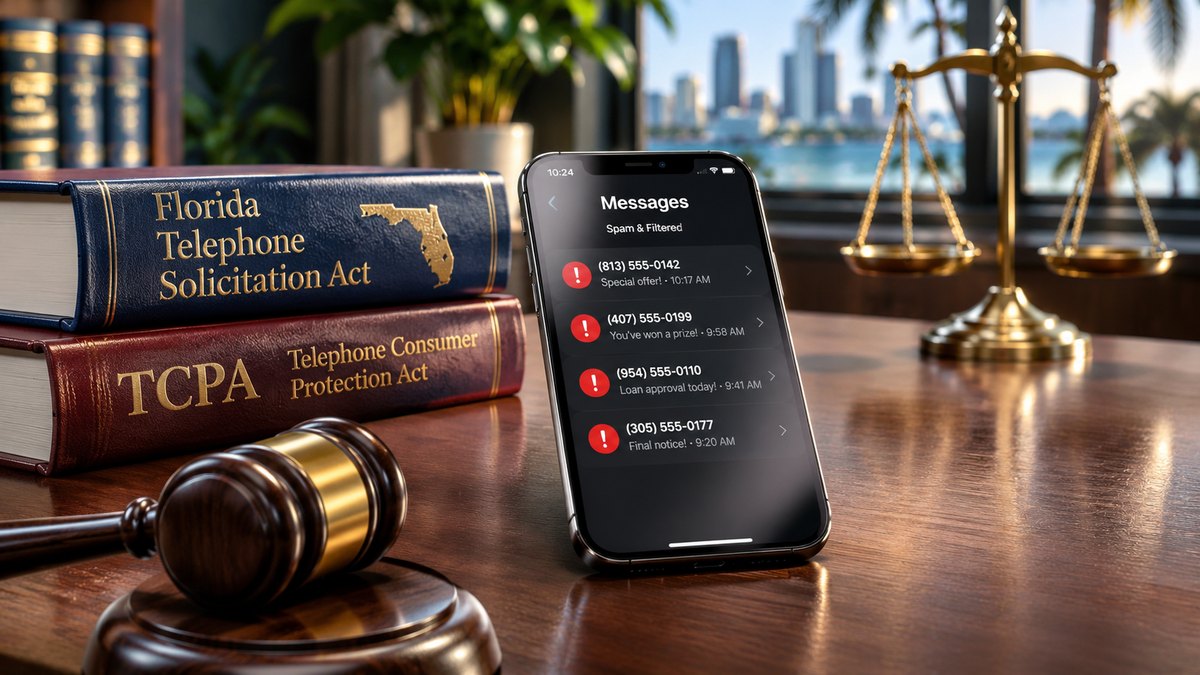
Quick Answer: Which Law Covers Spam Texts in Florida?
Often both laws can apply, but in 2026 they do not protect you in the same way. The Florida Telephone Solicitation Act (FTSA), Fla. Stat. § 501.059, expressly lists text messages in its definition of a telephonic sales call. The federal Telephone Consumer Protection Act (TCPA), 47 U.S.C. § 227, was written in 1991 and speaks of telephone calls, and federal courts are now divided over whether a marketing text counts as a call for some TCPA claims. In 2026, several federal judges in the Eleventh Circuit, which includes Florida, dismissed Do Not Call lawsuits based only on texts, and a federal magistrate judge in Florida recommended the same result.
Both laws allow a person who receives unlawful sales messages to seek actual damages or $500 per violation, whichever is greater, and a court may increase the award up to three times for willful or knowing violations. The FTSA adds a step the TCPA does not have: before suing over text solicitations, you must reply STOP to the number that texted you, and you may sue only if the texts continue more than 15 days later. The FTSA also awards attorney fees to whichever side prevails, which creates risk as well as leverage.
Published November 17, 2026. This guide is general educational information for consumers in Miami, Coral Gables, Fort Lauderdale, and across Florida. It is not legal advice about your situation, it does not suggest that every unwanted text is unlawful or that any claim will succeed, and reading it does not create an attorney-client relationship.
FTSA vs. TCPA at a Glance
| Question | Florida Telephone Solicitation Act | Federal TCPA |
|---|---|---|
| Who wrote it | Florida Legislature, Fla. Stat. § 501.059 | U.S. Congress, 47 U.S.C. § 227, with FCC rules at 47 C.F.R. § 64.1200 |
| Does the text of the law mention text messages? | Yes. A telephonic sales call includes a telephone call, text message, or voicemail transmission | No. The statute refers to calls, and courts disagree in 2026 about whether texts are calls for private Do Not Call claims |
| Main protections | Automated or recorded sales calls without prior express written consent, the Florida no sales solicitation calls list, contact after you say stop, caller ID rules | Autodialed or prerecorded calls to cell phones without consent, the National Do Not Call Registry, company-specific do-not-call lists |
| Who is protected | Consumers in Florida, including calls and texts from out-of-state businesses | People nationwide |
| Step required before suing over texts | Reply STOP, then wait. You can sue only if texts continue more than 15 days later | No STOP requirement in the statute itself |
| Statutory damages | Actual damages or $500, whichever is greater, up to three times that amount if willful or knowing | $500 per violation, up to $1,500 if willful or knowing |
| Attorney fees | Prevailing party recovers reasonable fees and costs, which can include a business that wins | No fee-shifting provision |
| Usual court | Florida state court, unless joined with a federal claim | Federal or state court |
The table summarizes Fla. Stat. § 501.059, 47 U.S.C. § 227, and the FCC's rules at 47 C.F.R. § 64.1200. Each law has exceptions and defenses that the table cannot capture, so treat it as a starting point rather than an answer for your specific messages.
What the Florida Telephone Solicitation Act Covers
The FTSA is Florida's own telemarketing law. It applies to a telephone solicitor doing business in Florida, which the statute defines to include businesses calling or texting consumers located in Florida from another state or country. It focuses on sales messages: a telephonic sales call is a call, text, or voicemail made to solicit the sale of consumer goods or services, to solicit credit for them, or to gather information for that purpose.
Automated Sales Texts Without Prior Express Written Consent
Under § 501.059(8)(a), a person may not make or knowingly allow an unsolicited telephonic sales call that involves an automated system for the selection and dialing of telephone numbers, or the playing of a recorded message, without the called party's prior express written consent. That consent must be a signed written agreement that names the phone number, authorizes automated or recorded sales messages, and clearly discloses that agreeing is not a condition of buying anything. Under the statute, a signature can include an electronic signature, checking a box, or replying yes to a text campaign, which is why online forms and contest entries often become the center of a dispute.
The Florida No Sales Solicitation Calls List
Florida's Department of Agriculture and Consumer Services (FDACS) maintains a no sales solicitation calls list. Under § 501.059(4), a telephone solicitor may not make unsolicited telephonic sales calls to numbers on the current quarterly list. The statute also directs FDACS to include Florida listings from the national registry kept by the Federal Trade Commission. You can learn more on the FDACS Florida Do Not Call page.
Texts After You Say Stop
Under § 501.059(5), a telephone solicitor or other person may not send an outbound call, text, or voicemail to someone who previously told it they do not want to receive them, when the message is made by or on behalf of the seller whose goods or services are offered. Unlike some other parts of the statute, this provision is not limited to unsolicited calls.
Caller Identification and Disguised Voices
The FTSA also requires telemarketers to transmit a working callback number to caller ID, and the business must connect that number to the solicitor or seller. It prohibits altering a caller's voice to defraud or obtain personal information. A telephone solicitor who makes an unsolicited sales call must give their true first and last name and the business they represent.
Important Exceptions
The statute's definition of an unsolicited telephonic sales call excludes calls made in response to your express request, calls primarily about an existing debt or contract that has not been completed, calls to a person with a prior or existing business relationship with the solicitor, and certain newspaper publisher calls. These exceptions matter for the automated-message and Do Not Call rules, so a text from a company you already do business with is analyzed differently from a text from a stranger.
The 2023 Amendments
Florida amended the FTSA in 2023 through House Bill 761, codified as chapter 2023-150, Laws of Florida, effective May 25, 2023. The changes narrowed the automated dialing language to an automated system for the selection and dialing of telephone numbers, broadened what counts as a signature for consent, and added the STOP and 15-day requirement for text message claims. Older articles and court decisions that describe the pre-2023 law may not reflect these rules.
What the Federal TCPA Covers
Autodialed and Prerecorded Calls to Cell Phones
Section 227(b) of the TCPA restricts calls to cell phones made with an automatic telephone dialing system or an artificial or prerecorded voice without the recipient's prior express consent. For telemarketing, the FCC's rule at 47 C.F.R. § 64.1200(a)(2) requires prior express written consent. In Facebook, Inc. v. Duguid, 592 U.S. 395 (2021), the Supreme Court held that equipment counts as an autodialer only if it can store or produce numbers using a random or sequential number generator. Many modern texting platforms send messages to stored customer lists, so this ruling made many autodialer claims harder to bring.
The National Do Not Call Registry and Company-Specific Lists
Section 227(c) protects residential subscribers who place their numbers on the National Do Not Call Registry. The FCC's rules prohibit telephone solicitations to registered numbers, subject to exceptions such as an established business relationship or permission, and require telemarketers to keep and honor their own do-not-call lists under 47 C.F.R. § 64.1200(c) and (d). The private right of action in § 227(c)(5) allows a person who received more than one telephone call within any 12-month period by or on behalf of the same entity in violation of these rules to sue.
TCPA Damages and Deadlines
Under § 227(b)(3) and § 227(c)(5), a person may recover actual monetary loss or $500 for each violation, whichever is greater, and the court may increase the award up to three times if it finds the violation was willful or knowing. The TCPA does not state its own filing deadline, and courts generally apply the four-year federal catch-all period in 28 U.S.C. § 1658(a). State courts and federal courts can both hear TCPA claims.
The 2026 Twist: Are Text Messages Calls Under the TCPA?
For years, courts largely treated a marketing text as a call under the TCPA because the FCC said so. That changed after the Supreme Court decided McLaughlin Chiropractic Associates, Inc. v. McKesson Corp. (2025), which held that federal district courts in civil enforcement cases are not bound by the FCC's interpretation of the TCPA and must decide what the statute means for themselves, while giving appropriate respect to the agency's views.
Since then, defendants have argued that the phrase telephone call in § 227(c)(5) means a voice call, not a text. On July 14, 2026, the U.S. Court of Appeals for the Seventh Circuit agreed in Steidinger v. Blackstone Medical Services, No. 25-2398, holding that the private right of action in § 227(c)(5) does not authorize suits over unwanted texts. That decision binds federal courts in Illinois, Indiana, and Wisconsin only, but other courts have found its reasoning persuasive.
What This Means in Florida Federal Courts
Florida is in the Eleventh Circuit. In 2026, several federal district judges in that circuit dismissed Do Not Call claims based only on texts, including decisions in the Northern District of Georgia in February 2026, and in the Northern District of Alabama in September 2026. In the Middle District of Florida, a magistrate judge recommended in February 2026 that a texts-only case be dismissed under both § 227(c) and the autodialer provision in § 227(b). An appeal on the issue to the Eleventh Circuit was voluntarily dismissed in July 2026. Based on our research as of November 17, 2026, the Eleventh Circuit has not issued a binding decision on whether a text is a call for these private claims, and federal courts in other parts of the country have reached the opposite conclusion.
The practical result is uncertainty. A TCPA claim built only on texts may face an early motion to dismiss in Florida federal court, while a claim that includes voice calls or prerecorded voicemails stands on different footing. None of these rulings stops the FCC or state officials from enforcing telemarketing rules, and the FCC's regulations continue to state that its do-not-call protections cover text messages to wireless numbers.
Why the FTSA Matters More for Texts Right Now
The FTSA's definition of a telephonic sales call names text messages directly, so the argument that a text is not a call does not fit Florida's statute the way it fits the TCPA. In Steidinger itself, the plaintiffs had also pleaded an FTSA claim, and the district court declined to hear that state-law claim once the federal claims were dismissed, which generally leaves the state claim to be pursued in state court. The FTSA has its own requirements and defenses, however, including the STOP and 15-day rule and the consent and exception rules described above.
The FCC's 2026 Opt-Out Update
The FCC also revised its consent-revocation rules in a final rule published in the Federal Register on October 26, 2026, effective November 25, 2026. Among other changes, a sender may treat an opt-out from one category of informational messages as applying only to that category, while an opt-out from a marketing message still ends consent to marketing messages, and a sender may designate an exclusive method for revoking consent. For consumers, the safest practice is the same under both laws: reply STOP from the phone that received the texts, use any opt-out method the sender identifies, and keep a screenshot.
Which Law Covers Your Spam Text? Six Common Situations
1. Marketing Texts Keep Coming After You Replied STOP
This is the clearest FTSA scenario. Section 501.059(5) prohibits further messages after you say you do not want them, and § 501.059(10)(c) allows a damages claim for text solicitations that continue more than 15 days after your STOP reply. A TCPA claim based on a company's failure to honor its internal do-not-call list may also be possible, but texts-only claims face the federal court split described above.
2. Sales Texts to a Number on the Do Not Call Registry
If your number is on the national registry, Florida's list includes Florida listings from the national database, so the FTSA's list protection in § 501.059(4) may apply to unsolicited sales texts. A federal Do Not Call claim requires more than one message within 12 months from the same entity and is currently contested for texts in many federal courts. Check your registration date at donotcall.gov, because messages sent before registration are treated differently.
3. Mass Automated Texts You Never Agreed To
Both laws restrict automated marketing messages without consent, but the definitions differ. The FTSA asks whether an automated system for the selection and dialing of telephone numbers was involved. The TCPA's autodialer definition is narrower after Duguid. Whether a particular texting platform meets either definition is a fact question that often requires discovery, and consent records from websites, sweepstakes, or lead sellers are frequently disputed.
4. Texts From a Company You Already Do Business With
Messages from a business you have an existing relationship with, or texts mainly about an account, appointment, or unpaid balance, may fall outside the FTSA's definition of an unsolicited sales call and may fit TCPA exceptions. Even so, a company generally must stop marketing texts after you opt out. Debt collection texts can raise issues under other laws, such as the Florida Consumer Collection Practices Act, Fla. Stat. § 559.72.
5. You Have an Out-of-State Area Code or Were Out of State
The FTSA protects consumers located in Florida, and § 501.059(8)(d) creates a rebuttable presumption that a sales call to a Florida area code is made to a Florida resident or a person in Florida. If you live in Florida but kept a number from another state, an FTSA claim may still be possible, but the presumption will not help you and location may become an issue. The TCPA applies nationwide.
6. Scam Texts From Unknown or Spoofed Numbers
Many spam texts come from scammers who hide behind spoofed numbers and fake links. Both laws require an identifiable business that sent the messages or benefited from them. If no company can be traced, a lawsuit may not be practical. Do not click links or reply with personal information, report the messages to your carrier by forwarding them to 7726, and file reports with the FTC or FCC.
Steps to Take Before You Sue Over Florida Spam Texts
- Do not delete anything. Screenshot each message with the sending number, date, and time visible, and back up the thread.
- Reply STOP from the phone that received the messages. Under the FTSA this step is required before a text claim, and it also creates a record for the TCPA.
- Note the date and time of your STOP reply and any confirmation text, then keep tracking messages for at least 15 days afterward.
- Confirm when your number was added to the National Do Not Call Registry at donotcall.gov.
- Think about whether you ever entered your number on a website, contest, quote form, or app connected to the company. Consent is usually the first defense raised.
- Identify the business being promoted, not just the number that texted you. Telemarketers often send messages on behalf of a seller.
- Note whether the phone is a personal cell phone, and whether you use it for business.
- Do not click links or provide personal information in response.
- Speak with a consumer protection attorney before sending demand letters or filing anything, because each law has its own requirements and deadlines.
Our separate guides explain whether you can sue a company for spam text messages in Florida and how TCPA claims work step by step.
Damages, Attorney Fees, and Risks: A Realistic Look
Statutory damages are the reason spam text cases can matter even when no money was lost. Under both laws, the minimum statutory award is $500 per violation, and a court has discretion to increase it up to three times for willful or knowing violations. Courts decide how violations are counted, and many cases settle, are dismissed, or are resolved through arbitration clauses before any award is made. No outcome can be predicted from message counts alone.
Attorney fees work differently under the two laws. The FTSA's fee provision in § 501.059(11) awards reasonable fees and costs to the prevailing party, which means a business that defeats a claim can recover its fees from the consumer. The TCPA has no fee-shifting provision, so each side usually pays its own lawyers. This difference is one reason to evaluate an FTSA claim carefully before filing.
Standing is another federal issue. In Drazen v. Pinto, 74 F.4th 1336 (11th Cir. 2023) (en banc), the full Eleventh Circuit held that receiving even a single unwanted telemarketing text is a concrete injury sufficient for standing to sue in federal court. Standing is separate from the question of whether a statute covers texts, so a person can have standing and still face the 2026 argument that § 227(c)(5) does not reach texts.
Where Florida Spam Text Cases Are Filed
FTSA claims are usually filed in Florida state court, although they can be joined with federal claims in federal court. TCPA claims can be filed in federal or state court. Many spam text cases are filed as class actions on behalf of everyone who received similar messages, and some companies' terms of service require individual arbitration. An attorney can help evaluate which forum and which law fit the facts, and whether pursuing a claim makes sense at all.
Florida also has a separate telemarketing statute, the Florida Telemarketing Act, which limits commercial telephone solicitation calls to between 8 a.m. and 8 p.m. local time and to no more than three calls from any number to a person in 24 hours on the same subject under Fla. Stat. § 501.616(6). Those rules are distinct from the FTSA's private damages remedy.
How The Farber Law Firm Reviews TCPA and FTSA Text Claims
The Farber Law Firm, based at 2199 Ponce de Leon Blvd in Coral Gables, represents consumers in TCPA and Florida Telephone Solicitation Act matters involving robocalls, prerecorded messages, and unwanted marketing texts. A review typically looks at your message log, the date of your STOP reply, Do Not Call registration, any consent the company may claim, who benefited from the campaign, and which law and court fit the facts in light of the 2026 decisions on texts.
Every case is different, and the firm cannot predict or promise a result. The initial review is free. When the firm accepts a consumer TCPA or FTSA matter, representation, fees, and costs are set out in a written agreement. Learn more on our TCPA robocall and spam text claims page, our Consumer Protection practice, our guide to robocall lawsuits in Florida, and what to look for in a TCPA lawyer in Miami. You can start the TCPA intake questionnaire or call 8888-FARBER.
Sources
- Fla. Stat. § 501.059 (2026), Florida Telephone Solicitation Act
- Fla. Stat. § 501.616 (2026), Florida Telemarketing Act, unlawful acts and practices
- Florida House Bill 761 (2023), chapter 2023-150, Laws of Florida
- FDACS: Florida Do Not Call program
- 47 U.S.C. § 227, Telephone Consumer Protection Act
- 47 C.F.R. § 64.1200, FCC telemarketing and robocall rules
- 28 U.S.C. § 1658, time limitations on federal civil actions
- National Do Not Call Registry
- Facebook, Inc. v. Duguid, 592 U.S. 395 (2021)
- McLaughlin Chiropractic Associates, Inc. v. McKesson Corp., No. 24-420, Supreme Court docket
- Steidinger v. Blackstone Medical Services, No. 25-2398 (7th Cir. July 14, 2026)
- Drazen v. Pinto, No. 21-10199 (11th Cir. 2023) (en banc)
- FCC final rule on revocation of consent, 91 Fed. Reg., October 26, 2026
- Fla. Stat. § 559.72 (2026), prohibited debt collection practices
Statutes, regulations, and court decisions were reviewed as published on November 17, 2026. Telemarketing law is changing quickly, and new appellate decisions may affect how these rules apply. Consult a Florida attorney about your specific messages.
If this article describes your situation, these practice pages explain how The Farber Law Firm can help: Consumer Protection and TCPA Robocall & Spam Text Claims. You can also call 8888-FARBER for a free case review.
Frequently Asked Questions
Does the Florida Telephone Solicitation Act cover text messages?
Yes. Fla. Stat. § 501.059 defines a telephonic sales call to include a telephone call, text message, or voicemail transmission made to solicit the sale of consumer goods or services. Whether a particular text violates the statute depends on consent, exceptions such as an existing business relationship, and whether you completed the STOP and 15-day step before suing.
Does the TCPA cover spam texts in 2026?
It depends on the claim and the court. The FCC has long treated texts as calls, but after the Supreme Court's 2025 McLaughlin decision, courts decide the question for themselves. The Seventh Circuit and several federal district courts, including courts in Georgia and Alabama, have held that texts-only Do Not Call claims under 47 U.S.C. § 227(c)(5) cannot proceed, a federal magistrate judge in Florida has recommended the same, and other courts disagree. As of November 17, 2026, the Eleventh Circuit had not issued a binding ruling on the question.
Do I have to reply STOP before suing under the FTSA?
Yes, for text message solicitations. Section 501.059(10)(c) requires you to reply STOP to the number that sent the texts, and you may sue only if the telephone solicitor keeps texting you more than 15 days after that notice. The company may send one text confirming your request.
How much can I recover for spam texts in Florida?
Both laws provide actual damages or $500 per violation, whichever is greater, and allow a court to increase the award up to three times for willful or knowing violations. Actual results vary widely, many cases are dismissed or settle, and no amount is guaranteed.
Can I sue under both the FTSA and the TCPA?
Often a complaint includes both, when the facts support each claim. Courts generally do not allow double recovery for the same harm, and the claims have different requirements, defenses, and fee rules, so an attorney should evaluate which claims make sense.
What happens if I lose an FTSA case?
The FTSA awards reasonable attorney fees and costs to the prevailing party after judgment and appeals. That means a business that wins may recover its fees from the consumer who sued. This is an important risk to discuss with a lawyer before filing.
Is my number protected if it is on the National Do Not Call Registry?
Registration can matter under both laws. Florida's no sales solicitation calls list includes Florida listings from the national database, and the TCPA's Do Not Call rules protect registered residential numbers. Exceptions apply, such as an existing business relationship or your permission, and texts-only federal Do Not Call claims are contested in 2026.
Does the FTSA apply to companies outside Florida?
Yes. The FTSA applies to businesses that make telephonic sales calls to consumers located in Florida, including from other states or countries. Calls and texts to Florida area codes are presumed to be made to a Florida resident or a person in Florida, although that presumption can be rebutted.
Can I sue over a single spam text?
In federal court in the Eleventh Circuit, the en banc court held in Drazen v. Pinto that one unwanted telemarketing text is a concrete injury for standing purposes. Standing alone does not establish a violation, and a federal Do Not Call claim requires more than one call within 12 months. The FTSA's text claim also requires messages that continue more than 15 days after a STOP reply.
How long do I have to file a spam text claim?
Courts generally apply a four-year federal limitations period to TCPA claims under 28 U.S.C. § 1658. The FTSA does not state its own deadline, so the applicable period should be reviewed with a Florida attorney. Acting promptly also helps preserve evidence such as screenshots and carrier records.
Can The Farber Law Firm review my spam texts?
Yes. The firm offers a free initial review of TCPA and FTSA matters through its TCPA intake questionnaire or by phone at 8888-FARBER. Submitting information does not create an attorney-client relationship, no result is promised, and accepted matters are handled under a written agreement.
About the Author
The Farber Law Firm, P.A.
The Farber Law Firm is a South Florida trial practice based in Coral Gables, representing injured people, policyholders and businesses across Miami-Dade, Broward and Palm Beach counties. Founding attorney David Farber has more than 25 years of Florida litigation experience and has been a member of The Florida Bar since 2000. The firm handles personal injury, wrongful death, insurance coverage disputes and commercial litigation.
Articles on this site are written and reviewed by attorney David Farber and reflect Florida statutes, court rules and Florida Bar regulations current as of the publication date.
- Office
- 2199 Ponce de Leon Blvd #301
Coral Gables, FL 33134 - Phone
- 8888-FARBER
- Consultations
- Free and confidential
Florida Legal Insights, in Your Inbox
Subscribe to The Farber Law Firm’s email list for educational articles on Florida injury claims, insurance coverage, and consumer rights.
By subscribing, you request legal insights by email. This is not a consultation request and does not create an attorney-client relationship. Privacy Policy.
The Farber Law Firm, P.A. · TCPA & FTSA Claims
Replied STOP and the texts kept coming? Find out which law fits.
Spam texts are easy to ignore and hard to stop. In 2026, choosing between the Florida Telephone Solicitation Act and the federal TCPA can decide whether a claim proceeds or is dismissed early. The Farber Law Firm reviews Florida consumers’ unwanted marketing texts and robocalls and gives you a straight answer about your options.
We read your message log
Dates, sending numbers, your STOP reply, and every text that arrived after it, organized into a clear timeline.
We match the facts to the right law
FTSA, TCPA, or both, weighed against the 2026 court decisions on texts and the court where a claim would be filed.
We test the consent story
Website forms, lead sellers, existing relationships, and Do Not Call registration dates are checked before anything is filed.
No cost for the initial review
Your first review is free. Accepted consumer matters are handled on a contingency basis under a written agreement.
See how we handle TCPA robocall and spam text claims
2199 Ponce de Leon Blvd #301, Coral Gables, FL 33134. Initial reviews are free; representation, fees, and costs are subject to a written agreement as required by Rule 4-1.5 of the Rules Regulating The Florida Bar. No result is promised. Contacting the firm does not create an attorney-client relationship or extend any deadline. Under the FTSA, a prevailing party may recover attorney fees, so discuss risks before filing.